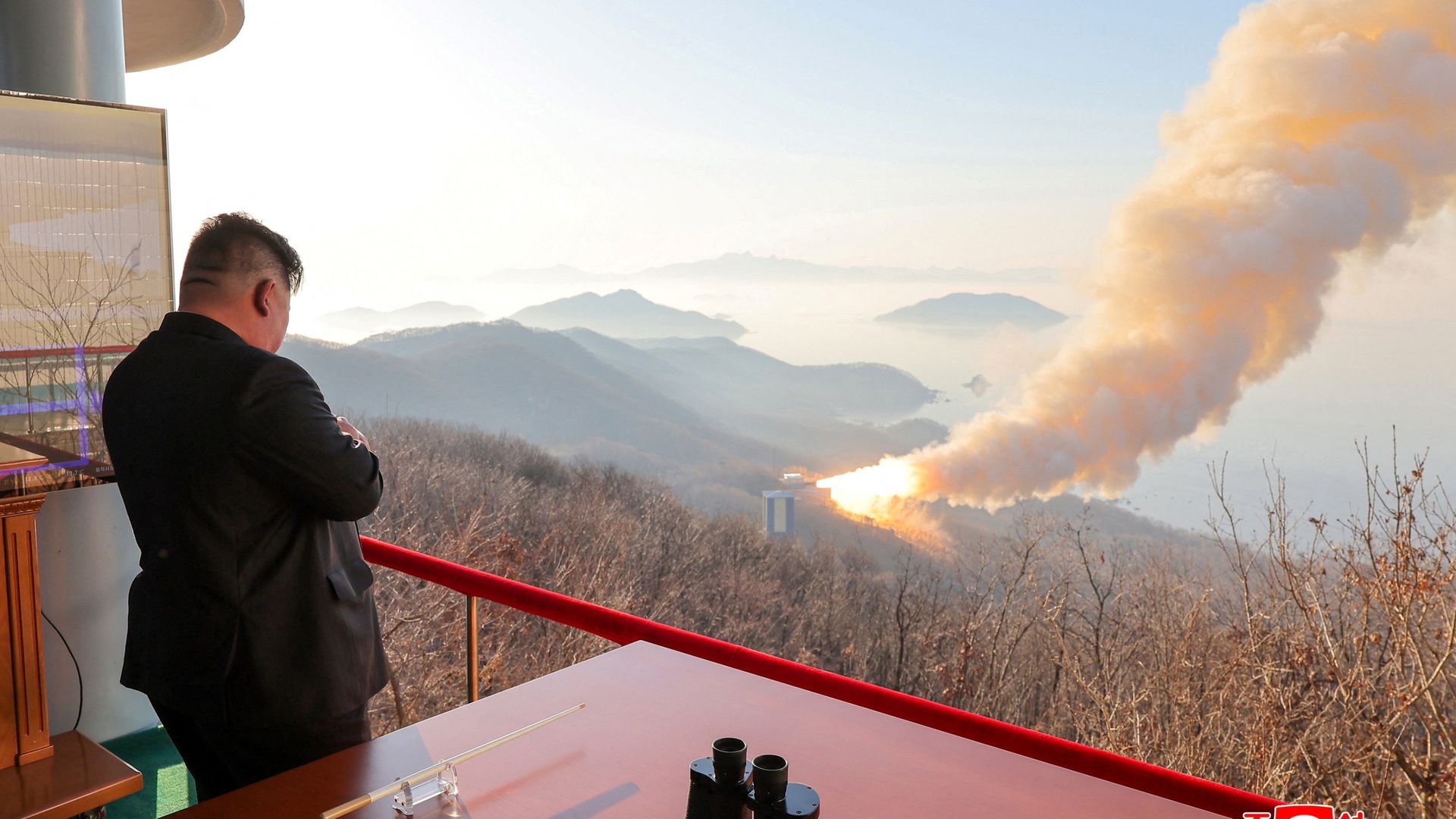
North Korea just hit a new milestone in its quest to put the American mainland within striking distance, and honestly, it’s a bigger deal than the usual headlines suggest. On March 29, 2026, state media confirmed that Kim Jong Un personally oversaw a ground test for an upgraded, high-thrust solid-fuel engine. This isn't just another repeat of old tech. This specific engine, built with advanced composite carbon fiber, clocked a maximum thrust of 2,500 kilonewtons.
To put that in perspective, their previous big test in September topped out at around 1,970 kilonewtons. That’s a 26% jump in raw power in just six months. If you think this is just about making a bigger boom, you're missing the point. It’s about speed, stealth, and something much more dangerous: the ability to carry multiple warheads at once.
The Solid Fuel Advantage
Most people hear "missile test" and assume it’s all the same. It’s not. For years, North Korea relied on liquid-fuel engines. These are powerful, but they’re a logistical nightmare. You can't keep a liquid-fuel missile gassed up on the launchpad for long because the fuel is highly corrosive. It eats the tank from the inside out.
That means if Kim wanted to launch a strike, his troops would have to roll the missile out and spend hours fueling it while Western satellites watched every move. It’s like trying to pull off a surprise party while the guest of honor is looking through the window.
Solid fuel changes everything.
- Launch Readiness: These missiles are basically "pre-packaged." The fuel is already inside, stable and ready to go.
- Mobility: You can hide them in tunnels or forests on mobile launchers and fire them in minutes.
- Survivability: Because they don't need a massive support convoy of fuel trucks, they're much harder to spot and take out before they leave the ground.
Why 2,500 Kilonewtons Matters
The jump to 2,500 kilonewtons is a technical flex that signals a shift toward Multiple Independently Targetable Reentry Vehicles (MIRVs).
Basically, instead of one missile carrying one nuke to one city, a higher-thrust engine allows the missile to carry a "bus" of several warheads. Once the missile reaches space, it releases these warheads toward different targets. This is the ultimate nightmare for U.S. missile defense. It’s much harder to intercept five incoming warheads than it is to hit one.
Experts at the Korea Institute for National Unification have pointed out that this extra thrust is exactly what you need to compensate for the added weight of those extra warheads and the shielding required to help them survive atmospheric reentry.
Connecting the Geopolitical Dots
Kim Jong Un didn't just pick this week for fun. This test follows a series of aggressive moves in early 2026, including a speech to the North Korean Parliament where he pledged to make his country’s nuclear status "irreversible."
There's also a clear message being sent to Washington. By showcasing a high-thrust engine that rivals the tech found in major global powers, Pyongyang is trying to prove they aren't just another regional threat. They want to be seen as a peer to the big players. Interestingly, this test happened right around the time North Korea was hosting Belarusian President Alexander Lukashenko, highlighting a growing web of "anti-Western" alliances that provide Pyongyang with more than just moral support.
What Experts Are Still Debating
Despite the scary numbers, there’s still plenty of healthy skepticism. Some analysts, like Lee Choon Geun from South Korea’s Science and Technology Policy Institute, argue that North Korea might be "bluffing" on some of the specifics.
They didn't release the total combustion time, which is the real metric for whether an engine is reliable enough for a 15,000-kilometer flight. There’s also the "reentry" problem. It’s one thing to build a rocket that goes up; it’s another to build a warhead that doesn't burn up like a shooting star when it tries to come back down.
However, dismissing them as "behind" has been a losing game for the last decade. Every time the West says they're years away, they close the gap in months.
If you want to stay ahead of how this affects global security, watch for the next flight test. Ground tests prove the engine works, but a full flight test of a Hwasong-19 or the rumored "Hwasong-20" will be the definitive proof of whether that 2,500-kilonewton engine can actually deliver on its promise. Keep an eye on satellite imagery of the Sohae Satellite Launching Ground for signs of a mobile launcher being prepped. That’s usually the first signal that a ground test is moving to the sky.