The dust in Khartoum has a specific weight. It is a fine, invasive silt that settles into the creases of your skin and the mechanics of your life, a constant reminder that in Sudan, nothing remains clean for long. For decades, a specific ideological architecture has sat atop that dust, a structure built by the Muslim Brotherhood and its various iterations. But the air changed recently. When the United States Department of State officially designated the Sudanese branch of the Muslim Brotherhood as a Foreign Terrorist Organization, it wasn't just a clerical update in a Washington D.C. office. It was a sledgehammer swung at a foundation that has propped up thirty years of systemic shadow-play.
Imagine a merchant in the Souq Arabi. Let’s call him Ahmed. Ahmed doesn't care much for high-level geopolitics, but he understands the language of the "Kezan"—the pejorative term locals use for the Islamists, meaning "cups" that scoop up everything for themselves. For years, Ahmed saw how the economy wasn't a free market; it was a closed circuit. If you wanted to ship grain, you dealt with a company owned by a shadow figure. If you wanted a loan, you checked your ideological credentials at the door. The designation of this group as a terrorist entity is the world finally acknowledging that the "Kezan" weren't just a political party. They were a cartel with a prayer mat.
The history here isn't a straight line. It’s a knot. After the 1989 coup that brought Omar al-Bashir to power, the National Islamic Front—the Sudanese face of the Muslim Brotherhood—began an ambitious project of social engineering. They called it the "Civilizational Project." It sounds noble until you realize it involved the systematic dismantling of the Sudanese civil service, the education system, and the military, replacing professionals with loyalists. They didn't just govern. They metastasized.
When the U.S. moved to label them as a Foreign Terrorist Organization (FTO), it triggered a series of financial and legal tripwires that are nearly impossible to bypass. This isn't like a standard diplomatic sanction. An FTO designation is the "nuclear option" of the financial world. It means that any bank, anywhere in the world, that facilitates a transaction for a member or a front company of the Brotherhood risks being frozen out of the U.S. dollar system entirely. For a country like Sudan, which is currently bleeding out from a brutal civil war between the Sudanese Armed Forces and the Rapid Support Forces, this designation is a desperate attempt to starve the ideological fire that many believe is fueling the conflict from the sidelines.
The stakes are invisible to the naked eye but felt in the price of bread. Consider the mechanism of a shadow economy. When a group is designated as a terrorist organization, their "charities" and "investment firms" lose their masks. In the past, these entities acted as the lungs of the movement, breathing in international aid and legitimate business revenue, and exhaling it into the pockets of militias. Now, those lungs are being collapsed. The U.S. Treasury Department isn't just looking for men with guns; they are looking for the accountants, the middle-men in Dubai, and the shipping magnates in Port Sudan who have kept the Brotherhood’s influence alive even after the 2019 revolution seemingly pushed them from power.
There is a pervasive fear in the streets of Omdurman that the Brotherhood is the "deep state" that never truly left. During the brief, hopeful window of the democratic transition, there was a sense that the ghost had been exorcised. But the ghosts have proven to be remarkably tangible. They are the ones, many analysts argue, who pressured the military to abandon the transition and return to the comfort of authoritarianism. By labeling them terrorists, the international community is signaling that there is no seat at the future negotiating table for the architects of the old regime.
But labels carry risks. The Brotherhood isn't a monolith with a single headquarters and a clear membership list. It is a philosophy, a network, and a social club rolled into one. When you designate such a broad and entrenched group, the net catches more than just the predators. Small-scale entrepreneurs who were forced to join "syndicates" just to keep their shops open now find themselves adjacent to a blacklisted entity. The line between a true believer and someone just trying to survive the bureaucracy is often blurred by thirty years of necessity.
The U.S. decision wasn't made in a vacuum. It was a response to intelligence suggesting that remnants of the Brotherhood were actively working to prolong the current war, hoping that chaos would provide a vacuum they could fill once again. It is a gamble. The hope is that by cutting off the money, you cut off the motivation. If the "Kezan" can no longer scoop up the wealth of the nation, perhaps they will finally lose their grip on its soul.
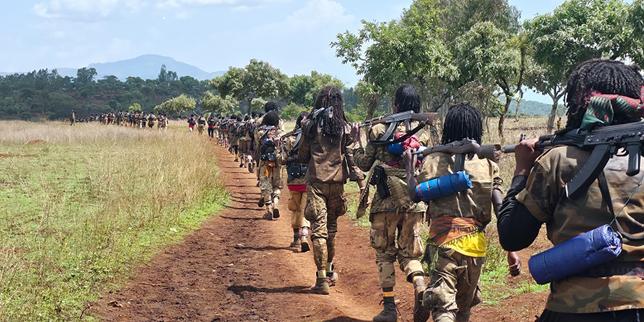
Violence in Sudan has always had a rhythmic quality, a push and pull between the center and the periphery. But the current war is different. It is an existential struggle for the identity of the state. On one side, you have the military, heavily influenced by the old Islamist guard. On the other, the RSF, a paramilitary force that grew out of the Janjaweed militias. In the middle is the Sudanese people, who are tired of being pawns in a game played by men who view the country as a private estate.
The designation serves as a warning to the military leadership: if you continue to dance with the Brotherhood, you will be treated as their partner. It is a diplomatic "divorce" decree. The U.S. is effectively saying that the path to legitimacy and the lifting of other sanctions does not run through the old guard. It requires a clean break.
But can you ever truly break a network that has spent three decades weaving itself into the fabric of a nation? The Brotherhood's influence is like the lead piping in an old house. You can change the faucets and paint the walls, but the water coming out is still tainted by what lies beneath. Removing that lead requires tearing down the walls themselves.
Critics of the designation argue it might backfire, driving the group further underground or pushing them toward more radical, violent expressions of their ideology. When you tell a group they have no future in the light, they become masters of the dark. Yet, for many Sudanese who spent years in the "ghost houses"—the secret detention centers run by the Brotherhood’s security apparatus—this move is a long-overdue act of justice. It is a recognition of the trauma inflicted upon a generation.
The emotional core of this story isn't found in a State Department press release. It is found in the quiet conversations in refugee camps in Chad, where families who fled the fighting wonder if they will ever return to a Khartoum that isn't ruled by fear. It is found in the students who marched in 2019, who saw their friends shot down on the streets, only to see the same faces responsible for the carnage trying to reassert control. For them, the "terrorist" label isn't a political tool. It is a description of their lived reality.
We often think of terrorism as a sudden explosion, a singular event that shatters the peace. But there is a slower, more corrosive form of terror. It is the terror of systemic exclusion. It is the terror of knowing that your daughter’s education, your son’s job, and your family’s safety depend on your loyalty to a secretive, ideologically driven clique. This is the legacy the U.S. is finally attempting to dismantle.
The road ahead is cluttered with the wreckage of failed transitions and broken promises. The designation is a significant hurdle for the Brotherhood, but it is not a finish line. The true test will be whether the international community has the stamina to enforce these sanctions, and whether the Sudanese people can find a way to build a new architecture on top of that heavy, persistent dust—one that isn't held together by the threat of the sword or the manipulation of the crescent.
As the sun sets over the White Nile, the call to prayer echoes through the city. It is a sound that should bring peace, but for many, it is now laced with the memory of those who used the divine to justify the demonic. The designation is a piece of paper, but it carries the weight of a world finally choosing to see Sudan not as a series of facts, but as a collection of human beings who have earned the right to breathe air that isn't thick with the past.
Would you like me to analyze the specific financial implications this designation has on international humanitarian aid flow into Sudan?