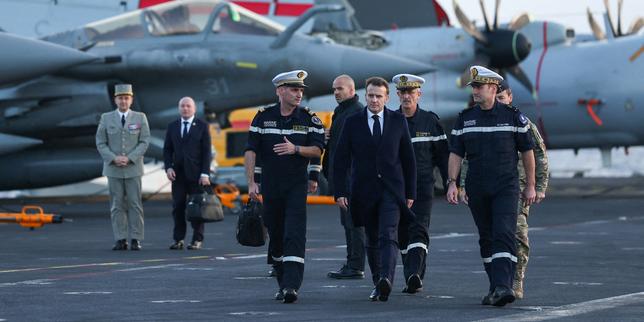
The flight deck of a nuclear-powered aircraft carrier isn't exactly the place for subtle metaphors. Yet, there was Emmanuel Macron, standing amidst the Rafale jets on the Charles-de-Gaulle, trying to thread a needle that seems to get thinner by the hour. He told the crew—and the world—that France isn't participating in an ongoing conflict. It’s a bold claim. Some might even call it a bit of a stretch when you’ve got one of the most lethal pieces of military hardware on the planet parked right in the middle of a literal powder keg.
You’ve seen the headlines. The Middle East is a mess of shifting red lines and retaliatory strikes. By sending the flagship of the French Navy into these waters, the Elysee is sending a message that is much louder than the "non-belligerent" stance Macron is publicly voicing. This isn't just a routine patrol. It’s a high-stakes diplomatic gamble wrapped in 42,000 tons of steel.
The Strategy of Being There Without Being In It
Macron’s "non-participation" rhetoric is a classic piece of Gaullist balancing. France wants to be the "balancing power." It’s an old dream. They want to show they have the muscle to intervene if things go south, while simultaneously claiming they’re only there to prevent things from going south. It’s a bit like a firefighter standing in your living room with a running hose, insisting he’s just checking the humidity.
The Charles-de-Gaulle isn't alone. It’s the centerpiece of a strike group that includes frigates, a supply ship, and usually a nuclear attack submarine lurking somewhere beneath the waves. When this group moves, the world watches. For Macron, the goal is simple. He wants to ensure that when the big players—the U.S., Iran, Israel—sit down to redraw the map or negotiate a ceasefire, France has a seat at the head of the table. You don't get that seat by staying in Toulon.
What the Charles de Gaulle Actually Does
Forget the polished speeches for a second. Let's talk about what happens on that deck. The Rafale Marine jets aren't just there for show. They’re flying intelligence, surveillance, and reconnaissance (ISR) missions. In plain English, they’re watching everything. They see the troop movements, the missile batteries, and the naval shifts that most satellite feeds might miss or delay.
This data is gold. France shares some of it with allies, but they keep the best bits for themselves. This "strategic autonomy" is what Macron obsesses over. If France knows exactly what’s happening on the ground in Lebanon or the Red Sea, they don't have to rely on Washington’s version of the truth. That’s a huge deal. It allows France to play its own hand, even if that hand occasionally annoys their NATO partners.
The presence of the carrier also serves as a massive "no-go" sign for regional escalations. It’s a deterrent. No one wants to accidentally clip a French jet or harass a French frigate when there’s a nuclear carrier nearby. It stabilizes the immediate waters, but it also paints a target on the back of French diplomacy. If a drone from a proxy group hits that deck, Macron’s "non-participant" stance evaporates in a heartbeat.
The Lebanon Connection
You can’t talk about French naval movements without talking about Lebanon. France views Lebanon as a sort of historical responsibility—or a "protected" interest, depending on how cynical you are. With the border between Israel and Hezbollah heating up, the Charles-de-Gaulle serves as a floating insurance policy for French nationals.
There are thousands of French citizens in the region. If a full-scale war breaks out, the carrier strike group is the primary tool for a massive evacuation. It’s the "Plan B" that nobody wants to use but everyone is glad is there. Macron knows that any disaster in Lebanon would be a domestic political nightmare for him. So, the carrier sits off the coast, a silent reminder that France won't just walk away if the Levant goes up in flames.
Why This Isn't Just Business as Usual
In the past, these deployments were about fighting ISIS or showing the flag in the Indo-Pacific. This time is different. The tension is more direct. The players are state actors or heavily armed proxies with sophisticated anti-ship capabilities. The Mediterranean isn't the safe playground it used to be.
Russia has a significant footprint in Tartus, Syria. Iran-backed groups have shown they can hit moving targets at sea. By placing the carrier in this environment, Macron is acknowledging that the era of "soft power" is over. France is lean, but it’s still mean. The Charles-de-Gaulle is currently the only nuclear-powered carrier in Europe. It represents the last gasp of European "hard power" that doesn't have a "Made in the USA" sticker on the side.
The Risks Macron is Downplaying
While the President speaks of peace and stability, the risks are soaring. An aircraft carrier is a prestige target. For a group looking to make a name for itself, even a near-miss on a French vessel is a propaganda victory. Macron’s insistence that France isn't a "participant" is a legal and diplomatic shield, but it doesn't stop a stray missile.
There’s also the internal cost. Running a carrier strike group is insanely expensive. Every day those jets fly, the French taxpayer is footing a bill that runs into the millions. In a time of domestic budget cuts and political instability in Paris, Macron has to justify why this floating city is thousands of miles away instead of focusing on problems at home. His answer is always the same: France is a world power, or it’s nothing.
Navigating the Mediterranean Chessboard
The Charles-de-Gaulle is currently operating in a sea crowded with American carrier groups and various regional navies. It’s a masterclass in deconfliction. One wrong turn or one misunderstood radar ping could trigger the very conflict Macron says he’s trying to avoid.
The French navy is incredibly good at this. They’ve spent decades practicing "integrated but independent" operations. They’ll swap pilots with American carriers and share fuel with British tankers, but the orders always come from Paris. This independence is what allows Macron to say things like "we aren't participants" while his ships are literally refueling the ships that are. It’s a technical truth that hides a much more complex reality.
Practical Realities of French Naval Power
If you're watching this situation, don't look at the speeches. Look at the flight cycles. When the Rafales start launching with full combat loads rather than just reconnaissance pods, the "non-participant" era is over. Right now, it’s a game of chicken.
France is betting that its presence will cool heads. The reality is that the Charles-de-Gaulle is a catalyst. Its presence forces every other actor in the region to recalculate their moves. You don't ignore a carrier. You plan around it. By being the "variable" in the Middle Eastern equation, Macron ensures that France remains relevant, even if the cost of that relevance is a permanent state of high-alert tension.
Keep an eye on the mission length. If the deployment gets extended, it means the backroom diplomacy is failing. A carrier that can’t go home is a carrier that’s waiting for a fight. For now, Macron’s "peace through strength" act is holding, but the deck is getting crowded, and the margins for error are razor-thin.
Pay attention to the maritime notices in the Eastern Med. That's where the real story is written. When the exclusion zones grow, the stakes have shifted. France isn't "in" the war yet, but they’ve certainly got the best view of the front line.