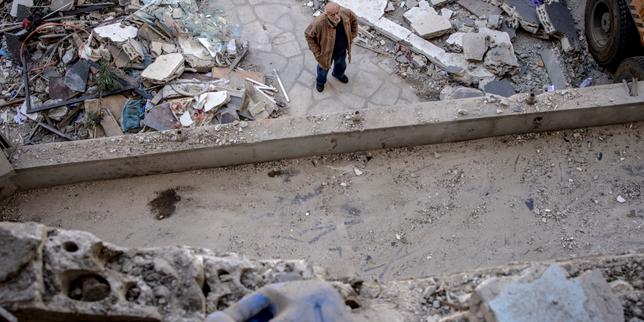
The air in Southern Lebanon doesn't just carry the scent of thyme and baked earth anymore. It carries the metallic tang of ozone and the invisible hum of a digital dragnet. In a small village near the Litani River, a man named Omar—a composite of the thousands caught in this friction—watches his smartphone screen flicker. He isn't checking the news. He is wondering if the device in his pocket is a beacon or a brick.
For decades, the border between Israel and Lebanon was defined by concrete walls, barbed wire, and the physical presence of soldiers. Today, that border has dissolved into a fluid, terrifyingly precise grid of data. Israel’s ambitions in Lebanon have shifted from the blunt force of territorial occupation to something far more complex and dangerous: the pursuit of a "buffer zone" that exists as much in the electromagnetic spectrum as it does in the soil.
It is a double-edged sword that cuts through the very heart of the Levant.
The Algorithm of Displacement
The strategy being deployed is no longer just about moving tanks across a line. It is about the "unmaking" of a space. When the Israeli military signals its intent to push Hezbollah back beyond the Litani River, it isn't just a tactical request. It is a demand to rewrite the geography of a nation.
Consider the sheer mechanics of modern precision. Israel’s military intelligence units, fueled by advanced AI and signals intelligence, can now map every window, every basement, and every moving vehicle in a southern Lebanese village with the granularity of a surgeon. This "God’s-eye view" creates an illusion of surgical perfection. But for the people living under that gaze, the perfection is the problem.
When a strike is "precise," it creates a specific kind of psychological terror. It suggests that if you are hit, you were meant to be hit. Or worse, that your neighbor was the target, and you are simply the margin of error in a digital calculation. This technological dominance has emboldened Israeli leadership to believe that they can finally solve the "Northern Problem" through a mix of high-tech attrition and limited ground incursions.
But maps are not the territory.
The Litani River has always been a siren song for Israeli strategists. In 1978 and 1982, the goal was the same: push the threat back, create a vacuum, and find security in the distance. Each time, the vacuum was filled by something more resilient, more bitter, and more entrenched. History is a repetitive teacher, yet we are notoriously bad students.
The Invisible Stakes of the "Buffer"
What happens to a town when it becomes a "buffer"? It doesn't just disappear. It enters a state of permanent suspension.
In the boardrooms of Tel Aviv and the bunkers of Beirut, the Litani is a line on a map. To a farmer in Nabatieh, it is the water that keeps his family alive. When Israel talks about "clearing" the area south of the river, they are talking about the erasure of a lived economy. They are talking about turning olive groves into "kill zones" and family homes into "structural liabilities."
The risk for Israel is that the pursuit of total security creates a total enemy. By using advanced technology to decouple the civilian population from the land—ordering mass evacuations via SMS and social media—they are creating a new class of the displaced. These are people who have lost their homes not to a random shell, but to a calculated, digitized directive.
That distinction matters. It turns a tragedy into a grievance.
The Hardware of Hubris
The Israeli military today is perhaps the most technologically sophisticated force to ever set foot in the Middle East. They are testing drone swarms that communicate in real-time, AI systems that can identify a weapon's heat signature through three floors of concrete, and electronic warfare suites that can black out an entire city’s communications in seconds.
This is the "edge" that gives the State of Israel its confidence. It is a belief that technology can bypass the messy, bloody reality of urban warfare. If you can see everything, you can control everything. Right?
Wrong.
The flaw in this logic is the human element. Hezbollah is not just a militia; it is a social fabric, a political entity, and a regional proxy. You can kill a commander with a drone. You can jam a radio frequency. But you cannot "jam" the resentment of a generation that watches its sovereignty dismantled by a remote-controlled aircraft.
The "double-edged" nature of these ambitions lies in the blowback. Every time a high-tech solution is used to solve a human problem, the human problem mutates. We saw this in the "Ring of Steel" around Gaza, where the most advanced border fence in history was bypassed by paragliders and bolt cutters. The more Israel relies on technological superiority to manage Lebanon, the more it ignores the underlying political rot that makes the conflict inevitable.
The Ghost in the Machine
Let's talk about the data. In the current conflict, the Israeli state has collected more biometric and locational data on the Lebanese population than ever before. This is the "invisible stake." Who owns this data? How is it used ten years from now?
When we look at the "ambitions" of the Hebrew state, we have to look past the tanks. We have to look at the attempt to create a permanent state of digital surveillance over a sovereign neighbor. This is the new frontier of occupation. It doesn't require a soldier on every corner if you have a sensor on every pole and a drone in every cloud.
But this creates a paradox. A security that depends on total surveillance is a security that is fundamentally fragile. It requires 100% success, 100% of the time. The adversary only needs to be lucky once.
The weight of this expectation sits heavy on the Israeli public. They have been promised a "final" solution to the rockets, a "definitive" end to the threat from the north. But there is no such thing as a final victory in a land of deep memories.
The Price of the "Second Front"
The economic cost of these ambitions is staggering, and not just in terms of shekels and cents. It is the cost of a society permanently mobilized for a war that has no finish line.
While the world watches the explosions over Beirut, the internal fabric of Israel is being stretched thin. Reservists are being pulled from their tech jobs and their families for the third or fourth time in a year. The "Start-up Nation" is becoming the "Fortress Nation." There is a deep, quiet exhaustion that no amount of military success can quite mask.
On the other side, Lebanon is a ghost of a country, its economy already in a coma, now being jolted by the electricity of war. The ambition to "weaken" Hezbollah by destroying the infrastructure around them is a gamble with human lives that often results in the opposite of the intended effect. Desperate people do not turn on the militants who claim to protect them; they turn toward them.
The River that Remembers
The Litani doesn't care about geopolitics. It flows regardless of who claims its banks.
If Israel succeeds in pushing Hezbollah north, what remains? A scorched earth. A demographic void. A line of sensors and automated turrets. This is the "security" of a graveyard.
The real tragedy is that both sides know this. They have seen this movie before. They know how the "buffer zone" ends—in more coffins, more ruins, and a deeper well of hatred. Yet, the momentum of military logic is a hard thing to stop once it gains speed.
We are witnessing the birth of a new kind of war, one where the "human element" is treated as a bug in the system, something to be managed, moved, or deleted. But humans are not data points. They are messy, unpredictable, and fueled by a sense of justice that no algorithm can quantify.
As the sun sets over the Galilee and the hills of Jabal Amel, the drones continue their steady, high-pitched whine. It is the sound of a modern world trying to solve an ancient problem with silicon and steel.
The man in the village, Omar, puts his phone face down on the table. He looks out at the river. He isn't thinking about the "ambitions of the state." He is thinking about whether the wind will change direction before the smoke reaches his children’s bedroom.
The state may have its ambitions, but the land has its memory. And the land always, eventually, wins.
Would you like me to analyze the historical parallels of the 1982 invasion to see how they compare to the current digital-first strategy?