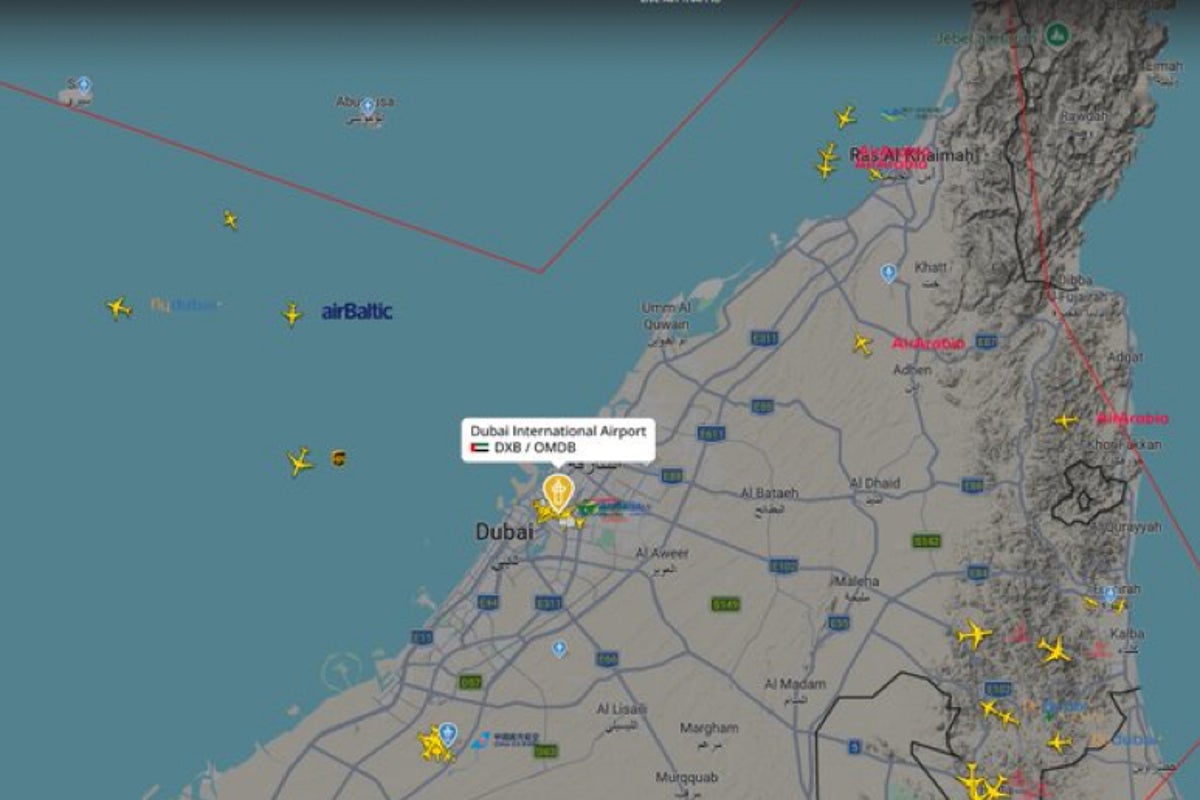
The air inside Terminal 3 at Dubai International usually smells of expensive oud, roasted coffee, and the electric hum of global ambition. It is a place that never sleeps, a gilded artery through which the world’s pulse beats. But when the drones began their slow, mechanical trek across the Middle Eastern sky, that pulse skipped. Then it stopped.
Silence in an airport is not peaceful. It is heavy. It feels like the static before a storm, or the breath held before a scream.
Consider Sarah. She isn’t a real person in the legal sense, but she is the composite of five thousand souls currently sleeping on yoga mats and upturned puffer jackets near Gate B25. She was headed to London for a wedding. Now, she is watching a flickering flight board turn a uniform, bleeding shade of red. "Cancelled." "Delayed." "Delayed." "Cancelled." The logic of the modern world—the idea that you can be in a desert at noon and a rainy metropole by dinner—evaporated the moment the airspace over Jordan, Iraq, and Israel slammed shut.
Geography is a stubborn thing. We like to think technology has conquered it, but a few hundred miles of "hot" sky can still turn the world's busiest international hub into the world's most expensive waiting room.
The Geography of Anxiety
When Iran launched its retaliatory strikes, the reaction was a frantic, invisible chess game played by air traffic controllers 30,000 feet below the actual action. Pilots who were mid-flight suddenly saw their routes vanish. Imagine being over the Persian Gulf, looking at a fuel gauge, and being told the door to your destination has been bolted from the inside.
This isn’t just about "disruption." That is a sanitized word used by PR departments to mask chaos.
The reality is the smell of thousands of bodies in a confined space. It is the sound of a toddler crying because the specific brand of milk they drink is three countries away. It is the sight of a businessman in a three-thousand-dollar suit arguing with a gate agent who has no more power over the situation than the janitor emptying the bins. The agent can't fight a ballistic trajectory. They can't negotiate with a closed border.
Dubai is the hinge of the world. When that hinge rusts or breaks, the door swings wildly.
Flights from Sydney to Paris, Mumbai to New York, and Manila to London all converge here. When the Middle Eastern corridor goes dark, the rerouting doesn't just add an hour to the trip. It adds five. It requires extra fuel that wasn't budgeted. It requires crew shifts that exceed legal safety limits. The logistics are a falling house of cards, and the people on the floor are the ones getting paper cuts.
The Invisible Stakes of a Closed Sky
We often talk about these events in terms of "geopolitical tension" or "regional instability." Those are grand, sweeping terms that look good in a newspaper headline but mean nothing to the woman whose grandmother is in a hospice bed in Manchester.
The hidden cost of a disrupted flight isn't the price of the ticket. It’s the missed goodbye. It’s the job interview that won't be rescheduled. It’s the fragile momentum of a life interrupted by a conflict the traveler has no stake in.
The sky used to be a commons. Now, it is a series of toll booths and trapdoors.
As the sun rose over the Hajar Mountains, the light didn't bring much warmth to the passengers stranded on the terminal’s marble floors. The "tension" the news anchors talk about isn't just between nations; it’s the tension in the shoulders of a father trying to explain to his kids why they are sleeping in an airport for the second night in a row. He tells them it’s an adventure. His eyes say it’s a hostage situation where the captor is a map.
The sheer scale of the backup is hard to visualize. When a hub like Dubai stalls for even six hours, the ripple effect lasts for days. Planes are in the wrong cities. Pilots are in the wrong time zones. The digital ghost of your flight might still exist on an app, but the physical reality is a metal tube parked on a sun-baked tarmac three hundred miles away.
The Fragility of the Hub
There is a specific kind of vulnerability that comes with being a "global citizen." We have traded the security of the local for the speed of the global, and we forgot that speed depends on a very thin veneer of peace.
One might wonder why these planes don't just "fly around" the trouble.
Physics and politics have a way of conspiring against the traveler. Flying around the affected airspace often means heading north over Turkey or south toward Africa, adding thousands of miles. This isn't a detour past a car accident on a highway. This is a total recalculation of weight, balance, and survival.
Modern aviation operates on a razor-thin margin. There is no "extra" plane waiting in the wings for a thousand stranded passengers. There is only the hope that the sky reopens before the water runs out or the tempers boil over.
The airlines do what they can. They hand out vouchers for sandwiches that will be gone in twenty minutes. They offer hotel rooms that are already full. They send automated emails that feel like being patted on the head while your house burns down. But the truth is, they are as stuck as the passengers. They are waiting for the men in rooms with no windows to decide if the air is safe enough to sell again.
The Long Walk to Gate B25
By the second day, the luxury of Terminal 3 starts to peel away. The high-end watch boutiques look absurd next to people brushing their teeth in the communal sinks. The digital displays, usually flashing advertisements for perfumes and sports cars, become the only thing people stare at—hoping for a green light, a "Boarding" call, a sign of life.
The human element is the only thing that keeps the place from descending into a fever dream.
You see it in the way a stranger shares a power bank with someone whose phone is at 1%. You see it in the way a group of travelers from four different continents starts a card game to pass the tenth hour of waiting. In the absence of a schedule, humanity defaults to a strange, weary solidarity. We are all just cargo in the end, waiting for the logistics of war to make room for the logistics of life.
The sky eventually cleared, as it always does. The drones fell or found their marks, the sirens stopped, and the NOTAMs (Notices to Air Missions) were quietly rescinded. The flight boards flickered again, the red text replaced by the blessed, boring white of "On Time."
But as Sarah finally boarded her flight, looking down at the desert sand as the wheels retracted, the perspective had shifted. The world isn't as small as the travel brochures claim. It is vast, and the paths we take across it are etched in water. We are allowed to cross these borders only as long as the ground stays quiet.
The engines roared, the cabin pressurized, and the coffee was served. Below, the red sky of the previous night had faded into a dusty, indifferent blue, leaving nothing behind but the ghost of a fear that the next time the sky closes, it might stay that way.
The plastic tray table clicked into place, a tiny, fragile shield against the reality that we are all just drifting between the whims of giants.