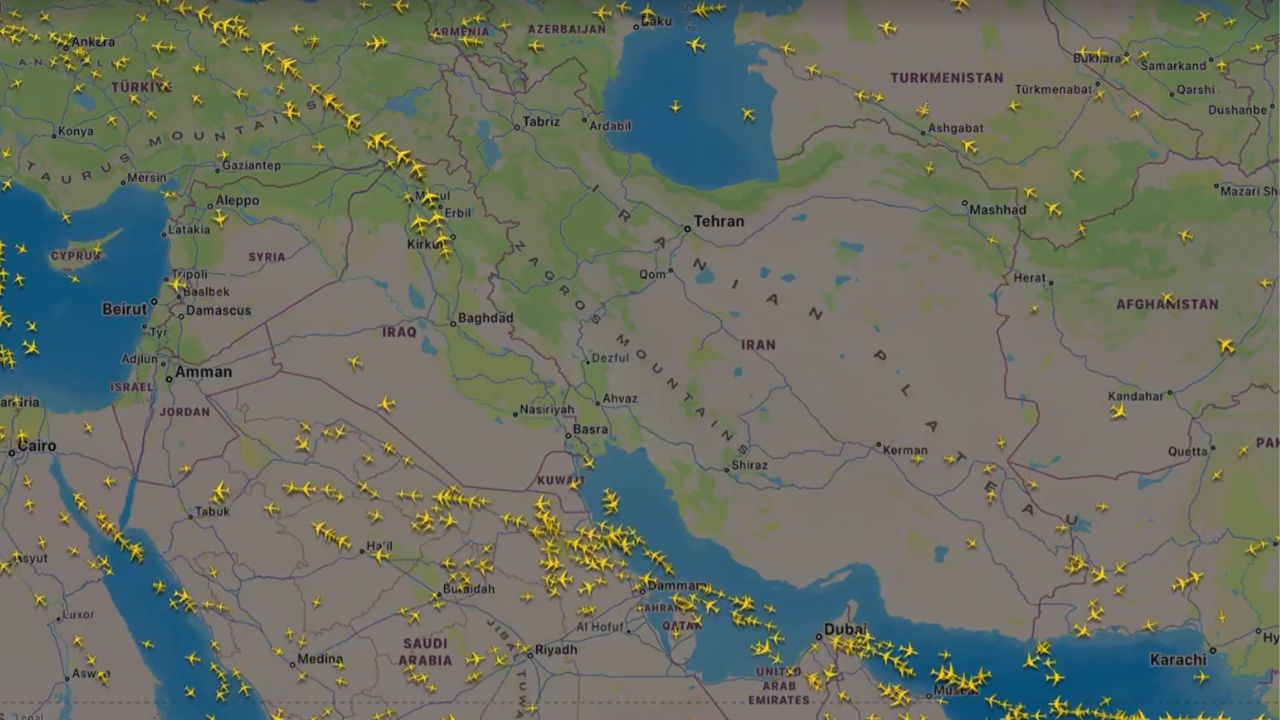
The world’s busiest international air corridor did not just experience a delay this week; it suffered a structural heart attack. When Iranian ballistic missiles and retaliatory strikes from the U.S. and Israel turned the skies over the Persian Gulf into a live-fire zone on February 28, 2026, the era of the "seamless" global hub effectively ended.
By March 1, the numbers were staggering. More than 3,400 flights were scrubbed across seven major Middle Eastern gateways, including Dubai International (DXB), Doha’s Hamad International (DOH), and Abu Dhabi’s Zayed International (AUH). For decades, these cities built their empires on the logic of geography, acting as the unavoidable middleman for anyone moving between London and Sydney or Mumbai and New York. That logic has been shattered by a reality where a $500 drone can ground a $400 million Airbus A380 for days.
The Myth of the Safe Transit
Airlines have long operated under the quiet assumption that even in times of regional friction, major commercial hubs remain off-limits. That assumption died when reports surfaced of damage to the tarmac at DXB and injuries at Zayed International. This is no longer about avoiding a specific combat zone. It is about the total collapse of the "super-connector" business model.
When Etihad Airways suspended all departures until the afternoon of March 1, it wasn't just a safety precaution. It was a recognition that the hub-and-spoke system cannot function when the hub itself is a target. If you are a passenger sitting in a terminal in London or Singapore, the Middle East is no longer a convenient 90-minute stopover; it is a high-stakes bottleneck.
The GPS Ghost in the Machine
Beyond the physical threat of missiles lies a more insidious danger that pilots have been whispering about for months: electronic warfare. As military assets in the region ramp up their defensive postures, GPS jamming and spoofing have moved from the periphery to the flight deck of civilian airliners.
In the last 48 hours, flight crews across the Gulf have reported "ghost" positions, where onboard navigation systems suddenly insist the aircraft is hundreds of miles away—sometimes deep inside hostile territory. Unlike traditional jamming, which simply cuts the signal, spoofing tricks the aircraft into thinking it is on a different path. For a pilot landing in heavy traffic at Dubai, the margin for error is zero.
Aviation authorities have been slow to admit the scale of this. While they focus on the "kinetic" threat of missiles, the digital threat to navigation is what will keep these airspaces restricted long after the smoke clears. Carriers like Air India and Lufthansa are not just rerouting to avoid bombs; they are rerouting to find "clean" sky where their instruments actually work.
The Cost of the Long Way Round
The immediate financial fallout is easy to see, but the long-term burn is what will bankrupt the smaller players. Rerouting a flight from India to Europe via Egypt and the southern tip of Saudi Arabia adds roughly 40 to 60 minutes of flight time.
That might sound trivial to a passenger, but for an airline, it is a logistical nightmare.
- Fuel Burn: Those extra minutes require tons of additional Jet A-1 fuel, often exceeding the weight limits for certain long-haul routes.
- Crew Duty: Pilots and cabin crew operate on strict legal clocks. A 14-hour flight that becomes a 15.5-hour flight can "time out" a crew, forcing an emergency stop in a third country just to swap personnel.
- Payload Penalties: To carry the extra fuel needed for a detour, airlines have to leave cargo or even passengers behind.
We are seeing the return of the technical stop. Flights that used to be non-stop are now landing in places like Rome or Athens just to refuel because they can no longer take the direct path through the Iranian or Iraqi corridors. This adds thousands of dollars in landing fees and handling costs to every single journey.
A New Map of the World
The geography of the 21st century is being rewritten by "Fortress Skies." If the Middle East remains a high-risk zone, the aviation industry will shift its weight back toward the North Pole or toward ultra-long-haul direct flights that bypass the region entirely.
Qantas and United have already proven that "Project Sunrise" style flights—18 to 20 hours in the air—are technically possible. Until now, they were a luxury niche. In a world where the Persian Gulf is a no-fly zone, these marathons become the only reliable way to move between East and West.
The "Golden Age" of the 90-minute Dubai layover is over. Travelers are now facing a binary choice: pay a massive premium for a direct flight that avoids the region, or risk being part of the 90,000 people currently sleeping on airport floors because a geopolitical calculation changed while they were at 35,000 feet.
Expect ticket prices to reflect this risk immediately. The "war risk" surcharges of the 1970s are coming back, and they won't be temporary. This is the price of flying through a world that has forgotten how to keep its transit points neutral.
Check your carrier’s "Conditions of Carriage" tonight. You’ll find they are under no obligation to get you home on time when the sky itself is closed.