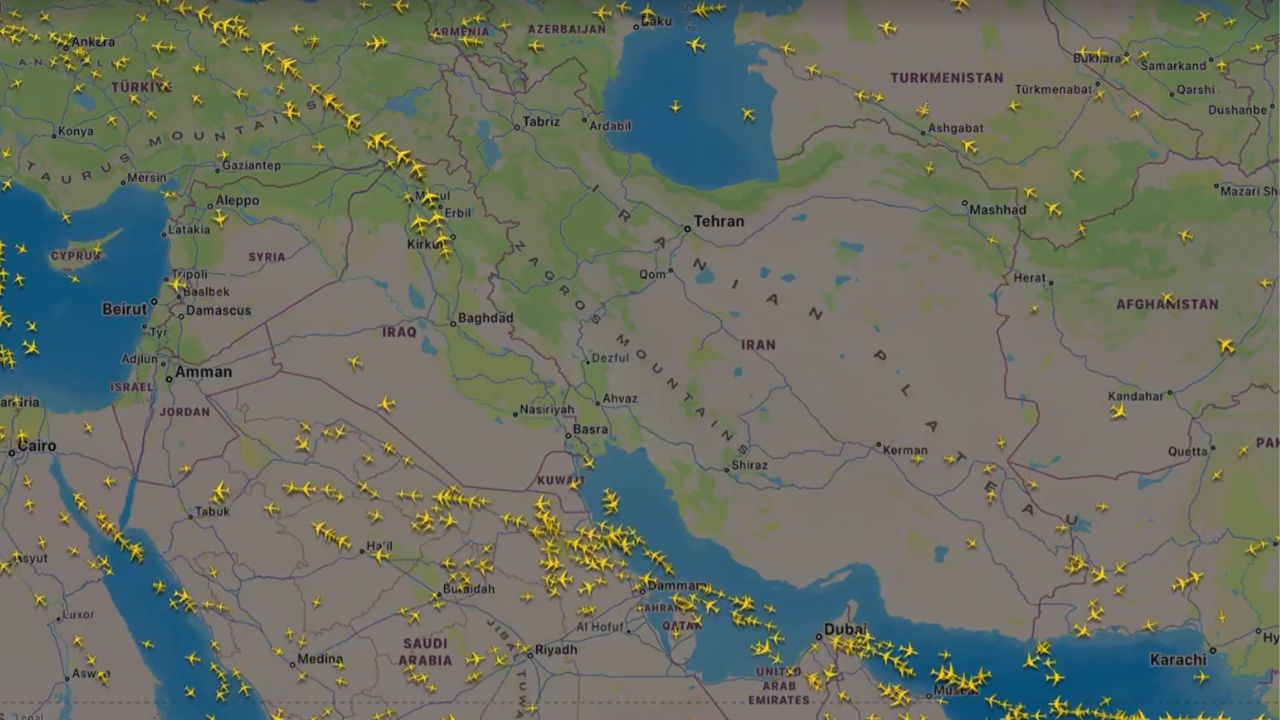
The standard media narrative regarding Iranian airspace is a masterclass in reactionary shallow-thinking. You’ve seen the flight tracker timelapses: a swarm of digital yellow planes suddenly veering away from Tehran like a school of fish dodging a shark. The pundits call it "unprecedented safety coordination." I call it a desperate, expensive performance that ignores the physics of modern warfare and the brutal math of aviation economics.
Airlines aren't moving because the sky is suddenly "closed" in a physical sense. They are moving because their insurance underwriters in London had a collective panic attack. By the time a NOTAM (Notice to Air Missions) is issued and a flight path is rerouted, the tactical reality on the ground has usually already changed. We are chasing ghosts with billion-dollar assets.
The Myth of the "Safe" Corridor
The biggest lie in aviation is that there is a binary state of "safe" or "unsafe" airspace. In reality, safety is a sliding scale of tolerable risk. When the industry abandoned Iranian transit routes following the exchange of strikes between Israel and Iran, they didn't eliminate risk; they simply traded one set of hazards for another.
Look at the bottlenecks. By avoiding Iran, traffic funnels into saturated corridors over Iraq, Saudi Arabia, and Egypt. We are creating aerial traffic jams in regions with their own history of volatility. When you cram 400 extra long-haul flights into a narrow strip of sky, you increase the probability of human error, mid-air proximity alerts, and fuel exhaustion.
I’ve seen carriers burn an extra 15 tons of fuel per flight to skirt a border, only to fly directly over a different active conflict zone that hasn't hit the news cycle yet. It’s security theater at 35,000 feet. If the goal is absolute safety, the only logical move is to ground the fleet. Since we won't do that, we pretend that a 50-mile detour makes a Mach 0.85 projectile untouchable.
The Mathematical Failure of Rerouting
Let’s talk about the variables the average "aviation expert" on cable news ignores. An extra two hours in the air isn't just a late arrival. It’s a cascading failure of logic.
- Crew Duty Limits: Every minute spent bypassing Iran is a minute ticking toward a crew "timing out." Once a pilot hits their legal limit, that plane stays on the tarmac at the next stop. This costs millions in passenger re-accommodation.
- Maintenance Cycles: Engines are rated by hours and cycles. Artificially inflating flight times for political optics accelerates the wear on critical components. You aren't just avoiding a missile; you’re shortening the life of the aircraft.
- The Carbon Hypocrisy: Every airline has a "Sustainability" page on their website. Yet, the moment a geopolitical tremor occurs, they dump thousands of tons of extra $CO_2$ into the atmosphere to maintain the illusion of a risk-free path.
The formula for the total cost of a reroute ($C_{total}$) is far more complex than just fuel price multiplied by distance:
$$C_{total} = (F_{rate} \times \Delta T) + (M_{cost} \times \Delta T) + L_{crew} + P_{delay}$$
Where:
- $F_{rate}$ is the fuel burn rate.
- $\Delta T$ is the added flight time.
- $M_{cost}$ is the hourly maintenance depreciation.
- $L_{crew}$ is the logic-based cost of crew duty extensions.
- $P_{delay}$ is the passenger compensation penalty.
When you run these numbers, the "safety" move often looks like a fiscal suicide pact.
The Intelligence Gap
Most people think airlines have a direct line to the CIA or Mossad. They don't. They rely on "Risk Intelligence" firms that aggregate open-source data and sell it back to them in a shiny PDF. By the time an airline's operations center decides to divert a flight, the information is already "stale."
During the 2024 escalations, I watched flights entering Iranian airspace after the first wave of strikes because the bureaucratic machinery of the ICAO (International Civil Aviation Organization) moves at the speed of a glacier. The "video evidence" of planes moving out of the way is usually a record of what happened two hours ago, not what is happening now.
The industry is reactive, not proactive. We saw this with MH17. The industry knew eastern Ukraine was a mess, but they kept flying because it was "legal." Now, we have the opposite problem: we flee perfectly navigable airspace because the PR risk of staying is higher than the actual kinetic risk of a stray missile.
The GPS Spoofing Reality Nobody Admits
While the media focuses on the spectacular visual of a missile launch, the real danger in the Middle East is invisible: Electronic Warfare (EW).
As flights divert around Iran and hover near the borders of Israel, Lebanon, and Jordan, they are flying into a soup of GPS jamming and spoofing. Pilots are reporting "phantom" locations, where their navigation systems think they are miles away from their actual position.
By forcing the entire global fleet into these narrow "safe" corridors, we are putting them exactly where the jamming is most intense. We are trading a 0.001% chance of being hit by a missile for a 10% chance of a total navigation failure in high-density traffic. It is a staggering failure of risk assessment.
Stop Asking if the Airspace is Closed
The question "Is the airspace closed?" is the wrong question. The right question is: "Does the airline have the balls to fly the most efficient route?"
Currently, the answer is no. We are living in an era of "defensive operations." Airlines operate in a state of constant fear—not of the weapons, but of the litigation. If an airline flies through Iran and nothing happens, they save $30,000. If they fly through and a 1-in-a-million event occurs, the company is liquidated by lawsuits.
This isn't safety management; it's legal hedging.
We need to stop treating these flight tracker maps like a game of "Red Light, Green Light." The sky is big. It is mostly empty. Modern anti-aircraft systems are designed to track specific heat signatures and transponders. A civilian jet is the loudest, most obvious thing in the sky. Misidentification happens, yes, but it happens because of human panic, not because a route is inherently "dangerous."
The Brutal Truth of the "Alternative"
When you see those planes banking away from the Persian Gulf, they are headed toward the "Silk Road" routes or the "Suez" routes. These areas are not exactly Swiss meadows. You are trading Iranian airspace for regions with less sophisticated Air Traffic Control (ATC), worse emergency landing options, and higher terrain.
If you have an engine fire over the Zagros mountains in Iran, you have options. If you have an engine fire while taking a massive detour over a remote desert or a secondary conflict zone to avoid a "red" area on a map, you might find yourself with nowhere to go.
The industry needs to grow up. Geopolitics is messy, and the sky is a reflection of the ground. Stop pretending that adding two hours to a flight from London to Singapore is a "solution." It’s a bandage on a gunshot wound, applied by people who are more afraid of Twitter than they are of reality.
Fly the line. Manage the risk. Stop the theater.
Next time you see a "dramatic" video of planes dodging a country, remember: you’re watching a boardroom make a decision based on insurance premiums, not a pilot making a decision based on physics. If you want a 100% guarantee of safety, stay on the ground. If you want to run a global transport network, admit that risk is the price of entry and stop the performative rerouting that solves nothing.