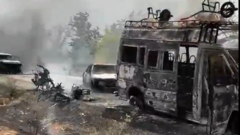
Malian insurgents are systematically choking off the country's main transit corridors, shifting their strategy from sporadic guerrilla ambushes to a sophisticated scorched-earth economic blockade. By intercepting commercial transport networks, burning dozens of civilian supply vehicles, and isolating key regional hubs like Timbuktu and Gao, jihadist coalitions—primarily the Al-Qaeda-linked Jama'at Nusrat al-Islam wal-Muslimin (JNIM)—are turning the simple act of logistics into a high-stakes theater of war. This is not mindless vandalism. It is a calculated campaign to starve the state of revenue, sap public confidence in the ruling military junta, and force local populations into submission by cutting off food, fuel, and medical supplies.
The violence on the tarmac represents a grim evolution in Sahelian warfare. For years, the international community viewed Mali's instability through the lens of ideological extremism or ethnic friction. While those elements remain, the current crisis is fundamentally about resource control and territory isolation. When insurgents torch a convoy of commercial trucks, they are not just destroying physical assets. They are cutting a vital artery that connects the landlocked nation to regional ports and agricultural zones. The immediate fallout is a localized economic paralysis that the central government in Bamako appears ill-equipped to reverse.
The Mechanics of the Tarmac Blockade
To understand how a handful of mobile insurgent units can freeze national commerce, one must look at Mali's geographic vulnerabilities. The country relies heavily on a few overextended highways to move goods from coastal West African ports through its southern hubs up to the arid north. By establishing illegal checkpoints at strategic bottlenecks along these routes, militants effectively dictate who moves, what goods enter the market, and at what price.
The strategy relies on a simple, brutal enforcement mechanism. Drivers who defy the blockade face immediate execution, and their vehicles are incinerated on the roadside. The wreckage is left to rot on the asphalt. It serves as a stark, smoking billboard for any other logistics operator thinking about making the run.
[Port of Entry] ---> (Vulnerable Highway Corridors) ---> [Insurgent Checkpoints] ---> [Targeted Regional Hubs]
                                                                |
                                                      (Convoy Destruction)
This enforcement model has triggered an immediate crisis in the transport sector. Freight companies are now refusing to service northern routes without heavy military escorts, which the Malian Armed Forces (FAMa) cannot consistently provide. The resulting supply deficit has caused the prices of basic commodities like rice, sugar, and cooking oil to skyrocket in blockaded cities. In some areas, the cost of grain has doubled in a matter of weeks, transforming a security crisis into an acute humanitarian disaster.
The Strategic Failure of Total Security
The current military administration ascended to power on the promise of restoring national security and reclaiming territory from insurgent groups. However, the persistence and expanding scope of these highway blockades reveal a significant gap between political rhetoric and operational reality on the ground.
The state’s tactical response has traditionally relied on conventional military sweeps. Troops roll out in armored columns, clear a section of the road, and then return to their bases. This method is ineffective against a highly mobile adversary that melts into the landscape the moment a government patrol appears. Once the military convoy passes, the insurgents return to the highway, re-establish their checkpoints, and resume their extortion racket.
The Problem with Wagner and Private Proxies
In its bid to reclaim the initiative, Bamako pivoted away from traditional Western security partnerships, opting instead to employ Russian private military contractors, widely recognized as the Wagner Group (now operating under the umbrella of the Africa Corps). This shift was marketed as a decisive move to crush the insurgency. The reality has proven far more complicated and destructive.
While these foreign forces bring significant firepower, their operational footprint has often exacerbated local tensions. Heavy-handed counter-insurgency operations in rural communities have sometimes driven alienated populations straight into the arms of militant recruiters. Furthermore, these private forces lack the troop density required to permanently garrison thousands of kilometers of vulnerable highway. They can secure a specific facility or join a high-profile offensive, but they cannot act as a permanent highway patrol. The insurgents have capitalized on this limitation, avoiding direct confrontations with heavily armed state convoys and instead striking soft civilian targets along undefended stretches of road.
The Localized Extraction Racket
The blockade is not merely a defensive tactic to keep government forces at bay. It is a lucrative revenue engine. Insurgents do not burn every vehicle that approaches their checkpoints; they extract rents.
A sophisticated system of revolutionary taxation has emerged along the transit corridors. Trucking companies, local merchants, and passenger bus operators are forced to pay substantial transit fees to guarantee safe passage through militant-held territory. Those who pay are issued informal passes or verbal clearances that are honored at subsequent checkpoints. Those who refuse, or those caught carrying goods destined for state agencies or military outposts, see their cargo confiscated and their vehicles set ablaze.
This extortion network creates a perverse economic reality:
- Funded Insurgencies: The revenue generated from highway extortion directly funds the procurement of weapons, fuel, and communications equipment for the militant groups.
- Artificially Inflated Prices: The cost of the transit tax is invariably passed down to the consumer, meaning ordinary citizens in Gao and Timbuktu are effectively subsidizing the very groups blockading them.
- Market Distortion: Legitimate businesses that refuse to engage with criminal networks are driven out of the market, leaving the supply of essential goods in the hands of black-market operators willing to cut deals with extremists.
This dynamics transforms the conflict from a political struggle into an embedded criminal economy. Once a militant commander tastes the profits of a successful highway shake-down operation, the incentive to negotiate a peaceful settlement evaporates. The war becomes self-funding.
The Human Toll Beyond the Statistics
While media coverage often focuses on the number of trucks destroyed or the tonnage of cargo lost, the human cost of these blockades extends far deeper into the social fabric of rural Mali. Entire communities are being systematically disconnected from the national grid of governance and aid.
Medical facilities in blockaded zones are running out of basic supplies, including antibiotics, anesthetics, and infant formula. International humanitarian organizations find themselves in an impossible position. They must either suspend operations due to unacceptable risks to their personnel or negotiate access with listed terrorist organizations, a move that risks violating domestic and international laws.
+------------------------+------------------------+------------------------+
| Commodity              | Pre-Blockade Cost      | Peak Blockade Cost     |
+------------------------+------------------------+------------------------+
| Imported Rice (50kg)   | Standard Market Rate   | Up to 100% Increase    |
| Cooking Oil (Liter)    | Baseline Price         | 60-80% Premium         |
| Diesel Fuel (Liter)    | Regulated Price        | Highly Volatile/Black  |
|                        |                        | Market Dependent       |
+------------------------+------------------------+------------------------+
The psychological impact is equally severe. The constant threat of ambush has effectively trapped urban populations within their city limits. Farmers cannot tend to fields located outside the immediate security perimeter of major towns, leading to a collapse in local agricultural production. The blockade does not just stop food from entering; it stops communities from growing their own.
Confronting the Logistic Chokepoint
Resolving Mali’s highway crisis requires a fundamental reassessment of how security is maintained along vital trade corridors. The current approach of reactive patrolling and reliance on foreign mercenaries has failed to secure the supply chains.
A shift toward a dedicated, mobile highway security task force is necessary. Instead of static garrisons or irregular sweeps, the state must deploy specialized units trained in rapid response and aerial surveillance to keep commerce moving. This must be paired with secured, scheduled commercial convoys where civilian transport vehicles are clustered together under continuous military protection from departure to destination.
Simultaneously, the economic incentives driving the blockades must be disrupted. This involves targeting the financial networks that launder the proceeds of highway extortion and addressing the corruption that allows illicit goods to pass through official state checkpoints. Without cutting off the financial lifeblood generated by these routes, any military victory on the asphalt will remain temporary. The road ahead remains perilous, and until the state can guarantee the safety of a single delivery truck, its sovereignty over the north will exist only on paper.