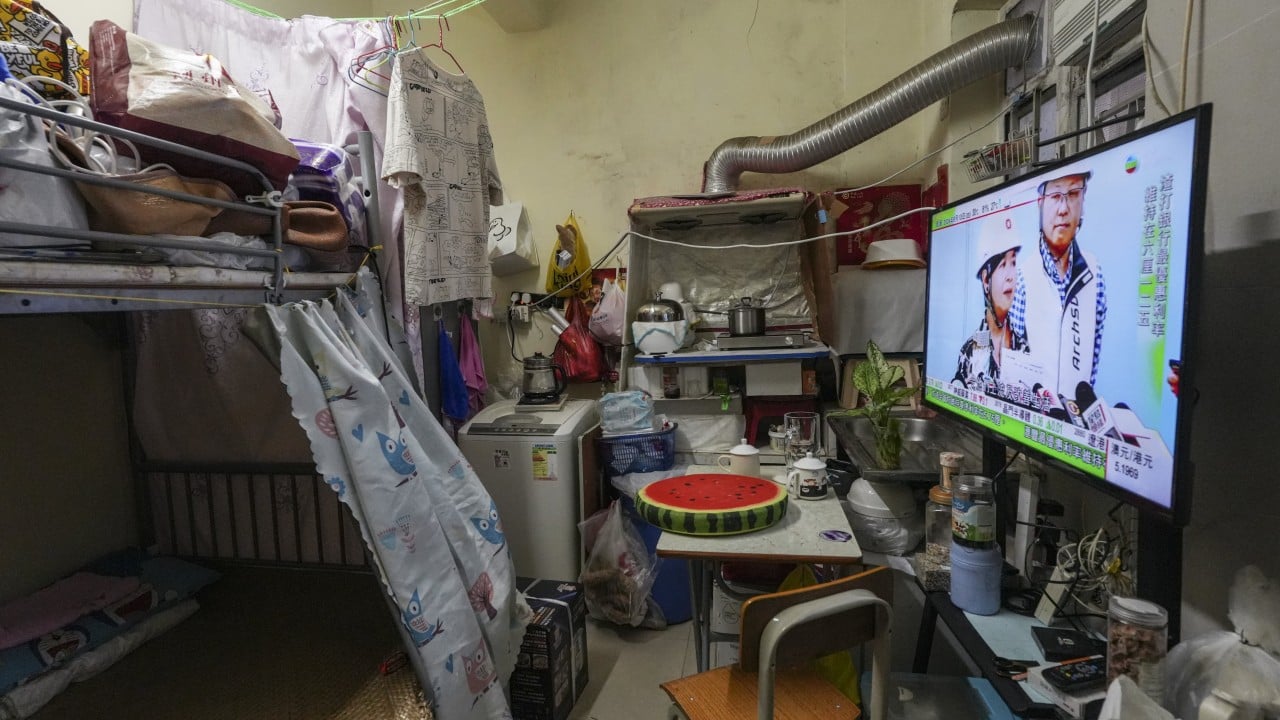
NGOs love a shocking statistic. It keeps the donations flowing and the press releases printing. The latest headline-grabbing figure doing the rounds claims that up to 66% of Hong Kong tenants living in subdivided flats suffer from moderate to severe anxiety and depression. The Kwai Chung Subdivided Flats Residents Alliance and various grassroots coalitions point to the 50-square-foot cubicles, the shared toilets, and the windowless rooms as the direct cause of this psychological trauma.
They are wrong. They are confusing the symptom with the disease.
Cramping a family into a space smaller than a standard prison cell is a structural failure of public housing policy, but blaming the physical walls for a clinical mental health crisis is lazy analysis. It presumes that if you magically double the floor space to 100 square feet, the depression vanishes.
It does not. I have spent over a decade analyzing urban poverty metrics across East Asia, watching organizations throw millions of dollars at interior redesigns and modular furniture installations. The results are always the same: prettier rooms, identical stress levels.
The mental health crisis in Hong Kong's poorest districts is not a spatial problem. It is a financial and structural trap. The walls of a subdivided unit do not generate anxiety; the economic violence required to pay for them does.
The Mathematical Math Behind the Misery
Let us look at the actual data that the standard media narrative glosses over. The median monthly rent for a subdivided flat sits around HK$5,800. On paper, that sounds cheap for one of the most expensive property markets on Earth. But when you look at the demographic profile of the tenants—cleaners, security guards, delivery drivers, and retail staff—that rent swallows up roughly 45% to 50% of their total monthly household income.
By comparison, residents lucky enough to secure public housing through the Hong Kong Housing Authority pay roughly half that amount for double the space, meaning their rent-to-income ratio stays well below 20%.
This is where the logic of the NGO consensus collapses.
If space were the primary driver of mental illness, then every high-earning finance professional living in a luxury 200-square-foot studio apartment in Mid-Levels would be clinically depressed. They are not. Why? Because their micro-flat costs them 15% of their salary, leaving them with massive financial buffers.
When an inadequate housing tenant experiences a panic attack, they are not suffocating because the ceiling is low. They are suffocating because a single bout of illness, a sudden rent hike, or a reduction in factory shifts means literal starvation or eviction.
The anxiety is a rational, baseline response to extreme financial instability. It is the cost of living on a knife's edge, not the lack of a window.
The Misdirection of Rent Caps
The standard activist response is to demand stricter rent controls. NGOs frequently lobby the government to lower the statutory cap on rent increases from the current 10% down to a tighter 3% to 8% bracket.
This policy prescription is economically illiterate.
When you artificially cap prices in a high-demand, low-supply market, landlords do not suddenly become altruistic. They simply find alternative ways to extract value or recoup costs. They defer basic maintenance, skimp on electrical safety, or evict tenants under the guise of "personal use" to reset the baseline rent for the next occupant.
The real problem is not that rent goes up by 10% every two years. The problem is that the baseline price per square foot for a squalid partitioned room in Sham Shui Po is higher than the price per square foot of a luxury development in Tai Koo Shing. Subdivided flats are a highly lucrative cash cow for private landlords who exploit a specific bottleneck: the massive, multi-year backlog for public rental housing.
Dismantling the Myth of Spatial Determinism
We need to address a fundamental psychological misunderstanding: the idea of spatial determinism. Academics routinely publish studies showing that children in subdivided units face developmental delays and lower academic performance due to a lack of study space.
Let us run a thought experiment. Imagine two children. Child A lives in a 60-square-foot subdivided unit but has access to free, high-speed internet, a dedicated community center study cubicle, healthy meals, and parents who are not working 14-hour shifts as security guards. Child B lives in the exact same 60-square-foot unit, but the internet disconnects constantly, food is scarce, and the family is trapped in an abusive relational cycle driven by financial desperation.
Does Child A suffer the same cognitive developmental deficits as Child B? No. Because the issue is not the physical square footage of the bedroom. The issue is the complete depletion of household resources.
When you live in poverty in Hong Kong, you do not just lack space; you lack time, nutrition, stability, and agency.
- Time Poverty: Parents work multiple blue-collar jobs to cover the inflated rent, meaning child-care is non-existent.
- Nutritional Poverty: The lack of a proper kitchen or individual stove forces families to rely on cheap, processed foods or expensive, low-quality takeout.
- Resource Depletion: Households cannot afford the stable digital infrastructure required for modern education, cementing intergenerational poverty.
By framing this as a "housing crisis" that causes a "mental health crisis," society gets a free pass. It allows the government and the public to treat the issue as a physical infrastructure deficit that can be solved with transitional housing blocks or stricter building codes. It ignores the broader, uglier truth: Hong Kong’s economic model relies on an underclass of low-wage workers who are systematically underpaid relative to the cost of survival.
The Hidden Cost of Transitional Housing
The current trend among policymakers is the construction of Transitional Social Housing (TSH). These temporary modular developments are touted as the ultimate bridge for families waiting for permanent public estates.
But look at the independent data tracking TSH tenants. Even after moving out of subdivided flats into these newly constructed, cleaner environments, up to 24% of tenants still report significant mental stress and chronic negative feelings.
Why does the anxiety persist when the environment improves? Because transitional housing is exactly that—temporary.
Tenants are given a two-to-three-year lease. The clock starts ticking the moment they unpack their boxes. They know that if their number for permanent public housing does not come up before the lease expires, they will be forced straight back into the private subdivided market. The physical space improved, but the structural volatility remained completely unchanged.
We are treating systemic economic terror with architectural band-aids.
Stop Funding Awareness, Fund Liquidity
If we want to actually move the needle on the mental health metrics of the city's poorest residents, we have to stop funding traditional NGO interventions that focus on counseling, mindfulness, and spatial optimization. Telling a mother of two who is facing eviction to "breathe deeply" or providing her with a folding table is insulting.
The only intervention that correlates with a sustained drop in clinical anxiety is direct, unconditional financial liquidity.
The absolute worst element of the current system is the bureaucracy of welfare distribution. The Working Family Allowance and the Comprehensive Social Security Assistance (CSSA) schemes are mired in administrative hurdles that assume applicants are trying to cheat the system.
If you want to clear the mental fog of a population segment, you do not give them a social worker; you give them cash to lower their rent-to-income ratio below the critical 30% threshold.
The downside to this approach is obvious to any economist: injecting direct cash subsidies into a supply-constrained housing market can inflate rents further, as landlords simply absorb the subsidy. This is why financial liquidity must be paired with aggressive, non-negotiable public asset acquisition.
Instead of waiting seven years to build massive concrete towers on reclaimed land, the government should use its immense fiscal reserves to buy back existing private residential buildings in urban centers, strip out the illegal partitions, and convert them into immediate, state-managed public housing.
Until we shift the conversation from "poor people live in small rooms and feel sad" to "the structure of our labor and property market inflicts chronic psychological trauma," the statistics will never change. The 66% figure is not an indictment of Hong Kong’s architecture. It is the exact mathematical price of an economy that values land revenue over human capital.