Cold.
It isn't just a temperature in northern Manitoba; it is a physical weight that presses against your sternum the second you step off the twin-prop plane onto the tarmac in Churchill. For generations, the residents of this subarctic outpost on the western edge of Hudson Bay have lived by an unspoken contract with the freezing air. The contract was simple: the humans kept to the gravel streets and the heated wooden houses, and the bears kept to the sea ice.
Then, the ice started breaking its promises.
Consider a hypothetical Tuesday evening in late October—the kind of brittle, star-choked autumn night that used to mean the bay was already locking up solid. Let’s call him Marcus, a local mechanic walking home from his garage on Kelsey Boulevard. His boots crunch on gravel dusted with the first dry snow. He is thinking about dinner, maybe the furnace filter he forgot to change, his breath pluming white in the beam of his headlamp. He rounds the corner near the town complex, and the beam catches two pale, amber circles reflecting back from the shadow of a dumpster.
Eight hundred pounds of muscle, hollow white guard hairs, and silent, terrifying grace.
Marcus freezes. His heart hammers against his ribs like a trapped bird. In almost any other town on Earth, an encounter like this ends in tragedy—either for the person or the predator. In Churchill, however, a siren wails, a conservation officer arrives with a shotgun loaded with cracker shells, and a bizarre, high-stakes choreography begins.
The Waiting Room at the Edge of the World
To understand why polar bears are wandering down main streets in Manitoba, you have to stop thinking of them as monsters and start thinking of them as starving commuters stuck at a closed train station.
Polar bears (Ursus maritimus) are marine mammals. Though they walk on land, their entire metabolic existence depends on the frozen surface of Hudson Bay. Out on that shifting, groaning expanse of sea ice, they hunt ringed and bearded seals—creatures packed with the dense, calorie-rich blubber a bear needs to survive the lean months. On land, a polar bear is essentially on a slow-motion starvation diet. They might nibble on kelp, berries, or the occasional unlucky goose, which is the biological equivalent of a marathon runner trying to fuel up on celery sticks.
Historically, the ice on Hudson Bay melted in July and froze back up by early November. During those ice-free summer months, the bears came ashore, lounged in the willow scrub, conserved energy, and waited.
Today, that waiting period has stretched by nearly a month.
Because the Arctic is warming roughly four times faster than the global average, the sea ice breaks up earlier in the spring and forms weeks later in the autumn. For the Western Hudson Bay subpopulation—one of the most studied groups of polar bears on the planet—those extra thirty days without seal blubber represent a massive calorie deficit. By the time October rolls around, these animals are desperate, irritable, and driven by an ancient biological imperative to find calories anywhere they can smell them.
And towns smell like calories.
Living Behind Unlocked Doors
If you spend time in Churchill, you quickly notice a strange architectural habit: nobody locks their car doors.
It isn't small-town naivete. It is a community-wide life insurance policy. If you are walking to the post office and a bear steps out from behind a snowbank, you need to be able to yank open the nearest truck door and dive inside without fumbling for keys. Residents don’t plant dense hedges near their front steps because hedges create blind spots. Kids learn "bear safety" alongside multiplication tables—never walk alone at dusk, stick to well-lit streets, know where the safe buildings are.
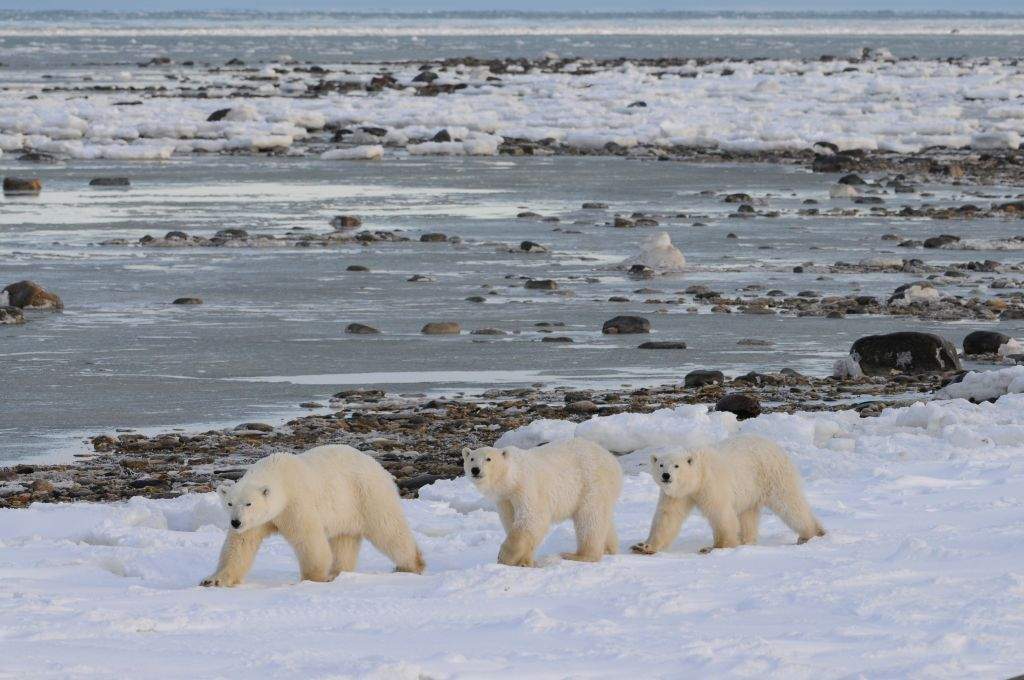
I remember standing near the edge of town one November afternoon, watching a mother bear and two cubs pick their way across the jagged coastal rocks just two hundred yards from a row of houses. The wind was whipping off the bay at thirty knots, stinging my cheeks and watering my eyes. Through binoculars, I could see the mother pause, lifting her black nose into the gale, reading the invisible library of scents blowing out from the town—frying bacon, diesel exhaust, garbage, human sweat. She wasn't looking for a fight. She was calculating odds.
That vulnerability—the realization that you are no longer at the top of the local food chain—changes how a community breathes. You carry a subtle, constant vigilance in your shoulders. It is exhausting, and at times, honestly terrifying. Yet, ask almost anyone who lives along the Manitoba coast if they want the bears gone, and they will look at you like you’ve lost your mind.
The Jail That Saves Lives
When a bear crosses the invisible boundary into town, the Manitoba government’s Polar Bear Alert Program steps in. Established in the late 1960s—back when bears were routinely shot at the town dump to protect residents—the program represents a radical shift in how humans coexist with apex predators.
First comes deterrence. Conservation officers patrol the town borders day and night, using loud horns, paintballs, and non-lethal cracker shells to teach the bears a simple lesson: humans are loud, unpleasant, and bad news.
If a bear refuses to take the hint—if it becomes a "repeat offender" drawn by the irresistible scent of a resident's dog food or a poorly sealed trash bin—officers sedate it with a dart and haul it to a converted military hangar on the edge of town.
Locals call it the Polar Bear Jail.
Officially known as the Polar Bear Holding Facility, this concrete building holds up to twenty-eight bears in individual cells. Inside, the bears are given water, and nothing else. No food. Feeding them would reward the exact behavior officers are trying to extinguish—associating humans with an easy meal. Instead, the bears wait out the final weeks until the bay freezes. Once the sea ice is thick enough to support their weight, the bears are drugged again, slung beneath a helicopter in a heavy-duty cargo net, and flown thirty or forty miles north out onto the frozen tundra, far from town limits.
It sounds harsh, even surreal, watching a sleeping giant dangle beneath a chopper against a bruised purple sky. For years, critics questioned whether trapping and fasting an already hungry animal was humane. The alternative, however, is written in bullet casings. Before the holding facility existed, dozens of "problem" bears were killed every single year in Manitoba. Today, fatal encounters—for both humans and bears—are extraordinarily rare.
The Paradox of the Viewing Buggy
Here is where the story twists into something far more complicated than a simple tale of wildlife rescue.
Every autumn, right as the bears are at their hungriest and most vulnerable, thousands of tourists fly into northern Manitoba. They pay upwards of ten thousand dollars a week to climb aboard Tundra Buggies—massive, bus-like vehicles mounted on six-foot-tall monster-truck tires—and rumble out across the wildlife management area to photograph the bears waiting for the ice.
At first glance, it looks like a contradiction. How can a town struggle with dangerous wildlife conflicts while simultaneously building its entire economy around bringing people face-to-face with those exact animals?
Look closer at the economics of conservation, and the paradox dissolves.
In many parts of the world, large predators survive only as long as local communities find them more valuable alive than dead. Without the global fascination drawing photographers, scientists, and travelers to Manitoba each fall, the political will—and the cold, hard cash—required to fund helicopter relocations, 24-hour patrol teams, and bear-proof waste infrastructure would vanish overnight. Tourism doesn't just bring money into hotels and restaurants; it transforms a terrifying local hazard into a global treasure worth protecting.
More importantly, it creates witnesses.
When someone stands on the open-air back deck of a tundra vehicle, smelling the salt spray of Hudson Bay and watching a scarred, thousand-pound male polar bear casually step over a four-foot boulder, climate change stops being an abstract graph in a scientific journal. You see the ribs showing slightly beneath the heavy winter coat. You see the bear staring out across dark, liquid water where solid ice should already be stretching to the horizon. People go home from Manitoba changed. They become ambassadors for a frozen world they finally understand is fragile.
A Fragile Truce on Thinning Ice
Still, nobody in northern Manitoba is under any illusion that this truce will hold forever on its own.
The Western Hudson Bay polar bear population has dropped by roughly thirty percent since the late 1980s. Scientists estimate that if global emissions continue unchecked, the ice-free season on the bay will eventually stretch past 180 days—a physiological tipping point beyond which even the largest, healthiest adult bears simply cannot store enough fat to survive the summer fast.
Until that day comes—or until the world finds the collective nerve to cool the atmosphere—towns like Churchill remain on the front lines of a great ecological squeeze. Every year, the town adapts a little more. They swap open dumpsters for heavy steel bear-proof bins. They install motion-activated deterrent systems. Neighbors check on neighbors when the fog rolls in off the water.
Back on Kelsey Boulevard, in our hypothetical Tuesday night encounter, Marcus doesn't panic. He remembers his training. He doesn't run—running triggers a predator's chase instinct. Instead, he makes himself look as big as possible, speaks in a low, firm, steady voice, and slowly backs toward the illuminated glass doors of the town complex, never taking his eyes off the white shape in the shadows.
The bear pauses, tests the air one last time, and decides the calories aren't worth the trouble. It turns and pads silently toward the dark shore, where the first thin sheets of slush ice are finally beginning to clink together in the tide.
Marcus slips inside the warm building, his hands shaking just a little as he reaches for his phone to call the alert line. Outside, the wind howls off the bay, carrying the scent of winter, salt, and a future that is still waiting to freeze.