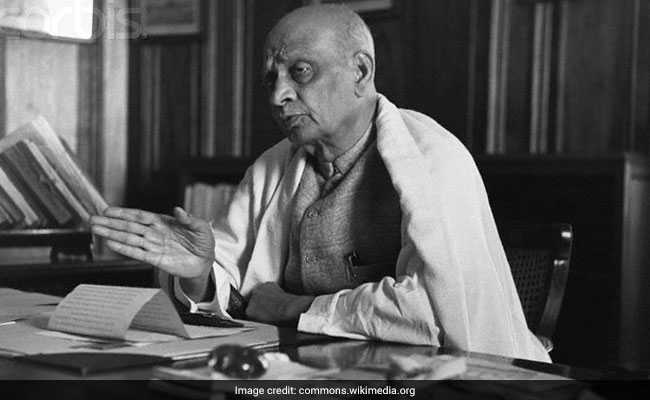
Every October, commentators recycle the exact same script about Vallabhbhai Patel. They paint him as the solitary "Iron Man" who walked into a room of 565 stubborn Maharajas, cracked his knuckles, and single-handedly hammered a fractured subcontinent into a unified republic through sheer willpower.
That story makes for great statue-dedication speeches. It also flattens one of the most complex administrative, constitutional, and political operations in modern history into a comic-book caricature.
The standard opinion piece—like the predictable tributes praising Patel’s "art of holding a nation together"—relies on a lazy consensus. It treats the integration of the princely states as a triumph of solitary strongman intimidation. In doing so, it erases the legal architecture, the bureaucratic machinery, the grassroots revolts, and the calculated compromises that actually kept India from balkanizing in 1947.
If you want to understand how a sprawling, diverse democracy actually stays intact, stop worshipping the myth of the lone strongman. Look at the mechanics of the deal.
The "Iron Fist" Fallacy
The popular narrative loves the image of Patel as a ruthless enforcer who bullied princes into submission. Historians who have actually read the primary archives—scholars like V.P. Menon, Ramachandra Guha, and Srinath Raghavan—tell a far more nuanced story.
Patel did not rule by decree in 1947. He couldn't. The British Parliament’s Indian Independence Act of 1947 had legally lapsed British paramountcy, leaving the 565 princely states technically independent. The newly formed Dominion of India had no automatic legal jurisdiction over Hyderabad, Travancore, Bhopal, or Jodhpur. Sending the army into every reluctant state wasn't just politically disastrous; militarily, the partitioned Indian Army was stretched thin managing the catastrophic violence of Partition in Punjab and Bengal.
Force was the exception, not the rule. Out of 565 states, military intervention occurred in only a tiny fraction—most notably Junagadh and Hyderabad (Operation Polo in September 1948), alongside Kashmir, which involved external invasion from Pakistan.
The remaining 560-plus states were integrated not at the point of a bayonet, but through institutional bribery, legal minimalism, and psychological leverage.
The Real Architect in the Room
You cannot talk about the integration of India without talking about V.P. Menon, the Secretary of the Ministry of States. Yet mainstream opinion pieces routinely reduce Menon to a footnote while crediting Patel with every stroke of genius.
Menon was a career civil servant who understood something politicians often miss: when people are terrified of losing everything, give them a graceful exit ramp.
Patel and Menon realized early on that demanding total surrender from the princes would trigger a coordinated princely federation—a "Third Force" backed by sympathetic British officials like Sir Conrad Corfield of the Political Department. Instead of asking the princes to hand over their sovereignty, Menon and Patel drafted an Instrument of Accession that asked them to surrender only three subjects:
- Defense
- External Affairs
- Communications
On paper, the rulers kept their internal autonomy, their titles, their palaces, and their tax-free privy purses. Patel famously appealed to their patriotism while Menon quietly reminded them of the alternative: if they didn't sign, New Delhi would stop protecting them from the Praja Mandal movements—the democratic, anti-feudal uprisings boiling inside their own borders.
That wasn't brute force. That was classic carrot-and-stick statecraft. The stick wasn't the Indian Army; the stick was popular democracy. Patel simply told the princes that he couldn't hold back their own angry subjects forever.
What Everyone Gets Wrong About "Holding a Nation Together"
When commentators ask, "How did Sardar Patel hold India together?" they are usually asking a loaded question designed to justify modern political centralization. The subtext is obvious: Strong central leaders keep nations united; regional autonomy and messy coalitions tear them apart.
History proves the exact opposite.
Consider what happened once the initial Instruments of Accession were signed before August 15, 1947. Patel and Menon didn't stop at three subjects. Over the next two years, they systematically merged smaller states into larger administrative unions (like Saurashtra, PEPSU, and Madhya Bharat) and eventually brought them under the full jurisdiction of the Indian Constitution.
Why did that second phase succeed without sparking a civil war? Because the Constituent Assembly—where Patel chaired the Advisory Committee on Fundamental Rights, Minorities, and Tribal and Excluded Areas—built a federal safety valve into the system.
Let’s look at the actual record of how India avoided collapse in its first decade:
- Privy Purses and Guarantees: Patel fiercely defended the constitutional guarantees of privy purses for the princes in the Constituent Assembly, arguing that a young nation must honor its word even to former autocrats. (Indira Gandhi later abolished them in 1971 via the 26th Amendment).
- Linguistic Reality vs. Administrative Stubbornness: Patel was initially skeptical of reorganizing states along linguistic lines, fearing it would ignite sub-nationalism. He sat on the JVP Committee (Jawaharlal Nehru, Vallabhbhai Patel, Pattabhi Sitaramayya) in 1948, which poured cold water on linguistic states. Yet history showed that suppressing linguistic identity nearly broke the country in the 1950s. It was the eventual acceptance of linguistic federalism—not rigid centralism—that neutralized separatist pressures in southern and western India.
- The Steel Frame of the Bureaucracy: While many Congress leaders wanted to dismantle the colonial Indian Civil Service (ICS) as a symbol of British oppression, Patel fought tooth and nail to preserve it as the Indian Administrative Service (IAS). In October 1949, addressing the Constituent Assembly, Patel warned his colleagues bluntly: "If you do not adopt this course, then do not follow the present Constitution. Substitute something else... You will not have a united India if you have not a good all-India service which has the independence to speak out its mind."
Notice what Patel actually prioritized. He didn't demand ideological conformity or absolute executive power. He demanded an independent, rule-bound bureaucracy that could tell politicians "no."
The Myth of the Patel-Nehru Civil War
Another favorite trope in shallow political commentary is pitting Patel against Jawaharlal Nehru as irreconcilable enemies—the pragmatic nationalist versus the naive idealist.
They disagreed fiercely on economic policy, social reform, and tactics in Kashmir and Hyderabad. In early 1948, their friction grew so sharp that both men contemplated resigning, until Mahatma Gandhi’s assassination on January 30, 1948, forced them to close ranks.
But treating their partnership as a zero-sum cage match misses how their contrasting strengths actually stabilized the state.
Nehru provided the ideological legitimacy that kept millions of minorities, marginalized castes, and regional populations invested in the idea of India. Patel provided the organizational discipline and administrative muscle that kept the Congress party and the civil services from splintering. As political scientist Rajni Kothari later documented in his analysis of the "Congress System," early Indian stability depended on this internal balance between ideological breadth and organizational control.
Without Patel’s institutional rigor, Nehru’s vision risked drifting into administrative chaos. Without Nehru’s inclusive democratic legitimacy, Patel’s administrative consolidation risked looking like authoritarian imposition—the exact mistake that tore Pakistan apart in 1971 when West Pakistan tried to impose linguistic and administrative uniformity on East Bengal.
The Real Lesson for Modern Statecraft
We have watched modern states and large institutions blow billions trying to manufacture unity through top-down enforcement, centralized mandates, and aggressive messaging. It fails every single time because compliance is not cohesion.
Patel understood the difference between the two, even if his modern admirers don't.
When he dealt with the integration of the states, he didn't demand humiliation from his adversaries. He gave them status, financial security, and a stake in the new order, while quietly stripping away their capacity to fracture the union. When he dealt with the civil services, he insulated them from political interference so the state could function impartially across thousands of miles of linguistic and cultural fault lines.
There is an obvious downside to Patel’s approach, and honest analysts admit it: institutional compromise leaves unfinished business. Preserving feudal privileges through privy purses and relying heavily on a colonial bureaucratic structure delayed deep grassroots social and land reforms across former princely territories for decades. States like Rajasthan, Madhya Pradesh, and Odisha carried the structural baggage of those compromises well into the late twentieth century.
You don't get clean breaks in real nation-building. You get messy trade-offs.
Stop Reading Statues, Start Reading the Blueprint
The next time you read an opinion piece celebrating Sardar Patel’s "art of holding a nation together," pay attention to what the writer leaves out.
If they talk about his iron will, ask them about V.P. Menon’s legal drafts. If they praise his decisiveness, ask them about his speech defending an independent, fearless civil service against political meddling. If they invoke his name to argue for unchecked central authority, remind them that he preserved a nation of 565 distinct political entities by negotiating terms, respecting local sensitivities, and building institutional guardrails—not by bulldozing every dissenting voice.
Nations aren't held together by strongmen. They are held together by institutions that outlive the men who build them.