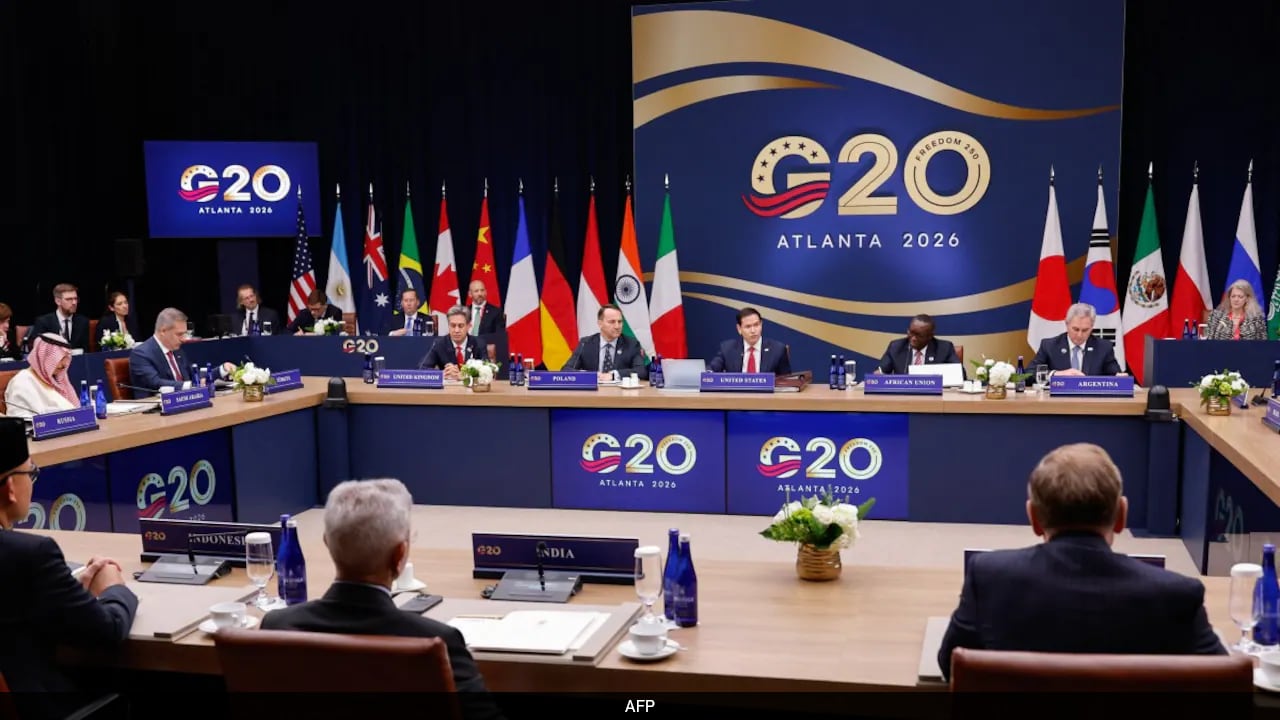
The United States quietly canceled the traditional G20 "family photo" during the Miami finance ministers' gathering after European delegates refused to stand on the same riser as Russian Foreign Minister Sergey Lavrov. While Washington cited vague "scheduling conflicts" to explain the omission, the reality inside the summit halls was far simpler. European diplomats threatened a boycott of the ceremonial event rather than hand Moscow a visual propaganda victory while Russian forces continue their war in Ukraine.
It looks like a petty squabble over staging. It is not.
In international diplomacy, choreography is policy. Every handshake, seating arrangement, and camera angle is negotiated months in advance by protocol officers who understand that a single photograph carries more weight with domestic audiences than a fifty-page communiqué. For the Kremlin, standing shoulder-to-shoulder with the leaders of the world’s largest economies signals normalcy. It tells Russian citizens and non-aligned nations in the Global South that Western isolation efforts have failed and that Moscow remains an indispensable power broker.
European officials recognized that trap immediately. Having spent years enforcing sweeping sanctions, freezing Russian central bank assets, and sending billions in military aid to Kyiv, participating in a smiling group portrait with Lavrov would have created an immediate political crisis back home in Berlin, Paris, and Warsaw. The Americans, acting as hosts, faced an impossible choice between enforcing a photo op that half the room would skip or killing the tradition entirely to preserve a veneer of institutional unity. They chose the latter.
The Weaponization of Summit Choreography
To understand why a thirty-second photo session nearly derailed a major economic summit, you have to look at how multilateral diplomacy has degraded since February 2022. Historically, the Group of Twenty was designed as a technocratic forum. Created in the late 1990s and elevated to a leaders' summit during the 2008 financial crisis, its core mandate was macroeconomic stability. Ideological rivalries were supposed to be checked at the door so finance ministers and central bankers could coordinate interest rates, debt relief, and currency interventions.
That firewall is gone. The Ukraine invasion turned every multilateral gathering into an active theater of information warfare.
When Russia sends Lavrov to these meetings, his primary objective is rarely to negotiate technical language on sovereign debt restructuring or global tax minimums. His objective is presence. By simply occupying the chair reserved for the Russian Federation, he forces Western democracies into a binary dilemma. They can either boycott the meeting—thereby ceding the floor to Moscow and Beijing to shape the narrative for developing nations—or they can attend and risk legitimizing a government accused of war crimes.
The family photo is the sharpest edge of that wedge. Unlike closed-door plenary sessions where delegates can visibly turn their backs or walk out during a Russian intervention, the group portrait requires static, collective participation. Protocol dictates alphabetical or seniority-based placement, meaning a European finance minister could easily find themselves standing directly beside Lavrov. One awkward glance captured by a wire service photographer becomes the defining image of the entire summit, completely overshadowing months of painstaking policy work on inflation or climate finance.
Washington's Delicate Balancing Act
The decision by the U.S. Treasury and State Department to scrap the photo reveals the quiet friction between Washington and its European allies over how to manage the G20. While both sides remain aligned on supporting Ukraine, their strategic priorities within multilateral institutions often diverge.
For the United States, keeping the G20 functional is a critical hedge against Chinese influence. Beijing has spent the last decade building parallel institutions—expanding the BRICS bloc, pumping capital into the Asian Infrastructure Investment Bank, and positioning itself as the true champion of the Global South. If the G20 collapses into irrelevance because Western nations refuse to sit in the same room as Russia, Washington loses its primary venue for engaging major emerging economies like India, Brazil, Indonesia, and South Africa.
Those middle powers have zero interest in turning the G20 into a NATO-style security forum. Officials in New Delhi and Brasília routinely express frustration that European fixations on Ukraine crowd out urgent discussions on sovereign debt distress, supply chain resilience, and development lending. From their perspective, Russia is a major commodities exporter and a permanent member of the UN Security Council; pretending it does not exist is neither practical nor helpful.
By canceling the photo rather than publicly shaming Moscow or forcing a showdown, American organizers tried to thread the needle. They protected European politicians from toxic domestic headlines without triggering a walkout by non-Western members who resent the politicization of economic summits.
The Precedent of Bali and New Delhi
This is not the first time protocol officers have scrambled to engineer around Lavrov's presence. During the 2022 G20 summit in Bali, Indonesian hosts quietly dropped the family photo after Western leaders made it clear they would not participate alongside the Russian delegation. A year later in New Delhi, Indian diplomats managed to salvage the photo op only because Lavrov stood in the back row while President Joe Biden and European leaders were positioned far across the stage, carefully insulated by neutral heads of state.
The Miami cancellation confirms that the Bali exception has hardened into an unwritten rule. Whenever the United States or a European nation holds the G20 presidency, the traditional visual markers of global consensus will be sacrificed to prevent Moscow from harvesting legitimacy. Conversely, when the gavel passes to countries in the Global South, the cameras will keep rolling, and Western leaders will be forced to swallow the optics or stay home.
What Happens When the Cameras Turn Off
Stripping away the ceremonial fluff of international summits might seem like an improvement to taxpayers tired of watching politicians pose at luxury resorts. Yet the disappearance of the family photo is a symptom of a much deeper institutional paralysis.
When nations cannot even agree to stand on the same stage for sixty seconds, their ability to reach binding agreements behind closed doors is severely compromised. For the past several cycles, G20 hosts have struggled to issue joint communiqués—the formal consensus documents that outline shared economic commitments. Instead, summits increasingly end with a "Chair’s Summary," a diplomatic euphemism meaning the participants failed to agree on the text, leaving the host nation to publish its own unilateral recap of the proceedings.
Without consensus communiqués, the G20 loses its teeth. Markets pay attention when the world’s twenty largest economies issue a unified pledge to stabilize currencies or coordinate fiscal stimulus. They ignore a fractured gathering where half the room is negotiating tariffs while the other half is arguing over photo placement.
The Cost of Symbolic Diplomacy
European delegates left Miami satisfied that they had denied Lavrov his photo op. In the short term, their stance makes complete political sense. Voters in democracies expect moral clarity from their leaders, and standing beside the chief diplomat of an invading army is impossible to defend on an evening news broadcast.
Still, there is a strategic cost to treating every diplomatic interaction as a zero-sum moral test. Diplomacy is not a reward granted to virtuous nations; it is a mechanism for managing conflict between adversaries. During the height of the Cold War, American and Soviet officials routinely posed together at arms control signings and international conferences, even as their proxies fought bloody wars across Asia, Africa, and Latin America. Those photographs did not imply approval. They acknowledged reality.
Today, modern media ecosystems leave no room for that kind of nuance. Every image is instantly stripped of context, weaponized by state propaganda networks, and amplified across social platforms within seconds. Protocol officers know this, which is why they chose an empty stage over a compromised frame. The G20 will continue to meet, ministers will continue to read prepared statements into microphones, and bureaucrats will continue to draft technical annexes that few people read, all while pretending the empty space on the riser doesn't exist.