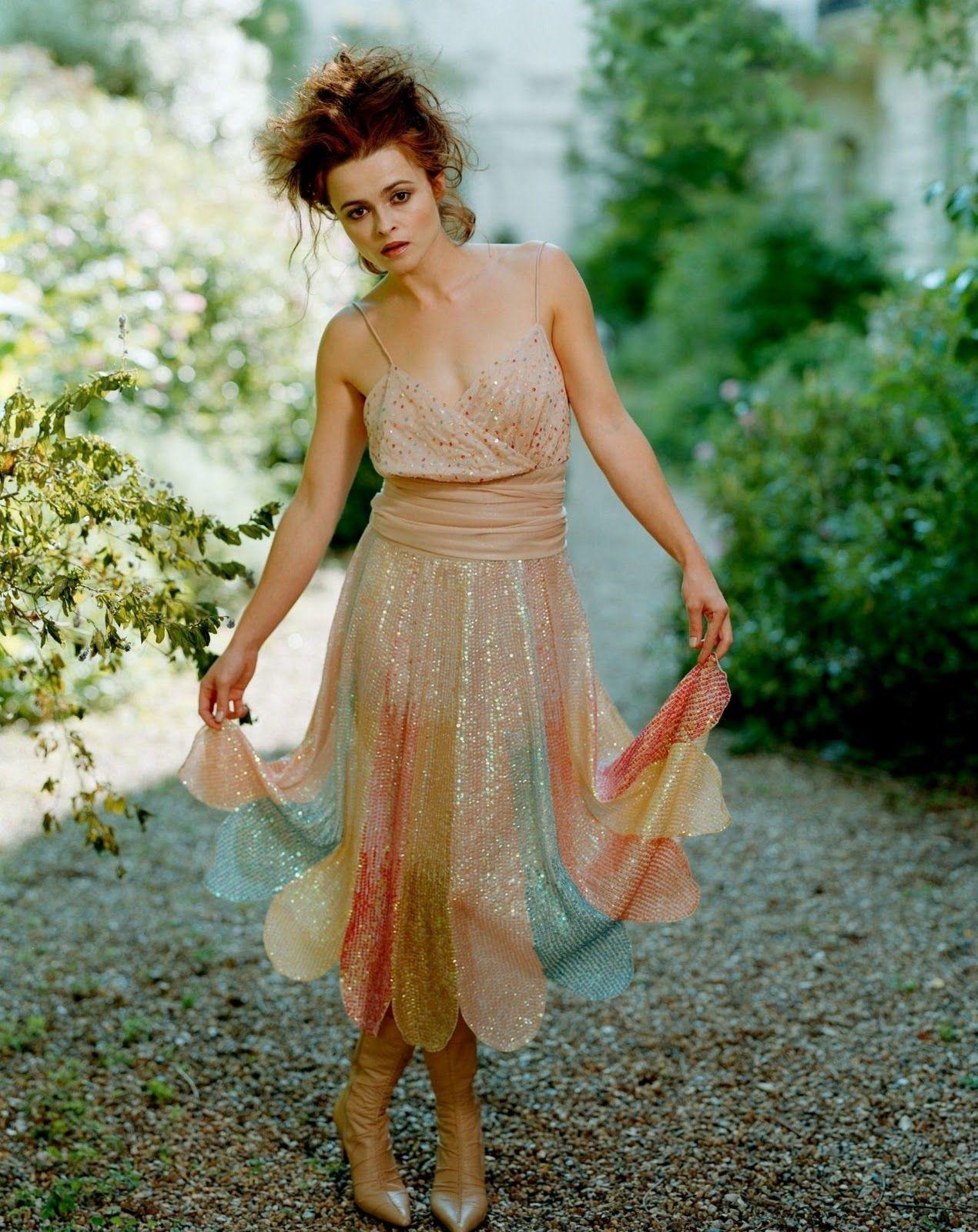
Before she was a chaotic, wand-waving witch or a pie-shop owner with a dark secret, young Helena Bonham Carter was the poster child for a very specific type of British cinematic elegance. Most people today see her through the lens of Tim Burton’s gothic whimsy or the gritty realism of Fight Club. But if you rewind the clock to the mid-1980s, she wasn't "weird" at all—she was the "Corset Queen."
It’s easy to look back and think she was always destined for the fringes. Honestly, though? Her early career was built on a foundation of lace, parasols, and high-society stifling. She basically owned the Edwardian period drama.
The Rejection That Changed Everything
You’ve probably heard that most stars drop out of school to act, but Helena’s story is a bit more ironic. She actually wanted to go to university. She applied to King’s College, Cambridge. She had the grades. She had the pedigree.
They rejected her.
The officials weren’t worried about her intellect; they were worried about her talent. They were literally afraid she would leave mid-term to pursue an acting career, so they just didn't let her in. It’s the ultimate "task failed successfully" moment. Instead of hitting the books, she hit the set of A Room with a View (1985).
Breaking the "English Rose" Mold
Playing Lucy Honeychurch at 19 made her a global sensation. It also trapped her. For years, she was typecast as the "bloated chipmunk"—her words, not mine—stuck in a perpetual loop of 19th-century repressed longing.
- Lady Jane (1986): Her debut lead. She played the tragic "Nine Days' Queen" with an intensity that felt way beyond her years.
- A Room with a View: The Merchant Ivory classic that cemented her status as the quintessential English Rose.
- Howards End (1992): Another E.M. Forster adaptation where she proved her dramatic chops alongside legends like Anthony Hopkins.
She hated the label. Being called "virginal" or "fragile" didn't sit right with a woman who, in real life, was already arm-wrestling and swearing like a sailor behind closed doors. She once famously said, "Period movies are my destiny." It sounded like a resigned sigh rather than a boast.
A Family History Unlike Any Other
Her "posh" vibe wasn't just acting. Helena comes from a staggering political lineage. Her great-grandfather was H.H. Asquith, the Prime Minister of the UK during WWI. Her grandmother was Lady Violet Bonham Carter, a formidable politician and close friend of Winston Churchill.
But it wasn't all silver spoons.
When Helena was five, her mother had a severe nervous breakdown. It took three years to recover. Then, when Helena was 13, her father, Raymond, suffered a stroke during surgery for a brain tumor. He was left partially paralyzed and in a wheelchair.
While her brothers were away at college, she stayed home to help her mother. She didn't have a typical teen experience. She used the money she won from a national writing contest to pay for her entry into the Spotlight directory. She was 13 and already hustling. That’s grit, not just privilege.
The Style Evolution: From Corsets to Chaos
In the late '80s and early '90s, you could see the "dark" Helena starting to peek through. Even while she was wearing period-accurate silks for the cameras, her personal style was shifting. She was obsessed with the theatricality of clothes.
She often felt "vulnerable," so she used corsets as a kind of emotional armor. It’s kind of wild to think that the very thing that typecast her was also the thing that made her feel safe. She’s always been honest about her "inferiority complexes." She felt like an outsider because she didn't have formal training.
What to Watch to See the "Young Helena" Magic
If you only know her as Bellatrix, you’re missing out on the nuance of her early work. These aren't just stuffy dramas; they are masterclasses in subtle acting.
- A Pattern of Roses (1983): Her first real role. It’s a ghost story where she plays a character named Netty. You can already see that "haunted" look in her eyes.
- Miami Vice (1987): Yes, really. She played Don Johnson’s love interest, Theresa, for a two-episode arc. It’s the most "non-Helena" thing she ever did.
- The Wings of the Dove (1997): This was the turning point. She played Kate Croy, a woman who was definitely not an innocent rose. It earned her an Oscar nomination and finally started to crack the corset-queen image.
Actionable Steps for Fans
If you want to dive deeper into the history of young Helena Bonham Carter, start by looking at her work with director Trevor Nunn or the Merchant Ivory productions. Compare the quiet, repressed energy of A Room with a View to the raw, messy desperation of Fight Club (1999).
The bridge between those two worlds is The Wings of the Dove. Watch that film to see exactly how she used her "period drama" reputation to subvert everyone's expectations. It’s a lesson in how to pivot a career without losing your identity. Check out some of her early interviews on YouTube as well; her wit was just as sharp at 20 as it is today.