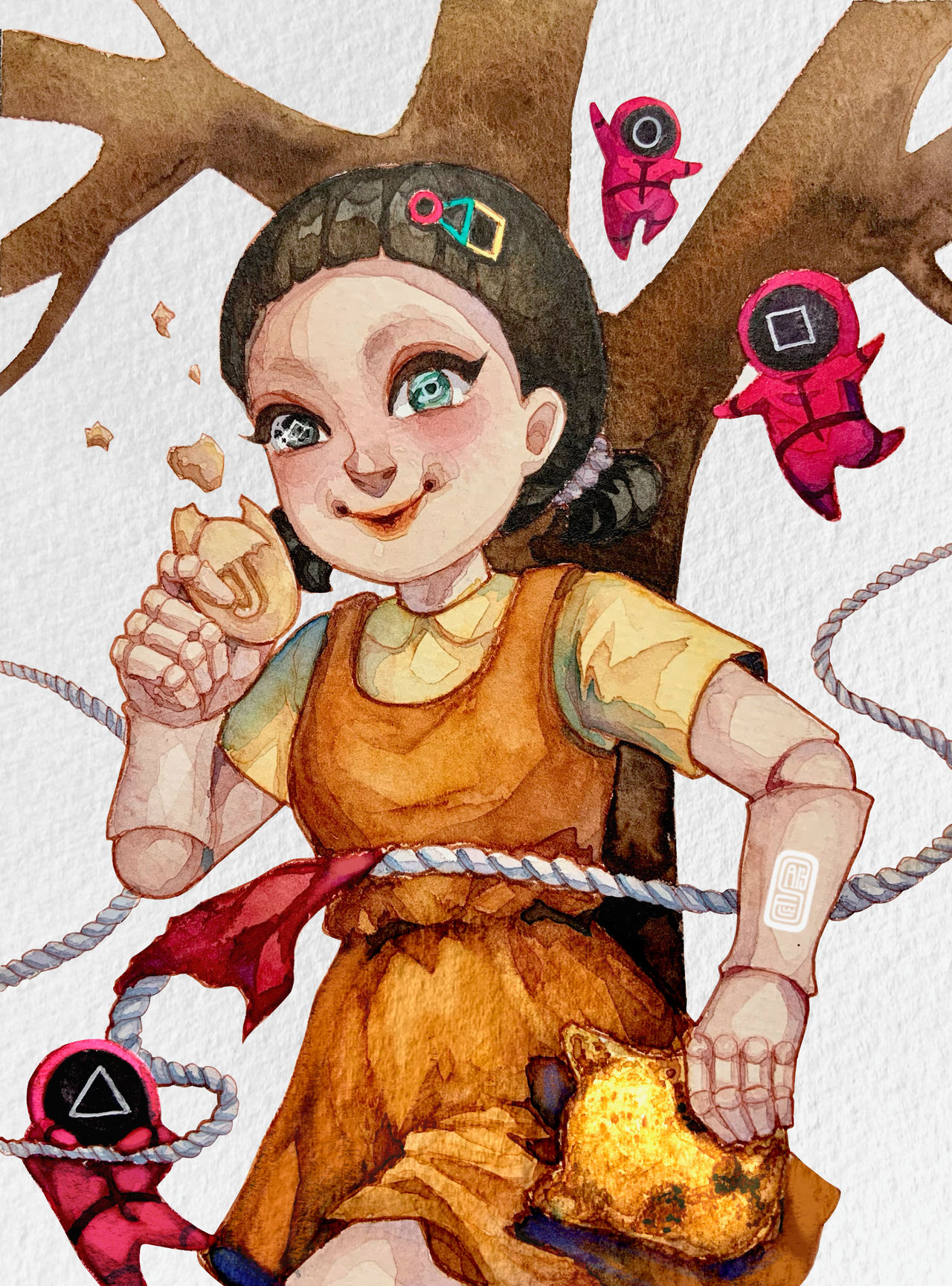
She is ten feet tall. She has a blunt bob. She wears a bright orange jumper over a yellow shirt that looks like something a schoolgirl would wear to a picnic in the 1970s. But if you see those mechanical eyes swivel in your direction, you are already dead. We are talking about Young-hee, the doll in Squid Game that turned a simple playground game into a global nightmare.
Honestly, nobody expected a fiberglass statue from a rural museum to become the face of modern horror. When Squid Game dropped on Netflix back in 2021, the world was hooked instantly. It wasn't just the gore. It was the contrast. You have this giant, innocent-looking doll chirping "Mugunghwa kkochi pieot seumnida" while snipers erase people from existence. It’s jarring. It’s weird. It’s exactly why we can’t stop thinking about her.
The doll isn't just a prop. She’s a cultural icon rooted in South Korean history. Most people outside of Korea just see a creepy robot, but for locals, she’s a childhood memory twisted into something unrecognizable. That’s where the real terror lives—in the perversion of innocence.
Where the Doll in Squid Game Actually Came From
You might think some set designer dreamed her up during a fever dream. Not quite. Young-hee is actually based on a character from Korean textbooks used in the 1970s and 80s. Think of her as the Korean version of "Sally" or "Jane" from Dick and Jane. She usually appeared alongside a boy named Cheol-su. They were the quintessential childhood figures.
The production team for Squid Game found a real-life version of this doll at a carriage museum called Macha Land in Jincheon County, about three hours south of Seoul. After filming wrapped, they actually returned her. For a while, tourists could go visit the doll in Squid Game in the flesh—or fiberglass—but she was eventually moved into storage because the sheer volume of visitors was overwhelming.
It’s interesting how the showrunners took something meant to represent education and safety and made it the arbiter of life and death. Director Hwang Dong-hyuk has mentioned in several interviews that he wanted to use games that were familiar to create a sense of "ironic violence." He succeeded. Now, you can’t look at a yellow-and-orange outfit without feeling a little bit of anxiety.
The Tech Behind the Terror
She isn't just a static statue. In the show, the doll in Squid Game is a high-tech motion-sensing machine. Her head rotates 180 degrees with a mechanical whir that sounds like a bone-grinder. Her eyes are essentially cameras linked to a sniper system.
In reality, the crew used a mix of a physical animatronic and CGI to make her movements feel just "off" enough to be uncanny. That stuttering, mechanical turn of her head? That’s intentional. Humans don't move like that. It triggers a lizard-brain response in the viewer. We know something is wrong before the first shot is even fired.
The Song You Can't Get Out of Your Head
If you’ve watched the show, you’ve probably hummed the tune. "Mugunghwa kkochi pieot seumnida."
It translates literally to "The hibiscus has bloomed." The Hibiscus syriacus is the national flower of South Korea. In the game "Red Light, Green Light" (or "The Hibiscus Has Bloomed" in Korea), the person who is "it" chants this phrase at varying speeds. The moment they finish the sentence, they turn around.
The doll in Squid Game uses a specific, digitized voice for this chant. It’s high-pitched and cheery. That’s the kicker. The contrast between the playful sing-song voice and the heavy thud of bodies hitting the dirt is what makes Episode 1 so traumatizing. It sets the tone for the entire series. It tells the audience: The rules of the playground no longer apply here.
Why the Doll Struck a Chord Globally
We've seen killer dolls before. Chucky. Annabelle. Talky Tina from The Twilight Zone. So why did this one hit differently?
Maybe it’s the scale. She’s massive. She looms over the players like a god. You can’t hide from her. You can’t fight her. You just have to hope you can hold your breath long enough. There’s also the psychological element of "gamification." We live in a world where everything is tracked, scored, and monitored. The doll in Squid Game is the ultimate personification of that surveillance. She’s the "eye in the sky" that judges your every move. If you slip, you’re deleted.
What Most People Get Wrong About the Doll
People often think the doll was built specifically for the show as a brand-new invention. As we covered, she’s a vintage callback. But there’s a deeper layer to the "Red Light, Green Light" game that many Western viewers missed.
In the Korean version of the game, the "it" person isn't just looking for movement. They are looking for life. The doll represents the cold, unfeeling nature of the system the players are trapped in. She doesn't have a grudge against Seong Gi-hun or anyone else. She’s just executing code. That’s way scarier than a villain with a motive. You can’t reason with a machine that only knows two states: "Still" or "Dead."
Also, did you notice her hair? It’s tied in perfectly neat pigtails with purple ribbons. It’s a detail that screams "order." The entire Squid Game is built on the illusion of fairness and order. The doll is the primary enforcer of that "fairness." If you move, you die. No exceptions. No "but I tripped." It’s a brutal meritocracy.
The Cultural Legacy of Young-hee
Since 2021, the doll in Squid Game has appeared everywhere. She was a giant installation in Sydney’s harbor. She’s been a Halloween costume for millions. She even made a cameo in various reality TV spin-offs.
But the real impact is in how she changed the "horror doll" trope. She isn't hiding in a closet or under a bed. She stands out in the bright sunlight. She doesn't need shadows to be scary. That’s a bold move for a director. Usually, horror relies on the unknown. Here, the threat is 10 feet tall and painted in primary colors.
Season 2 and the Return of the Doll
With Squid Game returning for a second season, fans are already speculating. We’ve seen teasers featuring a male counterpart—Cheol-su. Remember him? Young-hee’s "boyfriend" from the old textbooks.
If Young-hee was terrifying, imagine a pair of them. The stakes have to go up. The games have to get more complex. But the doll in Squid Game will always be the original. She’s the one who introduced us to the pink soldiers and the golden piggy bank.
Actionable Insights for the Squid Game Fan
If you're fascinated by the lore or planning a watch-party, here are a few things to keep in mind about the show's design language:
- Look at the colors: The doll’s orange and yellow palette is meant to clash with the green tracksuits of the players and the pink/magenta suits of the guards. This creates a visual "trinity" that makes every frame feel like a twisted comic book.
- Study the "Uncanny Valley": The doll works because she looks almost human but is clearly not. This "uncanny valley" effect is a powerful tool in horror. If you're a creator, notice how the stiff neck movements and glass eyes do more work than a thousand jump-scares.
- Understand the satire: The doll isn't just a monster. She’s a critique of how society monitors and "eliminates" those who can't keep up with the rules of the game.
Whether you see her as a piece of nostalgic art or a symbol of systemic cruelty, there is no denying that the doll in Squid Game is one of the most effective character designs in television history. She’s a reminder that sometimes, the things that look the most harmless are the ones you should fear the most.
If you want to understand the full impact, go back and watch Episode 1 again. Watch the doll's eyes. They don't just "look"—they scan. They process. They judge. And in the world of the Squid Game, judgment is final.
To really dive into the world of K-drama set design, look up the work of Chae Kyoung-sun, the production designer for the series. She’s the genius who decided to take a small museum piece and turn it into a global icon of dread. Understanding the intent behind the art makes the experience of watching the show even more intense. Stay still. Don't blink. The hibiscus is blooming.