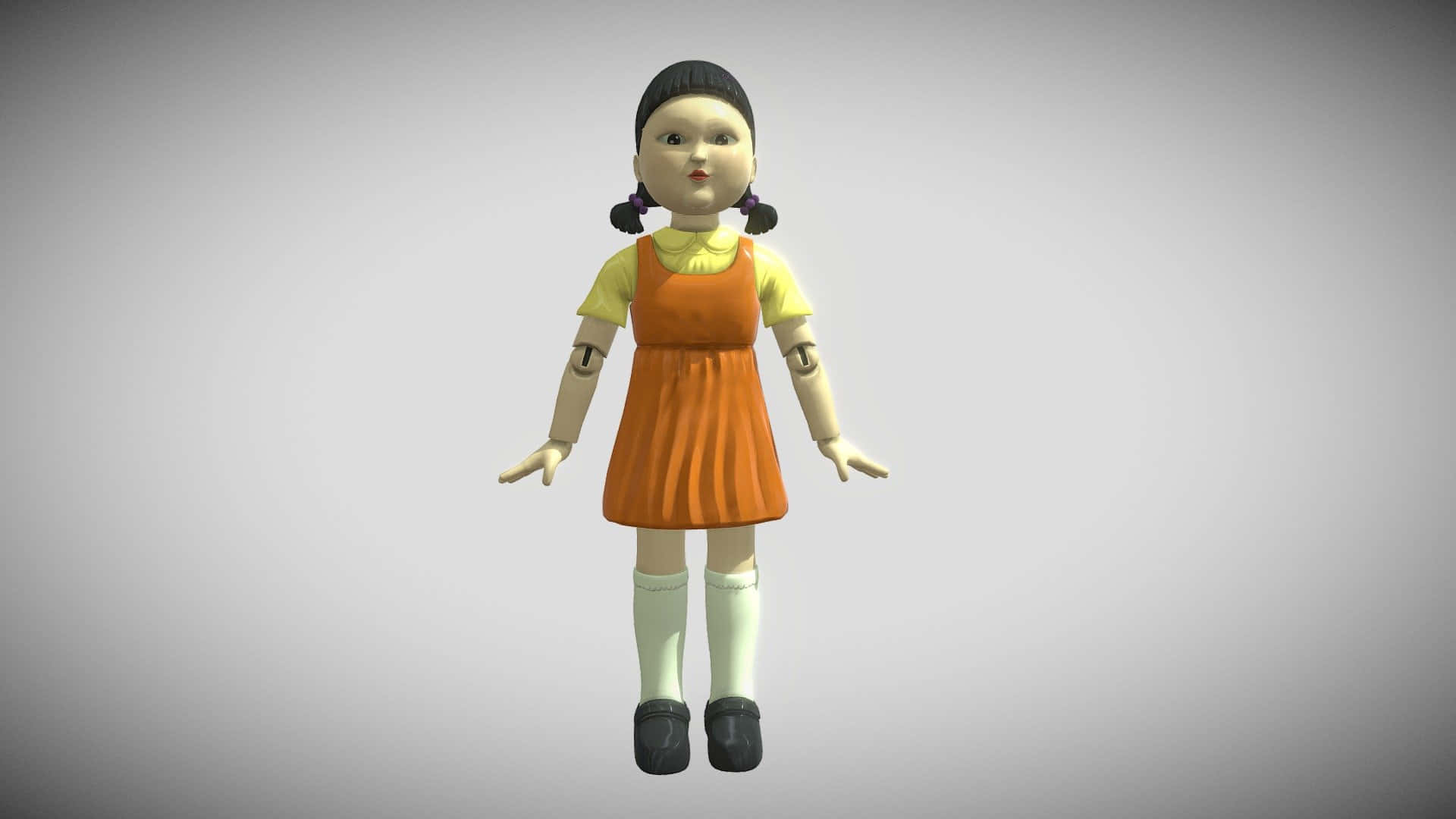
She’s tall. She’s terrifying. And honestly, she’s probably the first thing you think of when someone mentions Squid Game. That giant, mechanical schoolgirl with the rotating head and the motion-sensing eyes has become a global icon of horror. But if you’re searching for the Squid Game doll name, you won't find it in some high-concept sci-fi manual. It’s actually rooted in decades of South Korean childhood nostalgia.
Her name is Young-hee.
It’s a simple name. Iconic, even. For many Koreans, it carries the same weight that "Jane" or "Sally" might have in Western textbooks from the mid-20th century. Seeing her on screen isn't just about the gore of the "Red Light, Green Light" game; it’s about the perversion of something innocent.
Where the Squid Game Doll Name Actually Comes From
If you grew up in South Korea during the 70s or 80s, you knew Young-hee before she ever had a Gatling gun hidden in her neck. She was the female lead in a series of elementary school textbooks. Along with her male counterpart, Cheol-su, she was the face of Korean education. They were the "every-children." You’d see them on the cover of your "Cheerful Life" or "National Language" books, usually playing together or doing chores.
Director Hwang Dong-hyuk didn't just pick a random name out of a hat. He chose it specifically because it represents the purest form of childhood. By taking the Squid Game doll name from these textbooks, the show forces the audience to confront a twisted version of their own youth. It’s a classic horror trope: take something safe and make it lethal.
The Cheol-su Connection
You can’t really talk about Young-hee without mentioning Cheol-su. In the show’s lore—and in the actual physical production of the props—Young-hee is part of a duo. While the giant doll we see in the first episode is the female version, the male version (Cheol-su) makes a brief appearance in the series' promotional materials and is even hinted at in the teaser for Season 2.
Think of them as the Korean version of Dick and Jane. Or maybe Jack and Jill, minus the hill and the bucket of water. In the context of the show, these names serve as a psychological anchor. They remind the players (and the viewers) that these "games" are supposed to be for kids. But the stakes are, well, slightly higher than a gold star on your homework.
The Real-World Statue: Where Young-hee Lives Now
Did you know the doll is real? Kinda.
The production team didn't just build a CGI model. They constructed a massive, physical statue for the filming of the "Red Light, Green Light" sequence. After filming wrapped on the first season, the doll was moved to a museum. Specifically, it was stored at the Macha Land horse carriage museum in Jincheon County, about three hours outside of Seoul.
For a while, fans could actually go visit her. It was a weirdly popular pilgrimage site for Netflix devotees. However, things got a bit messy. The museum eventually had to cover her up. Why? Apparently, there was a bit of a communication breakdown regarding how long she was supposed to be on public display. She was eventually moved into storage, though she briefly resurfaced for promotional events in cities like Sydney and Los Angeles, where smaller replicas terrified commuters in public parks.
Why "Mugunghwa Kkochi Pieotseumnida" Matters
You’ve heard the chant. It’s haunting. It’s rhythmic. And it’s the only reason Young-hee starts and stops her scanning.
In the English dub, she says "Red Light, Green Light, One, Two, Three." But in the original Korean, she says: Mugunghwa kkochi pieotseumnida.
This translates literally to: "The Hibiscus syriacus has blossomed."
The Mugunghwa is the national flower of South Korea. It’s a symbol of persistence and resilience. There’s a deep irony here. The doll, named after a beloved textbook character, recites a phrase about the national flower, all while presiding over a massacre of her own citizens. It’s a layer of social commentary that often gets lost in translation. The Squid Game doll name is the starting point, but the cultural weight goes much deeper than just a name tag.
Behind the Design: The 1970s Aesthetic
The look of Young-hee is very specific. That yellow shirt and orange jumper? Pure 70s. The pigtails tied with red ribbons? Again, textbook accurate. Jung Ho-yeon (who played Sae-byeok) mentioned in interviews that seeing the doll on set was genuinely unsettling because it felt so "correct" yet so out of place in that barren, sandy arena.
Art director Chae Kyoung-sun spent a lot of time getting the proportions just right. She wanted the doll to look like a toy but feel like an authority figure. It’s about 10 feet tall. That height is crucial. It forces the players to look up at her, mimicking the perspective of a small child looking up at a teacher or a parent.
The Global Impact of the Name
Since the show exploded in late 2021, "Young-hee" has become a household name globally. But it’s also sparked some interesting legal and copyright conversations. Because the character is based on a public-domain textbook figure, the "ownership" of the name is a bit of a gray area. Of course, Netflix owns the specific design of the robot version, but the name itself belongs to Korean history.
We’ve seen her everywhere since.
- Halloween costumes (the orange and yellow combo is now a staple).
- Mobile game rip-offs.
- High-fashion parodies.
- Even safety videos in some airports.
It’s rare for a non-English name to permeate global pop culture so quickly. Usually, names get westernized. But "Young-hee" stuck. People wanted to know the "real" name. They didn't want "The Squid Game Girl." They wanted the specific cultural identifier.
Misconceptions and Internet Rumors
Because the internet loves a good conspiracy, there were plenty of rumors about where the doll came from. Some claimed she was an ancient ghost from a haunted village. Others said she was based on a real-life killer from the 1950s.
None of that is true.
She is purely a creation of the show's art department, inspired by the illustrations of Cheol-su and Young-hee. Any "haunted" backstory you read on Reddit is likely fan fiction or a clever marketing ploy that took on a life of its own. The reality—that she represents the loss of childhood innocence in a hyper-capitalist society—is actually much scarier than a generic ghost story.
What to Expect from Young-hee in Season 2
We know she’s coming back. Netflix has already teased her "boyfriend" or "brother," Cheol-su.
The return of the Squid Game doll name to the headlines isn't just a nostalgia trip. Director Hwang has hinted that the games in the second season will be even more psychological. If Young-hee was the introductory shock, Cheol-su might be the evolution of that terror. We might see more of their "textbook" relationship play out in a lethal format.
Imagine a game where the two dolls interact. One calls "Red Light," the other calls "Green Light." The potential for chaos is massive. It moves the show away from a simple "survival" mechanic into something more coordinated and cruel.
Actionable Insights for Fans and Creators
If you’re looking to dive deeper into the world of Young-hee or even use her likeness for content, here are a few things to keep in mind:
- Cultural Context is King: If you're writing about her or referencing her, don't just call her "the doll." Using the name Young-hee shows a level of respect for the Korean source material that sets your content apart.
- The "Cheol-su and Young-hee" Search: To see what she actually looked like before the blood and sensors, search for "vintage Korean textbooks 1970s." The contrast between the original drawings and the Netflix version is a great study in character design.
- Visit Safely: While the original Macha Land doll is currently tucked away, there are permanent "Squid Game" installations in various Netflix-themed experiences globally. Always check recent travel vlogs or official Netflix announcements before traveling specifically to see a prop, as they move frequently.
- Watch for the National Flower: In Season 2, pay attention to the lyrics and chants. If the game changes, the flowers or the textbook references likely will too. Understanding the "Mugunghwa" chant gives you a massive head start on predicting the "rules" of the next set of challenges.
The Squid Game doll name is more than a trivia answer. It’s a bridge between a specific Korean upbringing and a global audience. Whether she’s standing in a field or tucked away in a museum warehouse, Young-hee remains the definitive face of modern survival horror.
Keep an eye on the pigtails. When they turn, you better stop moving.