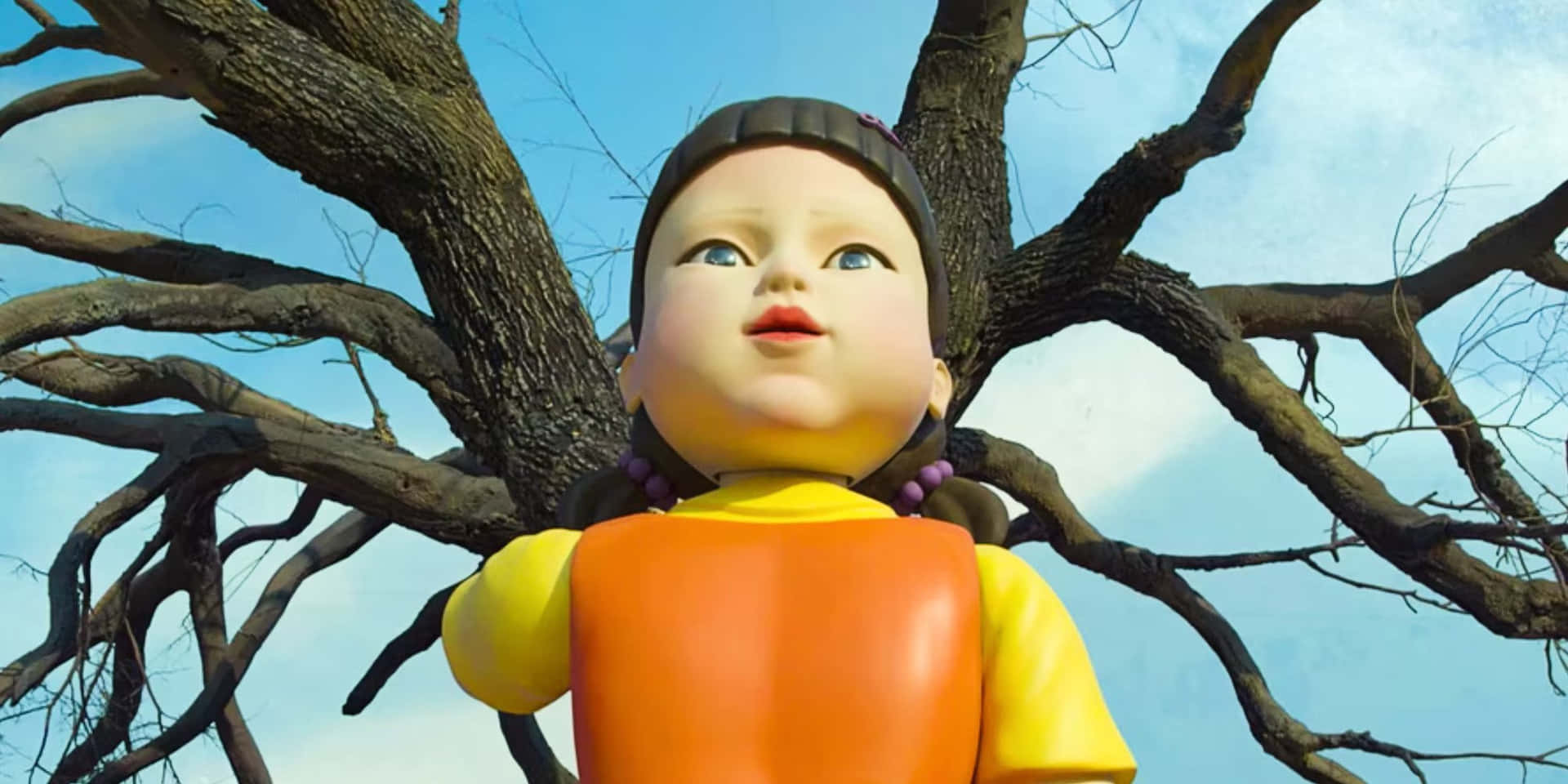
That giant, pigtail-wearing robot is burned into everyone's brain. You know the one. She stands at the end of a field, head swiveling 180 degrees with those mechanical, clicking eyes. If you move, you're dead. It’s a simple premise that turned a playground game into a global nightmare. But the Squid Game doll, officially known as Young-hee, wasn't just some random prop dreamed up in a writer's room to look scary. She’s actually rooted in South Korean childhood nostalgia, which makes the whole "Red Light, Green Light" massacre feel way more twisted than your standard slasher flick.
The contrast is what gets you.
Netflix didn't just stumble onto a hit; they tapped into a specific kind of cultural trauma by taking a symbol of innocence and wiring it for mass execution. When we talk about the Squid Game doll, we aren't just talking about a piece of plastic and electronics. We’re talking about a character that has appeared in Korean textbooks for decades.
Where did the Squid Game doll actually come from?
Most people outside of Korea assume she's just a "creepy doll" trope. Wrong. Director Hwang Dong-hyuk specifically modeled her after Young-hee, a character from South Korean textbooks used in the 1970s and 80s. Imagine if a giant, murderous version of Sally from "Dick and Jane" suddenly appeared in a dystopian thriller. That’s the level of cognitive dissonance Korean viewers felt.
She usually had a male counterpart named Cheol-su. They were the "everyman" children of the era. Putting her in the middle of a bloodbath was a deliberate choice to show how the "rules" we learn as kids are weaponized against us as adults in a hyper-competitive society.
Interestingly, the physical doll used in the show wasn't just a digital effect. It was real.
The production team actually built a massive, functional statue. After filming wrapped, she was moved to a horse carriage museum called Macha Land in Jincheon County, about three hours from Seoul. For a while, fans could actually visit her, though reports later surfaced that she was tucked away in storage or missing a hand. It’s kinda poetic, honestly. A forgotten relic of a TV show sitting in a quiet museum, waiting for someone to flinch.
Why that song is stuck in your head (and what it means)
You’ve heard it. Mugunghwa kkochi pieotseumnida. The rhythm is hypnotic. But if you look at the translation, it doesn't actually mean "red light, green light." It translates to "The Hibiscus flower has bloomed." The Hibiscus syriacus is the national flower of South Korea. So, while the Squid Game doll is chanting this, she’s invoking a deeply patriotic and sentimental image.
The game is played by the doll chanting the phrase at varying speeds. The faster she says it, the less time you have to freeze. It’s a psychological grind. In the show, the motion sensors in her eyes are linked to high-powered sniper rifles. In reality, the "eyes" were high-end cameras used to capture the actors' movements with terrifying precision.
The technical side of the terror
Constructing the Squid Game doll required a mix of traditional sculpture and modern robotics. The team wanted her to look "off." Not quite human, but not quite a toy. Her proportions are slightly bulky, her skin tone is a bit too sallow, and her expression is completely blank.
- She stands over 10 feet tall.
- Her head rotation was achieved using a heavy-duty servo motor.
- The orange and yellow outfit is a direct replica of the classic textbook illustrations.
It's the eyes that do the heavy lifting. They don't just look; they scan.
The global explosion of the Young-hee brand
After the show dropped in 2021, the Squid Game doll became a marketing juggernaut. We saw 10-foot replicas appearing in shopping malls in the Philippines. There was a pop-up in Sydney, Australia. People were terrified, but they also wanted a selfie. It’s a weird phenomenon where we take something that symbolizes the brutal culling of the poor and turn it into a TikTok trend.
But why did this specific character resonate more than the masked guards or the Front Man?
Basically, she represents the "System." The doll doesn't have a motive. She isn't "evil" in the way a villain is. She’s a machine following a program. If you break the rule, you are "eliminated." There’s no nuance. No mercy. In a world where people feel like cogs in a corporate machine, the Squid Game doll is the ultimate HR department from hell.
Common misconceptions about the doll
Let's clear some stuff up because the internet loves to make things up for clicks.
First off, there is no "haunted" history. Some creepypasta stories claim the doll was found in a haunted village. Total nonsense. She was commissioned specifically for the show.
Secondly, many people think the voice is a digital synth. It’s actually a processed recording of a child’s voice meant to sound tinny and broadcasted. That "hollow" sound is what makes your skin crawl.
Also, regarding the Season 2 rumors: Yes, Young-hee has a "boyfriend." Director Hwang has confirmed that we will be introduced to Cheol-su in the upcoming episodes. If Young-hee was bad, imagine what a duo will be like. The stakes have to escalate, and bringing in the male counterpart from those same textbooks is the logical, albeit horrifying, next step.
The cultural impact on gaming and VR
The Squid Game doll basically birthed a whole sub-genre of indie games. Within weeks of the premiere, Roblox was flooded with "Red Light, Green Light" clones. These weren't licensed, obviously, but they pulled in millions of players.
It changed how developers think about "tension" in simple mechanics. You take a game everyone knows, add a lethal consequence, and put a giant, unmoving observer at the center. It’s the ultimate "high stakes" simulation. Even high-end VR experiences have tried to replicate the feeling of being stared down by those oversized pupils.
How the doll changed costume culture
Before 2021, if you saw a girl in an orange jumper with pigtails, you’d think "cute." Now? You run.
The Squid Game doll costume became the most searched Halloween outfit for two years straight. It’s easy to DIY, but the impact is immediate. It’s recognizable from across a crowded room. It proves that iconic character design doesn't need to be complex; it just needs to be distinct. The yellow shirt, the orange dress, the white knee-high socks. It’s a uniform of doom.
What's next for the Young-hee legacy?
As we move toward the release of new content, the Squid Game doll is evolving from a single-scene threat into a symbol of the entire franchise. She is the face of the brand, even more than the circle, triangle, and square masks.
There's talk of more permanent installations and even high-end collectibles. Companies like Funko and various high-end statue makers have already cashed in. But the real "value" of the doll is how she makes us feel about our own childhoods. She forces us to look at the games we played—Tag, Hide and Seek, Red Rover—and realize how much they were actually about survival and social hierarchy.
If you’re looking to dive deeper into the lore or even recreate the "experience" (minus the snipers), here is how you can actually engage with the Squid Game doll phenomenon responsibly:
- Visit the Macha Land Museum: If you’re ever in South Korea, check if the original prop is back on display. It’s a pilgrimage for hardcore fans.
- Study the Original Textbooks: Look up "Cheol-su and Young-hee" to see the 1970s artwork. Seeing the "innocent" version makes the show's version much more impactful.
- Analyze the Cinematography: Watch the "Red Light, Green Light" scene again, but mute the sound. Notice how the camera uses wide shots to make the players look like ants compared to the doll. It’s a masterclass in scale.
- Look for Season 2 Teasers: Keep an eye out for Cheol-su. The introduction of a new mechanical "killer" will likely change the mechanics of the game, perhaps requiring cooperation between players rather than just individual survival.
The Squid Game doll isn't going anywhere. She’s become a permanent fixture in the horror hall of fame, right next to Chucky and Annabelle, but with a much more socialistic, haunting bite. She reminds us that the rules are always watching, and the moment you stop moving toward your goal—or move at the wrong time—the game is over.