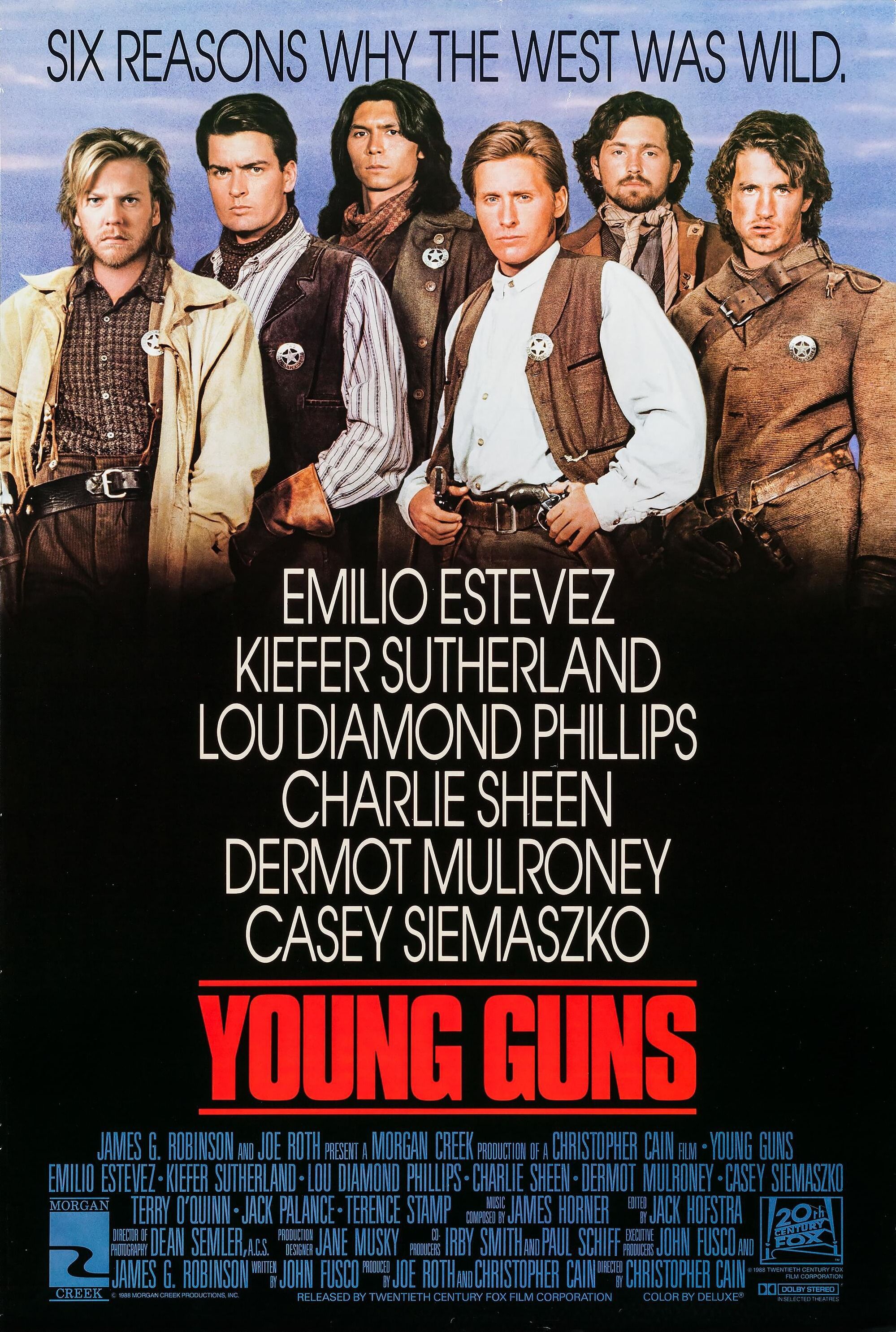
Let’s be honest. Most Western sequels are trash. They usually just rehash the same dusty tropes until the spurs fall off, but Young Guns 2 somehow dodged that bullet. Released in 1990, it didn’t just try to be a louder version of the first flick. It actually tried to say something about how legends are manufactured, and it did it while Jon Bon Jovi was screaming about being a cowboy on a steel horse in the background. It’s a wild, messy, and surprisingly cynical look at the end of the frontier.
People remember the first one for the "Brat Pack" novelty. You had Emilio Estevez, Charlie Sheen, and Kiefer Sutherland all looking pretty in the dirt. But the sequel? That’s where the grit actually showed up. It picks up the pieces of the Lincoln County War and drags us into the messy reality of Billy the Kid’s final days—or, if you believe the Brushy Bill Roberts theory, his transition into a ghost.
The Brushy Bill Frame: Fact vs. Folklore in Young Guns 2
The coolest thing about this movie is the framing device. Instead of a straight chronological narrative, we get an aged, unrecognizable Emilio Estevez as "Brushy Bill" Roberts in 1950. He’s talking to a lawyer, claiming he’s the real William H. Bonney. This isn't just a Hollywood invention; it’s based on the real-life claims of a man from Hico, Texas, who spent his final years trying to get the pardon Governor Lew Wallace promised him seventy years prior.
Most historians, like the late Robert M. Utley, have pretty much debunked Brushy Bill. DNA evidence and historical timelines don't really favor the old man’s story. But for a movie? It’s genius. It allows Young Guns 2 to play with the idea of the "Unreliable Narrator." We aren't just watching a Western; we're watching a man’s memory, which is naturally going to be a bit more poetic and violent than the truth.
The plot basically follows the "Regulators" as they flee toward Mexico. Pat Garrett, played with a simmering, tired intensity by William Petersen, isn't a villain in the mustache-twirling sense. He's a guy who realized the wind was changing. The era of the outlaw was dying, and he wanted to be on the side that owned the land, not the side buried under it.
Why the Cast Worked Despite the Hype
Look at this lineup. You’ve got Christian Slater joining the crew as "Arkansas" Dave Rudabaugh. Slater was at his peak "Jack Nicholson-lite" phase here, bringing a manic energy that made the group feel genuinely dangerous. He wasn't a hero. He was a psychopath. Then you have Alan Ruck—fresh off Ferris Bueller’s Day Off—playing Hendry William French. It’s a weird mix that shouldn't work, but it does.
Emilio Estevez doesn't get enough credit for his portrayal of Billy. He plays him with this high-pitched, cackling laugh that feels way more authentic to the historical accounts of Bonney being a charismatic but deeply disturbed kid. He wasn't a stoic gunslinger. He was a teenager with a gun and a chip on his shoulder.
The Bon Jovi Factor and the Sound of 1990
You can’t talk about Young Guns 2 without mentioning "Blaze of Glory."
Story goes, Emilio Estevez wanted to use "Wanted Dead or Alive" for the film. Jon Bon Jovi didn't think the lyrics fit, so he sat down and wrote a whole new album. It became the definitive sound of the movie. It’s rare for a soundtrack to become more famous than the film itself, but for a while, that was the case here. The music gave the movie a rock-star aesthetic that appealed to a generation that didn't necessarily care about John Ford Westerns. It bridged the gap between the 1880s and the MTV era.
Interestingly, Bon Jovi actually has a cameo. He gets shot in the pit scene. Blink and you’ll miss it, but it’s there. That kind of meta-fun defined the production.
The Harsh Reality of the Lincoln County Aftermath
While the movie takes massive liberties with the timeline—condensing years into weeks—it captures the desperation of the era perfectly. The "White Oaks" incident and the eventual betrayal by Pat Garrett are handled with a surprising amount of weight.
In the film, the Regulators are hunted by a posse that includes former friends. This highlights the central theme: the West wasn't won; it was sold. Garrett’s transformation from Billy’s friend to his executioner is the emotional core. Petersen plays Garrett as a man who is disgusted by what he has to do, but he’s more afraid of being irrelevant.
- The Pit Scene: One of the most claustrophobic moments in Western cinema.
- The Escape: Pure Hollywood action, but choreographed with a sense of frantic chaos.
- The Ending: A somber reflection on legacy.
The real Billy the Kid was likely killed in Fort Sumner in 1881. But the movie lets you hope he wasn't. It feeds into that American obsession with the guy who gets away, the one who beats the system.
Why We Still Watch It
Westerns usually come in two flavors: the "Golden Age" where the good guys wear white hats, and the "Revisionist" Westerns like Unforgiven. Young Guns 2 sits in this weird middle ground. It’s got the flashy pyrotechnics of a 90s action movie, but the soul of a tragedy. It understands that Billy wasn't a revolutionary; he was a byproduct of a corrupt system in New Mexico Territory.
The cinematography by James Muro is also surprisingly gorgeous. The New Mexico landscapes look vast and unforgiving. It’s not the postcard version of the West. It looks cold. It looks dusty. You can almost feel the grit in your teeth.
Honestly, the film holds up better than the first one because it’s less concerned with being "cool" and more concerned with being an ending. Every character is essentially mourning their own life before it’s even over. Chavez y Chavez (Lou Diamond Phillips) is looking for a spiritual exit, Doc Scurlock (Kiefer Sutherland) is trying to find a reason to keep breathing, and Billy is just trying to stay famous enough to live forever.
Next Steps for the Western Fanatic
If you want to separate the Hollywood magic from the actual history, your first stop should be the Lincoln State Historic Site in New Mexico. It’s one of the most preserved frontier towns in America. You can actually stand in the spot where Billy made his famous escape from the courthouse.
For those more interested in the "Brushy Bill" mystery, head to Hico, Texas. They have a dedicated Billy the Kid Museum there that presents the evidence for Roberts being the real deal. It’s polarizing stuff for historians, but it’s a fascinating look at how we cling to legends.
Finally, go back and watch the film, but ignore the explosions for a second. Listen to the dialogue between Billy and Pat. It’s a masterclass in how two people can love each other and still realize that one of them has to die for the world to move forward. That’s the real "Blaze of Glory."