You think you know the story. A kid from the Netherlands moves to Pasadena, picks up a guitar, and invents tapping. Simple, right? Honestly, the real story of young Eddie Van Halen is way weirder and a lot more desperate than the "guitar god" myth suggests. It wasn't about fame at first. It was about survival in a house where English was a second language and music was the only currency that mattered.
He wasn't even supposed to be a guitar player.
Imagine being six years old, sitting on a boat for nine days, headed to a country where you don't speak a lick of the language. That was Eddie in 1962. His dad, Jan Van Halen, was a jazz clarinetist who moved the family with basically fifty bucks and a piano. That piano became the center of Eddie’s universe. He and his brother Alex were classically trained for years. But here’s the kicker: Eddie couldn't read a single note of music. He won local piano competitions three years in a row at Long Beach City College just by watching his teacher’s hands and memorizing the sounds. He was a world-class "faker" before he was ten.
The Great Instrument Swap
By the time they hit junior high, the brothers were done with Mozart. They wanted to be the Dave Clark Five. Eddie saved up money from a paper route—throwing newspapers from his bike every morning—to buy a drum kit. Alex, meanwhile, was messing around with a guitar.
But while Eddie was out delivering papers, Alex would sneak onto the drums. One day, Eddie came home and heard Alex playing the drum solo from "Wipe Out" perfectly. He basically told Alex, "Fine, take the drums. I’ll play your guitar." It’s one of the most famous sibling pivots in history. If Alex hadn't been a "thief," we might never have had the solo to "Eruption."
Young Eddie Van Halen and the "Brown Sound" Myth
People talk about the "Brown Sound" like it's a secret recipe or a magical pedal. It’s actually a term Eddie used to describe a feeling. He wanted his guitar to sound like his brother's snare drum—warm, organic, and "majestic." To get it, he didn't just buy a Marshall amp and turn it up. He practically performed surgery on his gear.
He used something called a Variac, which is a variable transformer. In early interviews, because David Lee Roth told him to mess with people, Eddie claimed he used the Variac to increase the voltage to 140 volts to make the amp scream.
He was lying.
In reality, he was lowering the voltage to about 90 volts. This starved the amp of power, making the tubes saturate at a lower volume and creating that "brown," chewy texture. Years later, he felt bad because kids were blowing up their expensive Marshalls trying to follow his fake advice.
Building the Frankenstein
Eddie couldn't afford a high-end Gibson or Fender that did everything he wanted. He liked the tremolo bar on a Fender but hated the "thin" sound of the single-coil pickups. He loved the beefy sound of a Gibson humbucker but hated the clunky bodies. So, he went to Charvel’s shop and bought a "second" body—basically a piece of wood with a flaw—for $50 and a neck for $80.
He literally hacked a hole in the wood with a chisel to fit a Gibson PAF pickup from a 1961 ES-335. He dipped the pickup in paraffin wax to stop it from squealing. He used a single volume knob labeled "Tone" just to be funny. It was a junk-heap guitar held together by sweat and electrical tape. But that guitar redefined what a rock instrument could be.
The Backyard Era and the Sunset Strip
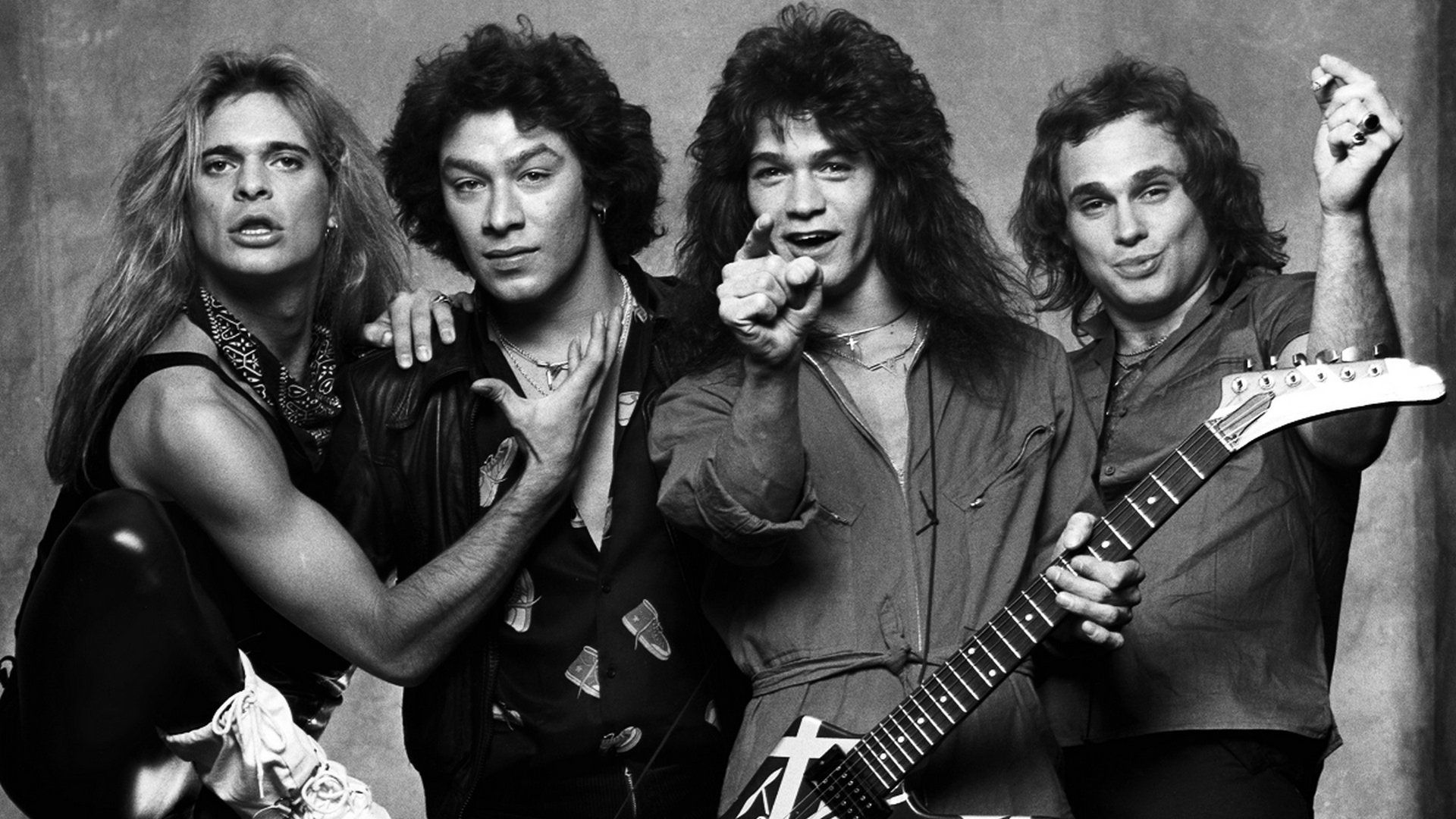
Before the record deals, young Eddie Van Halen was the king of the Pasadena backyard party circuit. These weren't polite gatherings. We’re talking thousands of kids, kegs of beer, and the police eventually showing up to shut them down. The band was called Mammoth back then. They’d charge a couple of bucks for "all you can drink" and just play covers for hours.
When they finally graduated to the Sunset Strip, they weren't immediate hits. Gazzarri’s, the legendary club, rejected them three times. When they finally got a gig in 1974, they played to four people. And according to Alex, they had to pay for those four friends to get in.
Eddie was only 18. He was wearing platform shoes to look like a rock star and almost breaking his ankles on stage. They played three sets a night, mostly covers of ZZ Top, Aerosmith, and James Brown. That’s where Eddie’s rhythm playing got so tight. You can't play "You Really Got Me" for three years in a dive bar without learning how to lock in with a drummer.
Why the Early Years Still Matter
What most people miss about this era is the sheer amount of work. Eddie used to lock himself in his room for hours, practicing until his fingers bled, literally. He’d walk around the house with the guitar strapped on while he brushed his teeth. He wasn't just a natural; he was obsessed.
He also had to deal with a lot of "imitation anxiety." Before the first album came out, Alex told him to play with his back to the audience so people wouldn't steal his tapping technique. Eddie was terrified that some other kid would see what he was doing and record it first.
How to Apply the "Eddie" Mindset Today
If you’re a musician or a creator looking to capture that early Van Halen energy, don't look for the "right" gear. Eddie’s whole thing was that the gear was broken and he fixed it to suit himself.
- Don't follow the manual. If a piece of tech isn't doing what you want, "break" it. Eddie’s best sounds came from using equipment in ways it wasn't intended for.
- Focus on the "Brown Sound" of your own craft. Find the one specific texture or feeling that makes your work unique, even if you have to coin a weird term for it.
- Embrace the backyard party. Before you worry about the "Sunset Strip" (the big stage), make sure you can command a room full of people who are only there for the beer.
- Learn by ear. Even if you don't know the theory, trust your instincts. Eddie won piano trophies without reading music because he understood the soul of the sound better than the people reading the page.
Eddie's early life wasn't a straight line to success. It was a series of accidents—a stolen drum kit, a lie about an amp, and a guitar made of scrap parts. But it proves that you don't need the best equipment to change the world. You just need to be the person who won't stop playing until the sun comes up.
For more on how Eddie's gear evolved throughout the 80s, you can check out the deep-dive archives at the Van Halen News Desk or read Steve Rosen’s book Tonechaser for the most accurate account of his technical experiments.