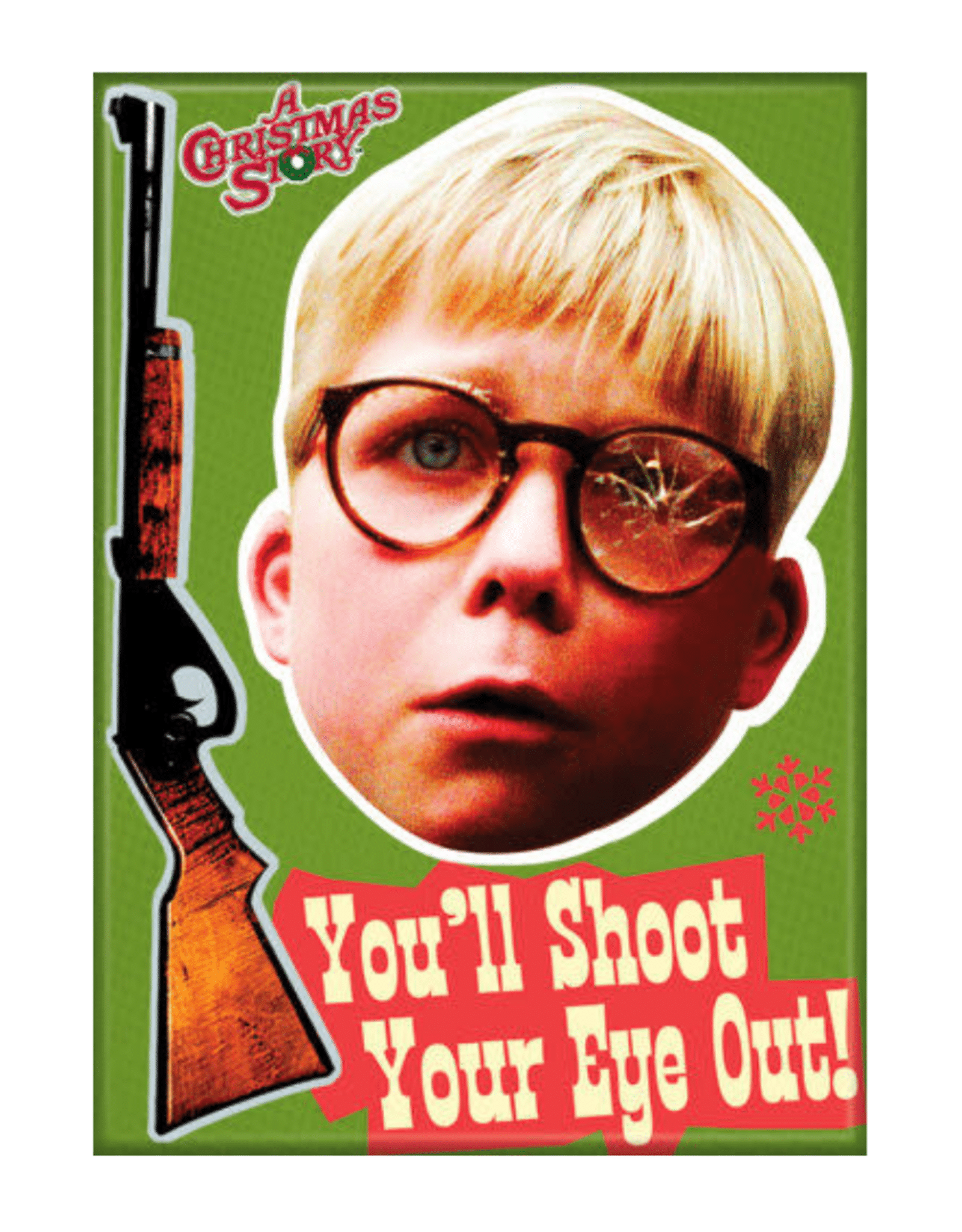
"You'll shoot your eye out, kid."
It’s the ultimate parental shutdown. Mention A Christmas Story to anyone born after 1970, and those six words immediately trigger a mental image of a crestfallen Ralphie Parker standing in front of a department store Santa. We’ve all been there. You want something so badly—something slightly dangerous, maybe a bit irresponsible—and the adults in your life treat it like a death warrant.
But here’s the thing. You'll shoot your eye out isn't just a funny movie line anymore. It has become a permanent fixture in the American lexicon, a shorthand for the eternal struggle between childhood ambition and adult pragmatism. Most people think the line was just a gag for the 1983 film, but the history of Ralphie’s Red Ryder BB gun goes much deeper than a simple Warner Bros. script. It’s actually rooted in the semi-autographical writings of Jean Shepherd, a master storyteller who understood exactly how it felt to be a kid in a world run by "The Old Man" and a mother who lived in constant fear of ocular trauma.
The Reality Behind the Red Ryder
Jean Shepherd didn't just pull the Daisy Red Ryder out of thin air. In his book In God We Trust: All Others Pay Cash, he details the agonizing wait for that 200-shot range model air rifle. It was real. The gun was real. The fear was real.
The 1930s and 40s were a different time for toy safety. Honestly, kids were basically playing with miniature ballistics. When Ralphie's mother, his teacher Miss Shields, and even the "Ho Ho Ho" Santa at Higbee’s department store all parrot the phrase you'll shoot your eye out, they aren't just being killjoys. They are reflecting a very specific cultural anxiety of the post-Depression era. During that time, air rifles were a rite of passage for American boys, but they were also a nightmare for suburban moms who didn't want to spend their Christmas in an emergency room.
Daisy Outdoor Products actually saw a massive resurgence in interest because of the movie. They've been making BB guns since the late 1800s. Interestingly, the specific model Ralphie wanted—with the "compass in the stock and this thing which tells time"—didn't actually exist in that exact configuration until the movie made it necessary. Life imitated art because art was busy imitating a very specific, nostalgic memory of childhood desire.
Why the Warning Failed (and Why We Love It)
We love Ralphie because he’s a schemer. He’s us.
When he hears you'll shoot your eye out, he doesn't give up. He pivots. He tries the "theme" approach in class. He tries the subtle hint. He tries the direct appeal to his father’s sense of masculinity. This is the core of the human experience: wanting something that the "authorities" tell us is bad for us.
There is a psychological phenomenon at play here called "reactance." When someone tells you that you can't have something because it’s dangerous, it often makes that object infinitely more desirable. By the time Ralphie finally gets his hands on that gun under the tree, the stakes have been raised so high by the repeated warnings that the eventual "accident" feels like a cosmic inevitability.
And let’s be real. He did almost shoot his eye out.
The ricochet happens. The glasses break. The lie about the "icicle" follows. It’s a perfect narrative arc because it proves the adults right while simultaneously proving that the experience was worth the risk. It’s about the loss of innocence and the realization that sometimes, your parents actually know what they’re talking about—even if they’re being annoying about it.
The Cultural Legacy of a Four-Word Threat
Go to any gift shop in December. You’ll see it on t-shirts, mugs, and even ornaments. The phrase has transcended the film. It’s used in sports when a player takes a risky shot. It’s used in finance when someone makes a speculative bet.
It works because it’s a universal "I told you so" in waiting.
Director Bob Clark, who also curiously directed the slasher flick Black Christmas, knew exactly how to pace the delivery of that line. Each time it's uttered, the tone shifts slightly. From the mother’s reflexive dismissal to the Santa’s booming, terrifying condemnation, the phrase builds a wall around Ralphie’s dream.
What’s fascinating is that the real-life Jean Shepherd, who narrated the film, actually lived this. He grew up in Hammond, Indiana (the inspiration for the fictional Hohman). He understood that midwestern grit where a BB gun wasn't just a toy—it was a symbol of being a "man."
Modern Safety and the "Eye Out" Mythos
Do kids still shoot their eyes out?
Statistically, eye injuries from non-powder guns (like BB and pellet guns) are still a thing. According to a study published in Pediatrics, there were roughly 13,000 emergency room visits per year related to these types of toys in the U.S. over a recent 20-year span. So, the moms of the 1940s weren't just being dramatic.
However, the way we perceive risk has changed. In the 21st century, the phrase you'll shoot your eye out is often used ironically because we live in a world of "bubble wrap" parenting. We look back at the 1940s setting of the movie and marvel that Ralphie was allowed to go out into the woods alone with a weapon at nine years old.
The humor has aged well because the conflict is timeless. It’s the friction between "I want to explore the world and take risks" and "I want to keep you safe and whole."
Actionable Takeaways for the Modern Nostalgic
If you're revisiting A Christmas Story or considering buying a Red Ryder for a kid in your life, keep these points in mind:
- Respect the Ricochet: The movie gets the physics right. BBs are made of steel and they bounce off hard surfaces. Always use a soft backstop.
- The Power of Narrative: Ralphie didn't just want a gun; he wanted the story of being a hero. When you're trying to convince someone of something, remember that facts (like safety stats) usually lose to a good story (like protecting the homestead from Black Bart).
- Identify the "No": When you're told you'll shoot your eye out in a professional or personal setting, identify if it's a genuine safety concern or just a "scripted" response from someone who is afraid of change.
- Safety Gear is Non-Negotiable: If Ralphie had been wearing modern ballistic eyewear, the icicle lie wouldn't have been necessary.
The legacy of the phrase remains strong because it captures the moment we realize our parents are human, our heroes (Santa) can be jerks, and our dreams often come with a side of broken glasses. It’s a messy, hilarious, and slightly painful part of growing up.
Next time you hear someone drop that line, don't just laugh. Remember the desperate, wide-eyed kid in the bunny suit. We've all been one icicle away from a total disaster.