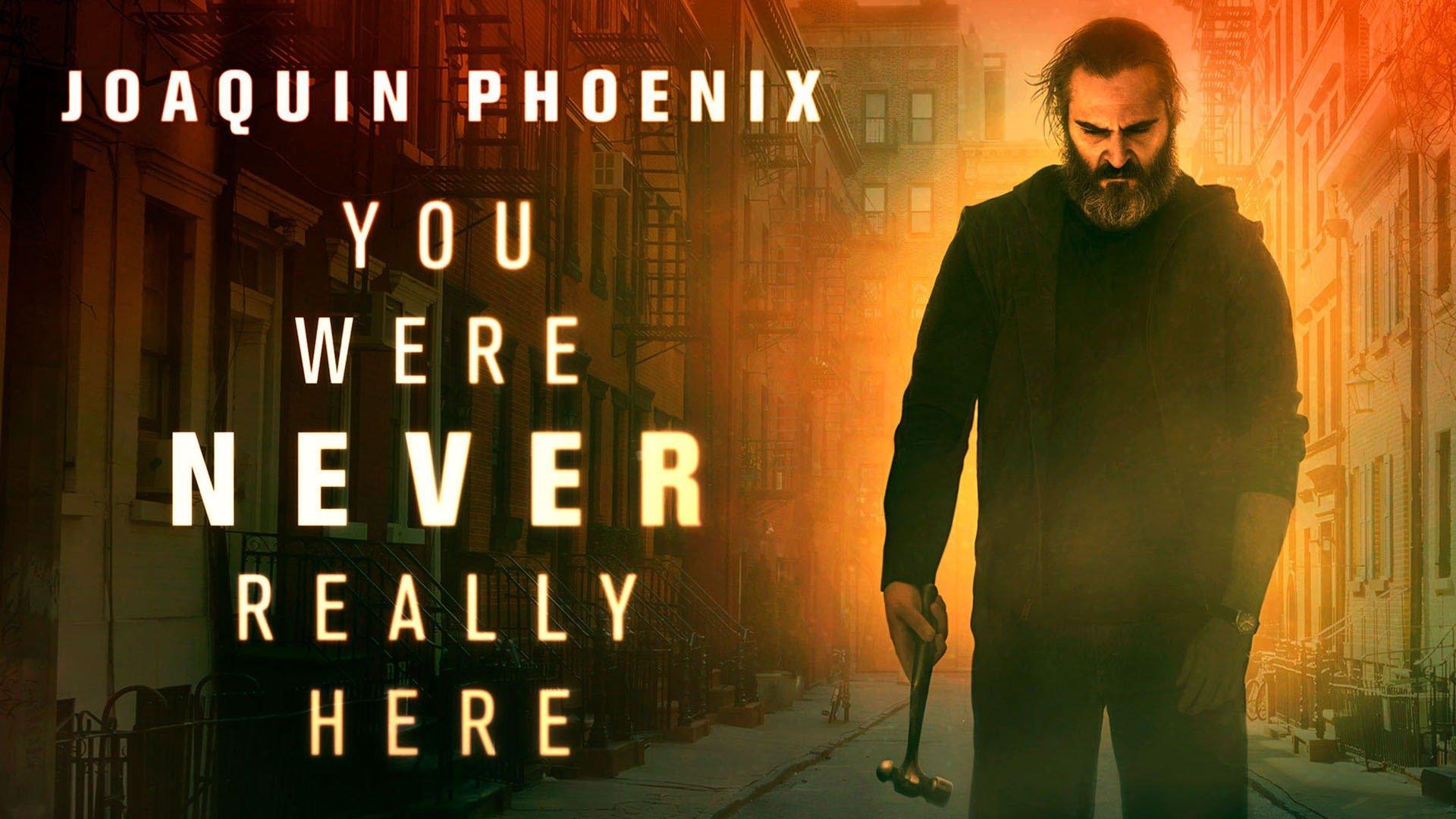
If you walked out of the theater after watching Lynne Ramsay’s 2017 thriller feeling a little bit hollow and very confused, you aren't alone. It happens. You Were Never Really Here isn't your typical Liam Neeson-style "Taken" clone, even though the logline—traumatized veteran rescues a young girl from a sex trafficking ring—makes it sound exactly like that.
The movie is a fever dream. It’s short. Barely 90 minutes. For another look, read: this related article.
Most people go into this movie expecting a high-octane revenge flick. Instead, they get Joe, played by a hulking, bearded Joaquin Phoenix, who spends more time contemplating a plastic bag over his head than he does clearing rooms with a gun. Honestly, the violence isn't even the point. Most of the "action" happens off-screen or via grainy security camera footage. It’s a choice that frustrates some but fascinates others.
The Disappearing Act of Joe’s Reality
What does the title actually mean? "You Were Never Really Here" refers to Joe’s dissociation. He’s a ghost in his own life. When he’s not taking care of his elderly mother—a relationship that provides the only warmth in the entire runtime—he’s a tool of blunt force. Related coverage regarding this has been provided by Deadline.
Joe lives with Post-Traumatic Stress Disorder (PTSD) that manifests as vivid, intrusive flashbacks. Ramsay uses quick cuts. A desert. A shipping container. A chocolate bar. These aren't just "cool edits." They are the fragmented reality of a man whose brain is stuck in the past.
Jonathan Ames, who wrote the novella the film is based on, depicted Joe as a man who wants to be invisible. In the book, Joe is a bit more of a "professional." In the film, he’s a mess. He’s suicidal. He’s constantly testing the boundaries of his own existence. When he’s doing his "job," he uses a ball-peen hammer. Why a hammer? Because it’s quiet. It’s personal. It’s brutal.
That Ending: What Actually Happened in the Diner?
Let's talk about the ending because that is where most people get tripped up. After the bloodbath at the manor and the discovery that the "villain" has already been dealt with by someone else, Joe and Nina (Ekaterina Samsonov) sit in a brightly lit diner.
Joe has a vision. He stands up, pulls out a gun, and shoots himself in the head. Blood splatters. The patrons scream.
Then, the camera cuts back. Joe is fine. He’s just sitting there. Nina tells him, "Joe, it’s a beautiful day."
Is he dead? No. Is it a dream? Sorta. It’s a representation of his internal state. For the first time in the movie, Joe realizes he doesn't have to be the "rescuer" anymore because Nina has already started rescuing herself. She’s the one who killed the Governor. She’s the one who nudges him back to reality.
The diner scene is a pivot point. In a traditional movie, the hero saves the girl and rides into the sunset. Here, the "hero" realizes he’s barely holding on, and the "victim" is the one providing the momentum to keep moving.
Why Joaquin Phoenix Changed the Character
Originally, Joe was supposed to be more "fit." More like a standard action lead.
Joaquin Phoenix decided against that. He showed up with a "dad bod"—heavy, lumbering, and physically exhausted. He wanted Joe to look like a man who carried his trauma in his muscles and his gut. This physical presence changes how we view the violence. It isn't sleek. It’s heavy.
- Joe’s relationship with his mother: This is based on Ames’ own experiences and feelings toward his parents.
- The use of "Angel Baby": The song playing during the hallway scene adds a surreal, almost romantic layer to a horrific situation.
- The Hammer: It represents Joe’s desire to not leave a "trace" like a gunshot would, though it’s arguably much messier.
The Sound of Trauma
Jonny Greenwood (of Radiohead fame) did the score. If the movie feels like a panic attack, it’s because of the music. It’s dissonant. It’s twitchy. It doesn't follow the emotional beats you'd expect.
Compare this to something like John Wick. In John Wick, the music pumps you up. It makes the violence feel like a dance. In You Were Never Really Here, the sound design makes you want to crawl out of your skin. It mirrors Joe’s tinnitus and his sensory overload.
A lot of viewers complain that the plot is "thin." They aren't wrong, technically. If you write down the plot points, it’s a very simple story. But Lynne Ramsay isn't a plot-driven director. She’s an atmospheric one. She did We Need to Talk About Kevin. She cares about the "why" and the "how it feels" more than the "what happens next."
Understanding the "Vora" Mystery
There is a lot of talk about the political conspiracy in the film. Who was the Governor? How deep did the pedophilia ring go?
The movie doesn't care.
This is the biggest hurdle for audiences. We are trained by movies like The Pelican Brief or All the President's Men to want the "reveal." We want the file folders. We want the names. You Were Never Really Here gives us none of that because Joe doesn't get any of that. He’s just a guy hired to get a girl out. He’s a blunt instrument. When the instrument is no longer needed, it’s discarded.
Why It’s Not a "Female Taken"
Some critics tried to frame this as a feminist take on the vigilante genre. It’s more complex than that.
Nina isn't a damsel. By the end, she’s arguably more composed than Joe. She has seen the worst of humanity, just like he has, but she hasn't reached the point of total ego-death yet. The "You" in the title could just as easily be Nina—a girl the world tried to make disappear, but who remains stubbornly, defiantly "here."
Practical Insights for Watching (or Re-watching)
If you’re going to watch this again, or if you’re trying to make sense of your first viewing, keep these three things in mind:
- Watch the hands. Joe is constantly fiddling with things. He’s checking his pulse. He’s counting. This is a grounding technique used by people with severe anxiety and PTSD. It shows he is constantly fighting to stay in the present moment.
- Ignore the "Villains." They are intentionally faceless. They represent a systemic rot, not a specific "boss" to be defeated. Killing them doesn't fix the world; it just clears a path for a moment.
- Focus on the water. Water appears throughout the film—the lake, the shower, the rain. It’s a classic symbol of purification, but for Joe, it’s also a place of possible suicide. His choice to come out of the water at the end of the film is his first real choice to live.
Final Steps for the Curious
If you enjoyed the vibe of this film, you should check out the original novella by Jonathan Ames. It’s a quick read—you can finish it in an afternoon—and it gives a bit more internal monologue to Joe that the movie replaces with visual metaphors.
Also, look into the film Point Blank (1967) or The American Friend (1977). These are the spiritual ancestors of Ramsay’s work. They deal with the "professional" criminal who is slowly losing his grip on what’s real.
The best way to appreciate You Were Never Really Here is to stop trying to solve it like a puzzle and start feeling it like a mood. It’s a portrait of a man trying to find a reason to exist in a world that feels increasingly phantom-like.
The next time you find yourself stuck in a loop of your own thoughts or feeling "not quite there," you might find that Joe’s journey feels a lot more relatable than you initially thought.