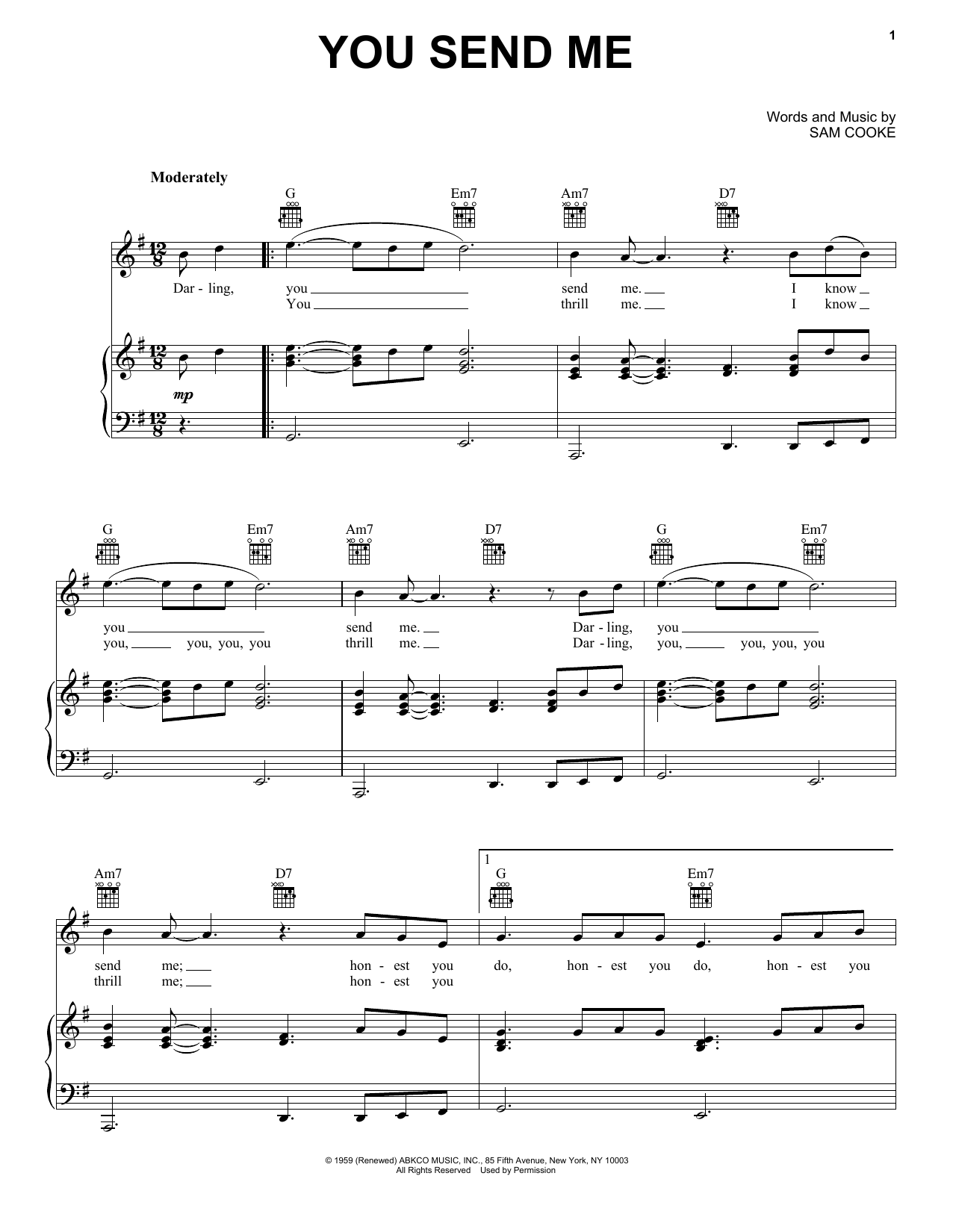
It starts with a hum. A gentle, floating "Mm-mm-mm" that feels like a warm breeze on a July evening. When Sam Cooke released "You Send Me" in 1957, the world of music didn't just change—it basically split in two. You've heard the song a thousand times in movies, at weddings, or on oldies stations, but honestly, most people miss the quiet revolution hidden inside those three minutes of pop perfection.
Why You Send Me Sam Cooke Lyrics Are More Than Just a Love Song
On the surface, the You Send Me Sam Cooke lyrics seem like a simple confession of a crush. "Darling, you send me / I know you send me / Honest you do." It’s sweet. It’s innocent. But back in 1957, this was radical.
Sam Cooke wasn't just some new kid on the block. He was a superstar in the gospel world with The Soul Stirrers. In that community, "crossing over" to secular music was often seen as selling your soul to the devil. When he sang these lyrics, he was using the same phrasing, the same "melisma" (that thing where you stretch one syllable over several notes), and the same raw intimacy he used to praise God, but he was directing it at a woman.
The phrase "you send me" itself is a bit of a relic now. Back then, it was jazz-inflected slang. To be "sent" meant to be transported—to be so moved by a feeling or a piece of music that you weren't quite on earth anymore. It’s why the song feels so weightless.
The Secret Battle Behind the Credits
Here’s a weird bit of history most folks don't know: Sam Cooke wrote the song, but the original records didn't say so.
He actually gave the writing credit to his brother, L.C. Cook. Why? Basically, Sam was in a nasty legal tangle with his publisher, Specialty Records. He didn't want them getting their hands on the royalties for what he knew was a hit. He even released his first secular attempt, a song called "Lovable," under the fake name Dale Cook. He was trying to hide from his gospel fans and his bosses at the same time.
It didn't work. His voice was too distinct. You can’t hide a diamond in a glass of water.
Breaking Down the "Infatuation" Verse
There is one specific part of the You Send Me Sam Cooke lyrics that grounds the whole song.
"At first I thought it was infatuation / But ooh, it’s lasted so long / And now I find myself wanting / To marry you and take you home."
This is the pivot. The song moves from a "feeling" to a "commitment." In the 1950s, pop music was cluttered with "moon/june/spoon" rhymes. Cooke brought a conversational, almost plain-spoken honesty to the booth. He’s admitting he was skeptical of his own heart.
The recording session itself was a mess, according to some accounts. Producer Bumps Blackwell brought in white backup singers to give it a "pop" feel, which initially annoyed the label owner, Art Rupe. Rupe hated the sound—he thought it was too wimpy compared to the gritty R&B of the time. He actually let Sam out of his contract because of it.
Talk about a billion-dollar mistake. The song went to #1 on both the R&B and Pop charts, a rare feat in a segregated America.
The Technical Magic of the Performance
Musically, the song is built on a "50s progression" (I-vi-IV-V), which is the DNA of early rock and roll. But it's Cooke's delivery that makes it immortal.
- The Ad-libs: Listen to the way he says "you-you-you-you." It’s not a stutter; it’s a rhythmic choice that mimics a heartbeat.
- The "Honest You Do": He repeats this phrase like he’s trying to convince himself as much as the girl.
- The Bridge: When the drums kick in a bit harder during the "whenever I'm near you" section, the song gains a physical weight it didn't have before.
What Most People Get Wrong About the Legacy
People often lump Sam Cooke in with the "safe" crooners like Nat King Cole. While he certainly had that polish, "You Send Me" was the gateway to something much deeper.
Without the success of this song, we never get "A Change Is Gonna Come." The money and power Cooke gained from this #1 hit allowed him to start his own record label (SAR Records) and his own publishing company. He was one of the first Black artists to truly own his work.
The You Send Me Sam Cooke lyrics weren't just about a girl; they were about a man finding a new way to speak to the world without losing the soul he found in the church.
Modern Relevancy and How to Listen Now
If you want to really "get" this song today, stop listening to it as a "golden oldie."
Listen to it as a DIY project. It was recorded with a small group, a simple arrangement, and a lot of tension in the room. It’s a masterclass in restraint. Every cover version—from Aretha Franklin to Otis Redding—tries to add more "fire," but Sam’s original works because it’s a slow burn.
Next time you hear those opening notes, remember you're listening to the exact moment the "King of Soul" took his throne.
To dive deeper into Sam Cooke’s influence, you should check out the 2020 film One Night in Miami, which dramatizes his friendship with Malcolm X and Muhammad Ali. It puts the "pop star" version of Sam in direct conversation with the "activist" Sam, showing just how much was happening behind that smooth, smiling voice. You might also want to track down the "Harlem Square Club" live recordings to hear how he sounded when he stopped being "polite" for the pop charts and really let loose.



