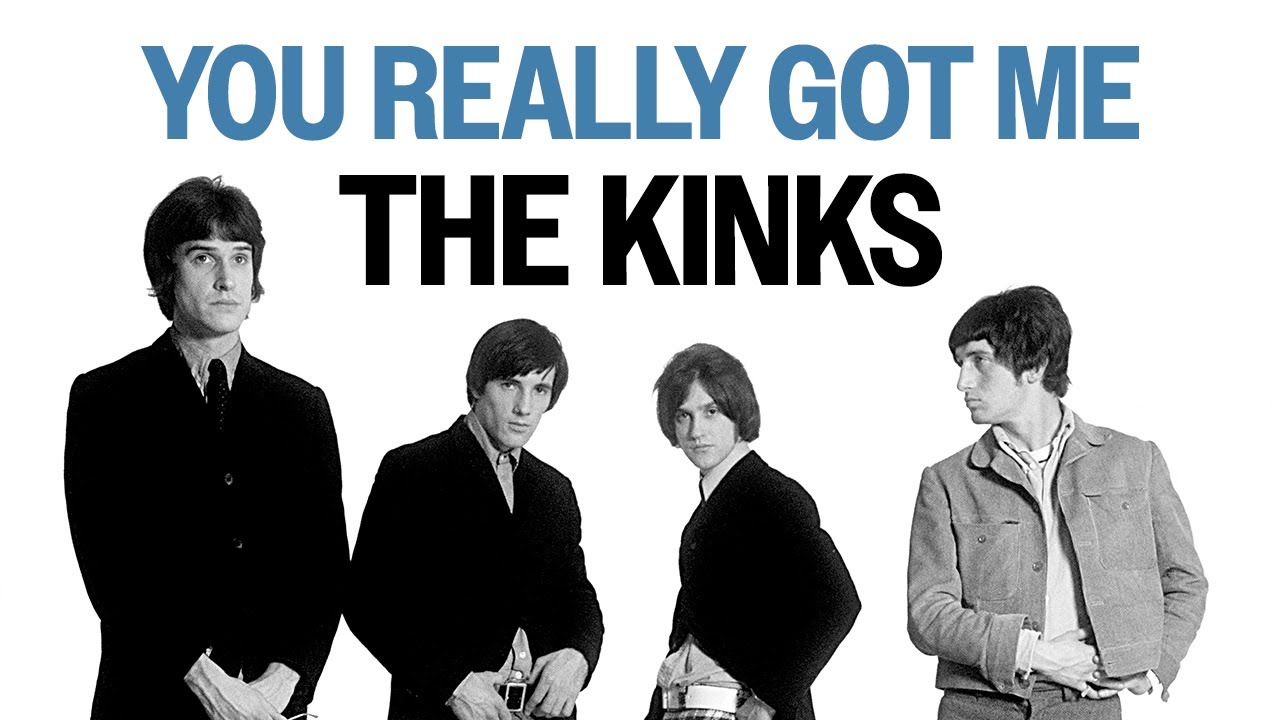
Let’s be real for a second. If you’ve ever felt that sudden, electric jolt in your chest when a guitar riff kicks in, you’ve probably felt the ghost of Ray Davies and The Kinks. We’re talking about You Really Got Me Going—or, as the world actually knows it, "You Really Got Me." It’s the song that basically invented heavy metal and punk before those things even had names. It’s loud. It’s messy. It’s perfect.
But there is a lot of confusion around the track. People often misremember the title or attribute that iconic, distorted sound to the wrong person. Honestly, the history of this song is as jagged and raw as the riff itself. It wasn't some polished studio miracle produced by a corporate machine. It was two brothers from Muswell Hill, London, fighting in a basement and literally slicing up their equipment with razor blades to get a sound that no one had ever heard before.
The Myth of the Razor Blade and the Elpico Amp
You’ve likely heard the legend. Dave Davies, frustrated and looking for a "dirty" sound, took a razor blade to the speaker cone of his little green Elpico amplifier. He poked holes in it. He slashed it. Then, he plugged that mangled amp into a larger Vox AC30.
That’s how you get the sound of You Really Got Me Going.
It wasn't a pedal. There was no "distortion" button in 1964. It was literal physical damage to a piece of electronics. When you hear that opening "da-da-da-DA-da," you’re hearing the sound of a speaker crying for help. It’s aggressive. It’s visceral. Interestingly, the band had actually recorded the song once before, but it was too clean. Pye Records wanted a hit, and they wanted it to sound like the Beatles or the Dave Clark Five. Ray Davies, the band's primary songwriter, knew that was a mistake. He fought the label. He insisted they re-record it with that broken, distorted energy. If he hadn't won that fight, rock history might look completely different.
Who Actually Played That Solo?
This is where things get spicy. For decades, a persistent rumor suggested that Jimmy Page—yes, that Jimmy Page—played the lead guitar on the track. Even today, you’ll find people arguing about this in the comments of old YouTube videos.
The truth? Jimmy Page didn't play it.
Shel Talmy, the producer, has confirmed that while Page was a session musician on some Kinks tracks (like "I'm a Lover, Not a Fighter"), the frantic, chaotic solo on "You Really Got Me" was all Dave Davies. Page himself has denied it multiple times. He’s famously said that he wouldn't want to take credit for something so uniquely Dave's. The solo is nervous. It feels like it’s about to fall off the rails at any moment. That’s the magic of it. It’s not a polished, technical masterpiece; it’s a burst of 17-year-old adrenaline.
Why the Lyrics Still Hit Different
Usually, pop songs from the mid-sixties were polite. They were about holding hands or dancing at a club. You Really Got Me Going is different. It’s obsessive.
"Girl, you really got me going / You got me so I don't know what I'm doing."
It’s simple. It’s repetitive. But it captures that specific, frantic feeling of being completely overwhelmed by someone. Ray Davies once mentioned that the song was originally inspired by a girl he saw dancing at a club—he didn't even talk to her, he just felt that "jolt." He initially tried to write it as a jazz-influenced blues number on a piano. Can you imagine? A jazz version of this song would have been forgotten in a week. By shifting it to the guitar and stripping the chords down to their bare essentials (mostly power chords), they created a blueprint that bands like The Who, Van Halen, and The Ramones would follow for the next fifty years.
The Van Halen Effect
We can't talk about this song without mentioning 1978. When Van Halen released their debut album, their cover of "You Really Got Me" reintroduced the song to a whole new generation. Eddie Van Halen took Dave Davies' raw power and added "Eruption" levels of technical wizardry to it.
Some purists hate it. They think it’s too flashy. Others think it’s the definitive version.
Actually, the Van Halen version is what usually leads people to search for the phrase You Really Got Me Going—it’s that heavy, driving energy that sticks in the brain. But even Eddie admitted that he was just trying to capture the spirit of what The Kinks had done. He wasn't trying to replace it. He was paying homage to the riff that made him want to pick up a guitar in the first place. It’s one of those rare cases where a cover is just as legendary as the original, creating a weird sort of temporal loop in rock music.
The Technical Brilliance of Simplicity
If you analyze the music theory behind the track, it’s remarkably straightforward. It’s built on G and F, then shifts up to A and G. It follows a basic blues structure but executes it with the speed of a freight train.
- Power Chords: This was one of the first times power chords (root and fifth) were used so prominently in a hit single.
- Vocal Delivery: Ray’s vocals are almost breathless. He’s not "singing" in the traditional sense as much as he is testifying.
- The Drumming: Mick Avory’s drumming is relentless. It doesn't swing; it pushes.
This simplicity is why the song is timeless. You don't need to be a virtuoso to play it, but you need a specific kind of soul to make it sound right. It’s why every garage band in history starts by learning these three chords. It is the DNA of rock and roll.
Misconceptions and Forgotten Facts
A lot of people think The Kinks were part of the "clean-cut" British Invasion. They weren't. They were the bad boys. They got banned from the United States for four years at the height of their popularity because they couldn't stop fighting—both with each other and with the unions.
This ban meant that while The Beatles and The Stones were conquering America, The Kinks were stuck in England. This isolated them. It made their music more "English" and more eccentric. But You Really Got Me Going was the song that survived the ban. It stayed on the airwaves. It stayed relevant.
There's also the weird fact that the song was recorded at IBC Studios in London in a very short window. They didn't have weeks to obsess over the mix. They had a few hours. That "live" feel isn't an accident; it was a necessity. They were capturing lightning in a bottle before the studio fees ran out.
How to Listen to It Like an Expert
If you want to truly appreciate the song today, stop listening to it on tiny smartphone speakers. Put on a pair of decent headphones. Focus on the left channel. Listen to the way the distortion cracks and sizzles. You can hear the physical air moving through that torn speaker cone.
Look for the 1964 mono mix if you can find it. The stereo mixes from that era often feel lopsided because engineers didn't quite know how to handle loud rock music yet. The mono mix is a punch to the face. It’s a singular, unified wall of sound that explains exactly why the elders of 1964 were so terrified of this music.
What You Can Do Now
If this song has been stuck in your head, there are a few ways to dive deeper into the world of The Kinks and the mid-sixties revolution:
- Check out "All Day and All of the Night": This was the immediate follow-up. It uses a similar structure but pushes the aggression even further. It’s basically the "sequel" to the riff.
- Read "Kink" by Dave Davies: If you want the firsthand account of the razor blade incident and the sibling rivalry that fueled the band, this autobiography is essential. It’s raw and honest.
- Compare the Mixes: Go on a streaming platform and listen to the 1964 original back-to-back with the Van Halen 1978 version. Pay attention to the swing of the drums versus the driving thud of the 70s production.
- Watch "You Really Got Me" Live (1964-1965): Find the black-and-white footage of them performing on Shindig! or Ready Steady Go!. Seeing the visual of the band—the suits, the hair, the sheer boredom on Mick Avory's face while he plays one of the most energetic songs ever—is a masterclass in cool.
The legacy of You Really Got Me Going isn't just in the notes. It’s in the attitude. It taught us that "perfect" is the enemy of "great." It taught us that if your equipment is broken, you might just be on the verge of a breakthrough. Most importantly, it proved that three chords and a lot of frustration can change the world. Over sixty years later, that riff is still the benchmark for everything loud, proud, and slightly dangerous in music.



