Sean Connery was tired. You can see it in his eyes throughout almost every frame of You Only Live Twice. By 1967, Bond-mania had reached a fever pitch that was frankly unsustainable, and Connery was caught in the middle of a media circus in Japan that would make modern influencers look like amateurs. People were following him into bathrooms. He was over it. This exhaustion is the secret ingredient that makes the film so strange and, honestly, kinda brilliant in its own detached way.
It’s the movie where the "Bond Formula" finally solidified into the giant, explosive spectacle we know today. Think about it. We get the volcano lair. We get the piranha tank. We get the definitive introduction of Ernst Stavro Blofeld, played with creepy, scarred perfection by Donald Pleasence. Before this, the Bond films were mostly gritty spy thrillers with some gadgets. This one? This was a sci-fi epic.
The Japanese Odyssey and a Script by Roald Dahl
Wait, did you know Roald Dahl wrote this? Yeah, that Roald Dahl. The guy who wrote Charlie and the Chocolate Factory. Producers Albert R. Broccoli and Harry Saltzman were in a pinch because the original Ian Fleming novel was a dark, brooding meditation on grief and suicide—basically the exact opposite of what 1960s audiences wanted for a summer blockbuster.
Dahl famously hated the book. He called it Fleming's worst work. So, he basically tossed the source material out the window and kept only the title and the Japanese setting. He treated the screenplay like a formula. He knew he needed three girls: one who dies early, one who dies late, and one who survives. It sounds cynical, but it worked.
The plot is pure Cold War paranoia. Someone is "swallowing" American and Soviet spacecraft in orbit using a giant rogue ship. The world is on the brink of nuclear war. Bond has to fake his own death—hence the title You Only Live Twice—to go undercover in Japan and find out who’s behind it.
The scale of production was insane. Ken Adam, the legendary production designer, built a full-scale volcano interior at Pinewood Studios. It cost about $1 million back then, which was more than the entire budget of Dr. No. It had a working monorail, a retractable roof, and enough space to house hundreds of stuntmen. It remains one of the most impressive practical sets ever built in cinema history. If you look at the wide shots, those aren't models. That's real steel and real fire.
The Cultural Complications of 1967
We have to talk about the "Bond turns Japanese" sequence. It’s... uncomfortable. In the film, 007 undergoes a surgical transformation to look Japanese so he can infiltrate a fishing village. By modern standards, it’s cringeworthy at best and offensive at worst. The prosthetic makeup didn't even really work; Connery just looks like Connery with a bowl cut and slightly altered eyebrows.
But if you look past that specific, dated plot point, the film is actually a beautiful love letter to 1960s Japan. The cinematography by Freddie Young—the guy who shot Lawrence of Arabia—is breathtaking. We get sweeping shots of the Himeji Castle and the bustling neon streets of Tokyo. It captured a country that was rapidly transitioning from its traditional past into a technological powerhouse.
The Japanese cast was also stellar. Tetsurō Tamba as Tiger Tanaka, the head of the Japanese Secret Service, is perhaps the only "Bond Ally" who feels like 007’s genuine equal. He has his own private subway system and an army of ninjas. Honestly, Tanaka is cooler than Bond in half their scenes together. Akiko Wakabayashi and Mie Hama, who played Aki and Kissy Suzuki, brought a level of capability to the "Bond Girl" trope that was often missing in earlier entries.
Little Nellie and the Gadget Peak
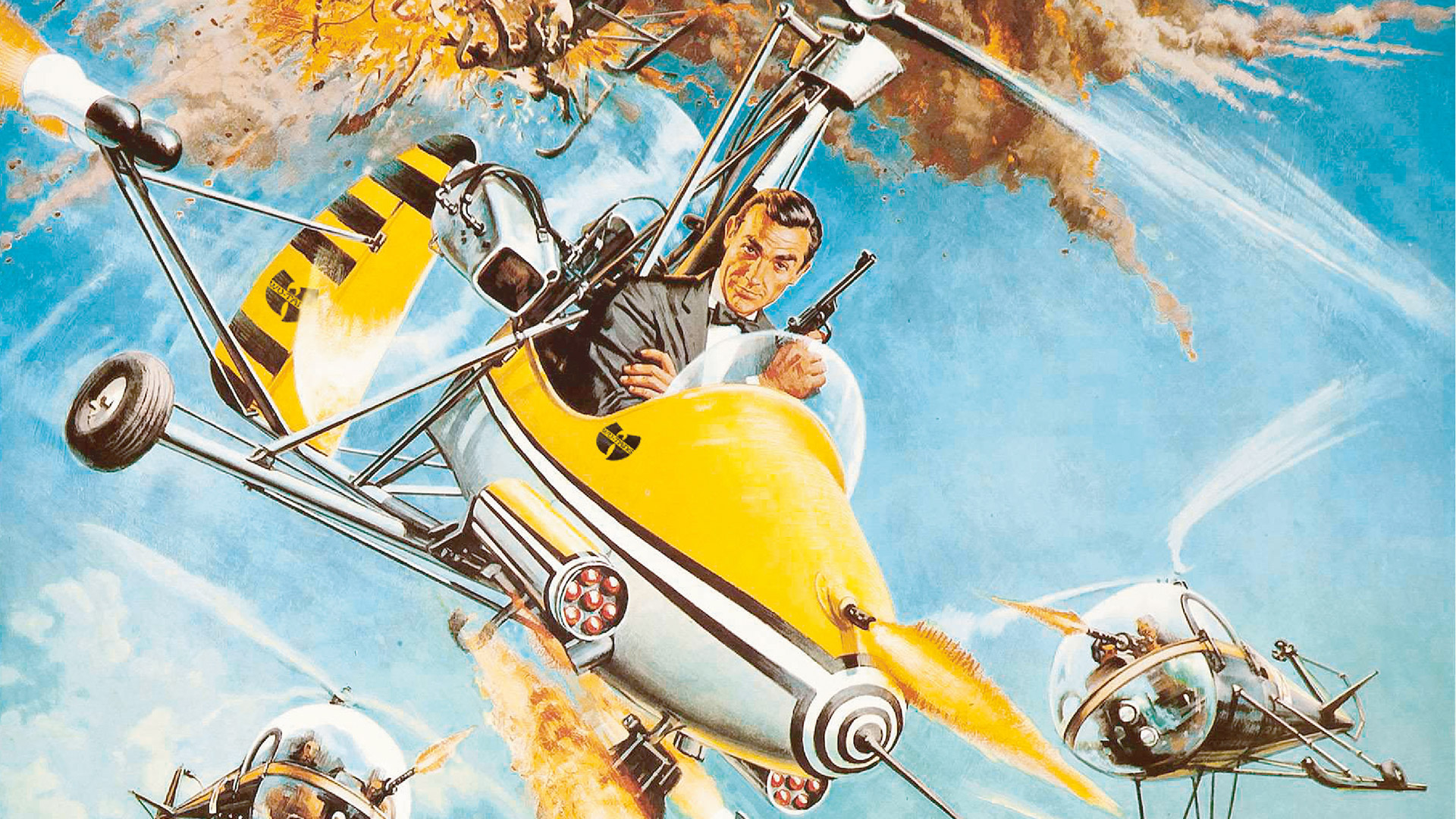
Then there’s Little Nellie.
The WA-116 Wallis Autogyro. It wasn't a prop; it was a real, experimental aircraft flown by its inventor, Wing Commander Ken Wallis. The sequence where Bond fights off a fleet of full-sized helicopters while piloting this tiny lawnmower-with-rotors is a masterclass in practical stunt work. There are no CGI drones here. Wallis actually flew those maneuvers, often in high winds, to get the shots.
This film marked the point where the gadgets started to overshadow the character. Bond became a passenger in a machine of plot beats. For some fans, this is where the series lost its soul. For others, it’s the peak of the franchise's imaginative power.
- The cigarette that fires a rocket? Real (sort of).
- The magnetic helicopter that drops a car into the ocean? Pure cinema gold.
- The ninja training school? A bit campy, but undeniably fun.
It’s easy to poke holes in the logic. Why does Blofeld have a piranha tank in his office? Because it’s cool. Why do the ninjas use rappelling ropes when there are stairs? Because it looks better on a 70mm screen. You Only Live Twice isn't interested in realism; it’s interested in myth-making.
Nancy Sinatra and the Sound of Bond
You can’t talk about this movie without mentioning the music. John Barry’s score is lush, haunting, and heavily influenced by Japanese scales. But the title track by Nancy Sinatra is the real MVP.
Legend has it Sinatra was incredibly nervous during the recording session. It took about 25 takes to get the vocals right. Barry eventually had to piece together the final version from different takes to get that perfect, ethereal sound. The opening strings are so iconic that Robbie Williams sampled them decades later for his hit "Millennium." It sets a tone of melancholy that the rest of the movie doesn't always live up to, but man, it sounds great.
The Legacy of the Volcano
When you watch a parody like Austin Powers, you’re mostly watching a parody of You Only Live Twice. The bald villain with the white cat? That’s this movie. The over-the-top death traps? This movie. The secret base inside a natural landmark? You guessed it.
It’s the blueprint for the "Big Bond" movie. Every time a modern Bond film like No Time To Die goes for a massive, high-stakes finale, it’s chasing the ghost of the volcano lair.
But there’s a sadness to it, too. This was the end of the first era of Connery. Although he eventually came back for Diamonds Are Forever (and much later for the "unofficial" Never Say Never Again), he was never quite the same after this. The spark was fading. He had become a global icon, and the weight of that icon was starting to crush the performance.
Actionable Takeaways for the Bond Completist
If you’re revisiting this classic or watching it for the first time, keep these specific things in mind to get the most out of the experience:
- Watch the Background: Pay attention to the Ken Adam sets. The sheer scale of the volcano base is mind-blowing when you realize it’s a physical structure built by hand. Look for the way light reflects off the metallic surfaces.
- Listen for the "Space" Motif: John Barry’s use of high-pitched brass to represent the vacuum of space was revolutionary for 1967. It’s subtle, but it builds the tension during the capsule snatching scenes.
- Contrast the Novel: If you can, find a copy of Fleming’s book. It’s almost a direct sequel to On Her Majesty’s Secret Service and deals with Bond’s mental breakdown. Comparing the two shows just how much the "movie version" of Bond had diverged from the literary version by the late 60s.
- Check out the "Making of" Documentaries: The behind-the-scenes footage of the autogyro sequences and the aerial photography in Japan is some of the best documentary work on 1960s filmmaking.
- Look for the Cameos: See if you can spot the various uncredited actors in the background of the SPECTRE base—some of them went on to have long careers in British television.
Ultimately, You Only Live Twice is a flawed masterpiece. It's too long in the middle, the "transformation" subplot is a disaster, and Connery is clearly dreaming of a golf course in Scotland. Yet, it remains one of the most visually stunning and influential action movies ever made. It’s the moment Bond became a superhero. It’s big, it’s loud, it’s colorful, and it’s unapologetically weird.
For the best viewing experience today, try to find the 4K restored version. The colors of the Japanese landscape and the intricate details of the SPECTRE uniforms pop in a way that old DVD transfers just can't match. It reminds you why people fell in love with cinema in the first place—to see things they could never see in real life, even if those things involve a secret base hidden inside a volcano.