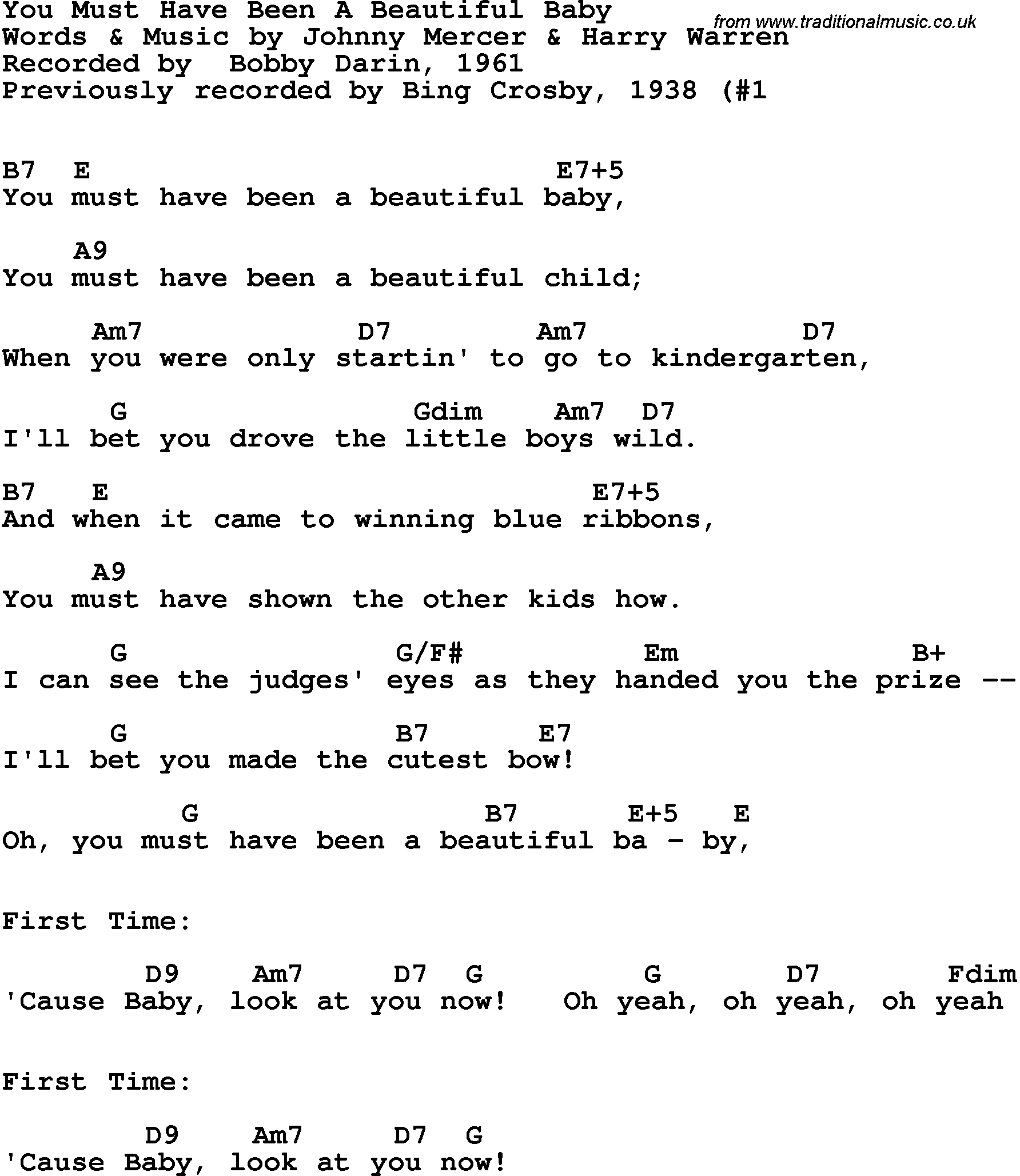
Johnny Mercer probably didn't know he was writing a permanent fixture of the American lexicon when he sat down to pen the lyrics to You Must Have Been a Beautiful Baby in 1938. It’s one of those songs. You know the ones. They feel like they’ve just always existed, like they were born out of the ether rather than written by a guy in a room with a deadline.
Music moves fast. Trends die. But this track? It stuck.
The song first appeared in the Warner Bros. film Hard to Get, performed by Dick Powell. It’s a cheeky, bouncy number. It isn't trying to be profound or revolutionary. Honestly, it’s just a flirtatious bit of songwriting that leans heavily into the "nature vs. nurture" debate of physical attractiveness. Mercer, working alongside composer Harry Warren, captured a specific kind of lighthearted energy that was essentially the "viral hit" of the late 1930s.
Why You Must Have Been a Beautiful Baby Stayed Famous
Most movie songs from 1938 are completely forgotten. They’re ghosts. Yet, You Must Have Been a Beautiful Baby survived because it transitioned from a movie prop to a jazz standard.
The genius is in the simplicity.
Mercer was a master of the "colloquialism." He wrote the way people actually talked back then, or at least how they wanted to talk. When you listen to the lyrics, they aren't flowery or overly poetic. They're conversational. He’s essentially saying, "Hey, you're good-looking now, so you must have been a knockout as a kid." It’s a backhanded compliment that somehow feels purely sweet.
The Bing Crosby Factor
If Dick Powell gave the song its birth, Bing Crosby gave it its life. Crosby recorded it shortly after the film’s release, and his version is arguably the definitive one for that generation. Crosby had this way of making everything sound effortless. His phrasing on the line "cause baby, look at you now" turned a simple observation into a flirtatious wink. It hit number one on the charts.
It wasn't just Bing, though.
Bobby Darin took a crack at it in 1961. This is where the song changed. Darin didn't do the "gentle crooner" thing. He injected it with a rock-and-roll, swing-heavy swagger. It felt younger. It felt faster. That version reached number five on the Billboard Hot 100, proving that a song written before World War II could still dominate the airwaves in the era of the twist.
Breaking Down the Lyrics: More Than Just Flattery
The song follows a standard AABA structure, which was the bread and butter of Tin Pan Alley. But look at the specific imagery Mercer uses. He mentions the "nursery" and being the "pride of the neighborhood."
It’s nostalgic.
People in 1938 were dealing with the tail end of the Great Depression. They didn't want complex political allegories in their pop music. They wanted something that felt like a warm hug or a playful nudge. The idea of a "beautiful baby" taps into a universal sentiment of innocence and potential.
The Harry Warren Touch
We can't talk about the lyrics without the melody. Harry Warren is arguably the most underrated composer in American history. He wrote "At Last," "Chattanooga Choo Choo," and "That's Amore." The man was a hit machine.
For You Must Have Been a Beautiful Baby, Warren created a melody that is incredibly easy to whistle. That’s the secret sauce. If a delivery driver in 1940 could whistle the hook while walking down the street, the song was a success. The intervals are playful. It jumps around just enough to keep you interested but stays within a range that any amateur singer can handle at a party.
From the Big Screen to the Looney Tunes
If you grew up after the 1940s, there’s a high chance you didn't hear this song in a Dick Powell movie. You probably heard it in a cartoon.
Warner Bros. owned the rights to the music, so they used it relentlessly in their animated shorts. It became the default soundtrack for any scene involving a baby, a flashback to a character's childhood, or a moment of extreme vanity. This is how songs become "immortal." They stop being "a song" and start being "a cultural cue."
When Bugs Bunny or Daffy Duck hums a bar of You Must Have Been a Beautiful Baby, it’s a shorthand for the audience. We immediately get the joke. We know the vibe.
The Modern Resonance
Does anyone still care about this song in 2026?
Surprisingly, yes. It shows up in commercials for everything from baby formula to high-end skincare. It’s been covered by everyone from Perry Como to Dr. John. Even Bette Midler did a version. Each artist brings something different, but the core remains the same: it’s a song about recognizing beauty in the present by imagining its origins in the past.
It’s also a staple in the "Great American Songbook" education. If you’re learning jazz vocals, you’re probably going to sing this at some point. It teaches you how to handle "swing" feel without being too heavy-handed.
Misconceptions and Forgotten Facts
People often think this song was written for a specific person. It wasn't. Mercer was a professional. He was writing for a script. In Hard to Get, the song is used as a way for the characters to bond.
Another common mistake? Thinking it’s a nursery rhyme.
Because the title mentions "babies," people often lump it in with "Twinkle Twinkle Little Star." But the lyrics are definitely adult. It’s a song about attraction. It’s a pick-up line. When you say "You must have been a beautiful baby / 'Cause baby, look at you now," you aren't talking to a toddler. You're talking to a date.
The Mercer Legacy
Johnny Mercer went on to co-found Capitol Records. He wrote "Moon River." He was a titan. But You Must Have Been a Beautiful Baby represents his early ability to capture the American "vernacular." He took the way people joked with each other in bars and diners and put it on a lead sheet.
He understood that music didn't always have to be "art" with a capital A. Sometimes, it just needs to be a good time.
What We Can Learn From the Song's Longevity
The success of this track offers a few real insights into what makes content—whether it's music or writing—actually stick around for nearly a century.
- Simplicity is King: Complex things are hard to remember. Simple things are hard to forget. The central hook is a basic observation that anyone can relate to.
- Adaptability Matters: The song worked as a ballad, a swing number, a rock track, and a cartoon gag. If your work only fits in one tiny box, it will die in that box.
- Voice is Everything: Mercer’s "voice" was his superpower. He didn't sound like a poet; he sounded like a friend.
If you’re looking to dive deeper into this era of music, don't just stop at the Bing Crosby version. Seek out the Bobby Darin recording from '61. It’s a masterclass in how to take a "standard" and make it feel dangerous and modern.
Your Next Steps for Music Discovery
To truly appreciate the craft of You Must Have Been a Beautiful Baby, you should listen to it in context. Start with the Harry Warren catalog. Listen to "I Only Have Eyes for You" and then jump to this. You'll see the range.
Next, look up the lyrics to "Jeepers Creepers," another Mercer/Warren collaboration from the same year. You’ll notice the pattern. They were capturing the slang of the era and turning it into gold.
Finally, check out the 1940s radio broadcasts of the song. Hearing it with the crackle of a live orchestra and the roar of a studio audience tells you more about its impact than any history book ever could. It wasn't just a hit; it was a mood.
Actionable Insights:
- Listen to the evolution: Compare the 1938 Dick Powell version with Bobby Darin’s 1961 version to understand how arrangement changes the "soul" of a lyric.
- Study Johnny Mercer: If you’re a writer, study how Mercer uses everyday language. He avoids "purple prose" in favor of words that actually land.
- Explore the Songbook: Use this song as a gateway into the Great American Songbook. It’s a more accessible entry point than some of the denser Gershwin or Porter tracks.
The song is a reminder that sometimes the most enduring things are the ones that don't take themselves too seriously. It’s a three-minute celebration of a compliment. And honestly? We could use more of that.