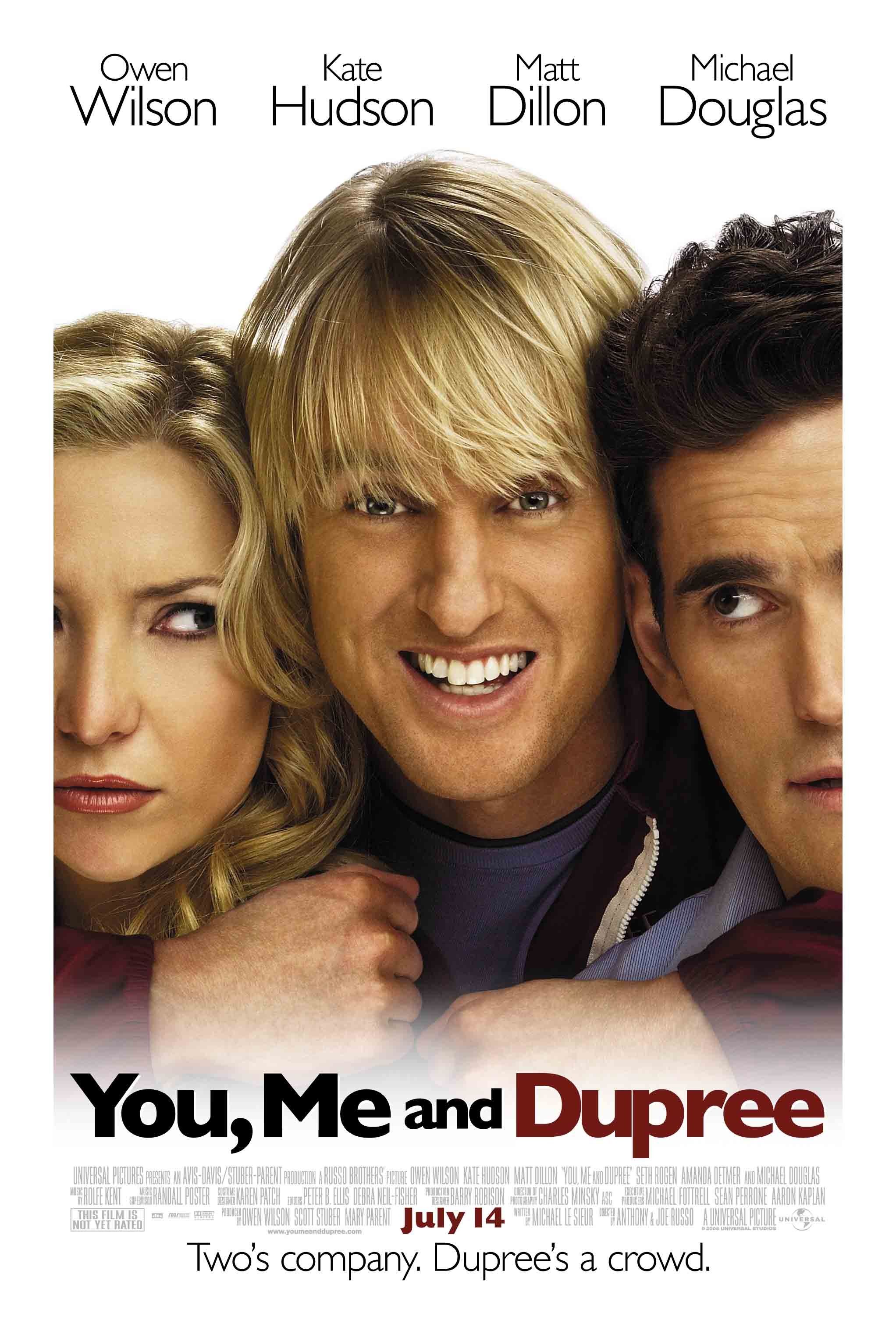
You remember the mid-2000s. It was a weird time for movies. Big-budget comedies were everywhere, usually starring a rotating cast of the "Frat Pack" or their immediate orbit. Among them, You, Me and Dupree arrived in July 2006, right in the heat of Owen Wilson’s peak era of playing the lovable, slightly unhinged drifter. It didn't exactly reinvent the wheel, but looking back at it twenty years later, the movie is a fascinating time capsule of a specific kind of American anxiety. It’s about more than just a couch-surfer. It’s about the death of the "slacker" archetype and the crushing pressure of the corporate grind.
Honestly, the plot is pretty simple. Carl (Matt Dillon) and Molly (Kate Hudson) are newlyweds. They’ve got the perfect house, the perfect careers, and a perfect future. Then there’s Dupree. Owen Wilson plays Randolph Dupree with this breezy, almost spiritual commitment to doing absolutely nothing. He’s the best man who never left the wedding headspace. When he loses his job and his home, he moves in with the newlyweds "for a few days." Naturally, those few days turn into a nightmare of clogged toilets, accidental fires, and some surprisingly deep life lessons.
The Slacker vs. The Suit: Why the Conflict Still Works
The movie works because we’ve all been on both sides of that living room. Carl is the guy we're told to be. He’s ambitious, he’s working for his father-in-law (played with a terrifying, understated intensity by Michael Douglas), and he’s slowly losing his soul. Dupree is the guy we secretly want to be—or at least, the guy we’re afraid we used to be before we started worrying about 401ks.
It’s interesting how the film portrays "The Man." Michael Douglas’s character, Mr. Thompson, represents a very specific kind of 2000s corporate dominance. He’s not just a boss; he’s an architect of Carl’s identity. There’s that infamous scene where he suggests Carl get a vasectomy so he can focus more on work. It’s played for laughs, but it’s dark. It touches on that fear that once you enter the professional world, your personal life isn't yours anymore. It belongs to the firm.
Dupree is the antidote. Or the toxin, depending on who you ask.
Most critics at the time, like Roger Ebert, pointed out that the movie relies heavily on Owen Wilson’s charm. Ebert actually gave it two stars, noting that while Wilson is likable, the movie feels a bit thin. But that thinness might actually be its strength. It doesn’t try to be a complex psychological thriller. It’s a vibes movie. It’s about the friction between a guy who lives for "the lifestyle" and a guy who lives for "the career."
Why did people hate-watch this?
There’s a segment of the audience that found Dupree unbearable. He’s a "houseguest from hell." He’s messy. He’s intrusive. He’s basically a golden retriever in a Hawaiian shirt that somehow knows how to use a microwave. But if you look at the box office, the movie was a massive hit. It pulled in over $130 million worldwide. People went to see it because, in 2006, we were just starting to feel the burnout of the pre-recession work culture. We needed to see someone stick it to the system by just... sitting on a couch.
Looking Back at the Russo Brothers' Early Work
It’s easy to forget that You, Me and Dupree was directed by Anthony and Joe Russo. Yes, the same guys who directed Avengers: Endgame and Captain America: The Winter Soldier. Before they were the architects of the Marvel Cinematic Universe, they were doing these grounded, character-driven comedies. You can actually see some of their later DNA here. They have a knack for ensemble dynamics. They know how to make a space feel crowded and claustrophobic.
In Dupree, they use the house as a character. It starts as a pristine, minimalist sanctuary for the newlyweds. By the middle of the film, it’s cluttered, lived-in, and chaotic. That visual progression is classic Russo Brothers. They understand that the environment reflects the internal state of the characters. Carl’s life is falling apart, so his house becomes a disaster zone.
The "Dupreeism" Philosophy
Is there actual wisdom in Dupree’s nonsense? He talks about finding your "ish." Everyone has their "ish." It’s that thing that makes you you.
"You've got to find your inner Dupree, man."
It sounds like something you’d see on a cheap t-shirt at a beach gift shop. But think about it. In a world where we’re constantly told to optimize every second of our lives, there’s something radical about a guy who just wants to ride a bike and hang out with the neighborhood kids. He’s the only person in the movie who is actually happy. Carl is miserable. Molly is stressed. Mr. Thompson is a sociopath. Dupree is just... chilling.
There was a real-world controversy surrounding this character, too. Steely Dan—yes, the band—actually wrote an open letter to the Russo brothers. They claimed the movie was "borrowed" from their song "Cousin Dupree." It was a tongue-in-cheek letter, but they were half-serious. They even invited Owen Wilson’s brother, Luke, to come on stage and apologize for his brother’s "theft." It was a bizarre moment in pop culture history that added a layer of weirdness to the movie's legacy.
The Supporting Cast: Michael Douglas and the Power of the Father-in-Law
We need to talk about Michael Douglas. He is the secret weapon of You, Me and Dupree. He plays Mr. Thompson with this cold, reptilian precision. He doesn’t scream. He doesn’t throw things. He just looks at Carl and makes him feel like a small, insignificant insect.
This dynamic is something that many viewers found relatable. The pressure of marrying into a family that has more money or more status than you is a classic trope, but Douglas elevates it. He represents the "You" in the title—the external forces that come between a couple. If Dupree is the "Me" (the messy, internal self), then Thompson is the world that demands perfection.
Kate Hudson also does a lot of heavy lifting here. Often in these comedies, the wife character is just a "shrew" or a killjoy. While Molly has her moments of frustration, she’s often the only one who sees Dupree’s value. She recognizes that he’s a good person, even if he’s a terrible roommate. Her performance keeps the movie from becoming a total bro-fest.
Fact-Checking the 2006 Vibe
A lot has changed since this movie came out. If Dupree tried to do this today, he wouldn’t be sleeping on a couch; he’d be living in a van and documenting it for TikTok. He’d have a million followers. He’d be an "influencer."
In 2006, being a slacker was still seen as a moral failing. Today, "quiet quitting" is a movement. In a sense, Dupree was ahead of his time. He was a pioneer of the work-life balance movement, even if he leaned a little too hard into the "life" side of the equation.
Actionable Takeaways from the Dupree Experience
If you’re revisiting this movie or seeing it for the first time, don’t just watch it as a dumb comedy. There are some genuine lessons tucked between the fart jokes and the slapstick.
- Audit your "ish": Are you doing things because you want to, or because a "Mr. Thompson" in your life told you to? Identify one hobby or passion you’ve let slide and reclaim it.
- Set boundaries for your "Duprees": If you have a friend who is overstaying their welcome—literally or emotionally—be clear. The conflict in the movie escalates because Carl and Molly aren't honest until things explode.
- Evaluate your workspace: Carl’s descent into madness starts with his office environment. If your job is making you lose your sense of humor, it might be time to look for a new "ish."
- Re-watch for the craft: Take a look at the Russo Brothers’ direction. Notice the framing and the pacing. It’s a great masterclass in how to direct a commercial comedy without losing a sense of style.
You, Me and Dupree isn't going to win any Oscars. It isn't going to be studied in film schools as a pinnacle of the medium. But it’s a movie that understands the quiet desperation of the American middle class. It knows that sometimes, the most dangerous thing you can do to a stable, boring life is to let a little chaos in. Or a guy who doesn't believe in wearing pants.