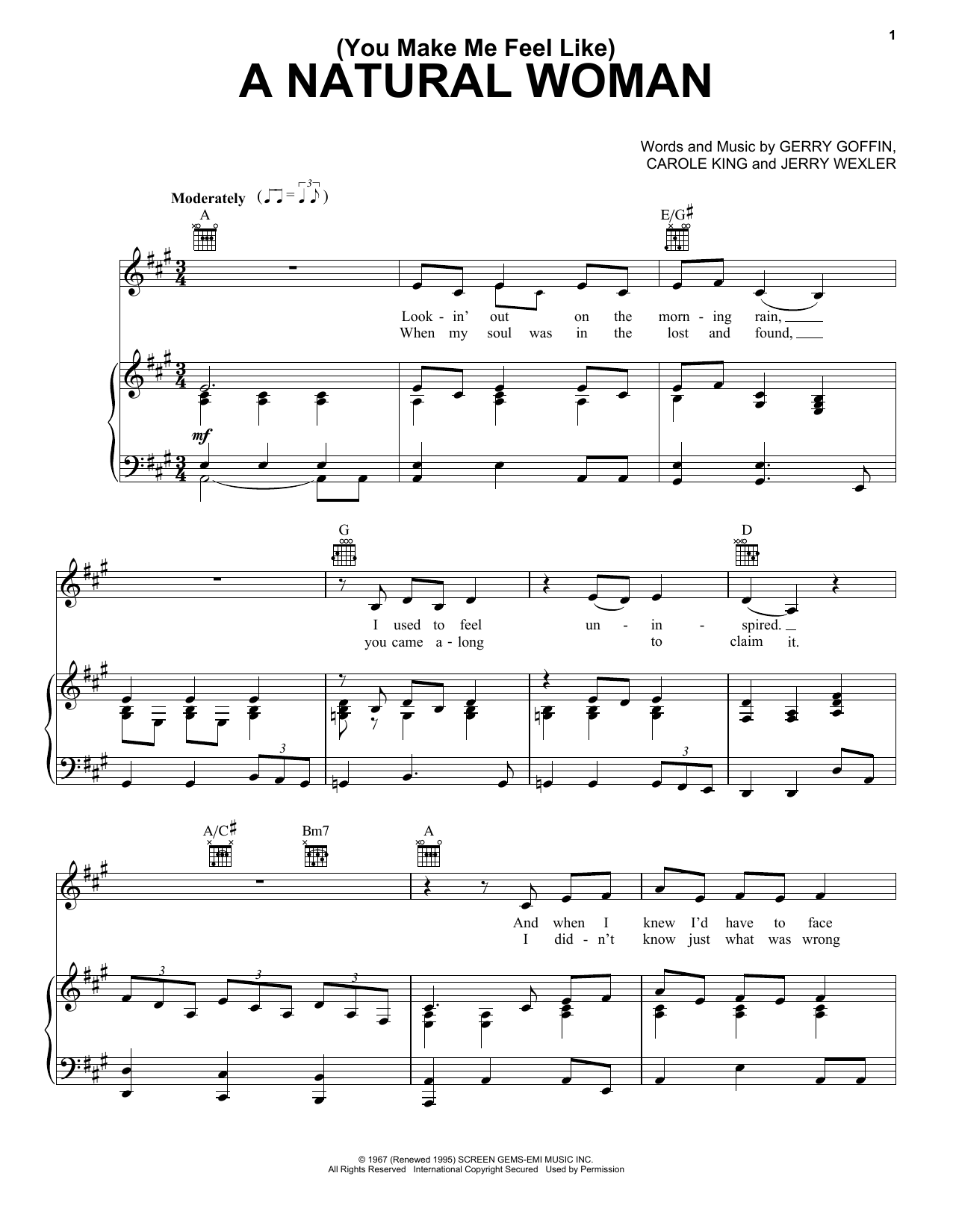
It’s the gold standard. When those first piano chords of (You Make Me Feel Like) A Natural Woman land, something in the room shifts. It’s not just a song; it’s a moment of cultural tectonic plates sliding into place. Aretha Franklin didn’t just sing this track—she claimed it, owned it, and basically redefined what soul music was supposed to do for the human psyche.
You’ve heard it at weddings. You’ve heard it in movies. Maybe you’ve even belted it out in the shower while pretending you have a tenth of her vocal range. But the story behind how Aretha Franklin turned a songwriting prompt into a feminist anthem is actually way more grit than glamour.
The Night a Car Window Changed Everything
History has a funny way of happening in the most mundane places. For this track, it happened on a New York City street. Carole King and Gerry Goffin, the legendary songwriting duo, were walking along when Jerry Wexler, the big boss at Atlantic Records, pulled up in his limo. He rolled down the window and shouted out a title he’d been sitting on: "How about a song called 'A Natural Woman' for Aretha?"
He wanted something that captured a specific kind of earthy, grounded femininity.
Goffin and King went home and wrote it that night. Think about that. One of the greatest songs in the American canon was essentially a homework assignment completed in a few hours. But they knew they were writing for "The Queen." You can’t give Aretha fluff. You have to give her meat.
When Aretha walked into American Sound Studio in Memphis, the atmosphere was electric. This wasn't the polished, polite Aretha from her Columbia Records days. This was the Atlantic era. She was raw. She was confident. She took a lyric about personal validation and turned it into a spiritual awakening.
Why the Vocals Feel Like a Gut Punch
There is a specific technique Aretha uses in the chorus that most singers can’t touch without sounding like they’re trying too hard. She starts the phrase "You make me feel..." with a controlled, almost conversational intimacy. Then, on the word "natural," she opens up the throttle.
It’s a masterclass in dynamics.
Honestly, the backing vocals are just as important. The Sweet Inspirations—which included Cissy Houston, Whitney’s mom—provided that gospel-infused call and response. It creates this wall of sound that feels like a congregation lifting Aretha up. If you listen closely to the 1967 recording, you can hear the slight imperfections, the breath, the heat of the room. It’s human.
Modern production often polishes the soul right out of a track. They Autotune the character away. But with Aretha, the "character" is the whole point. Every crack in her voice or pushed note tells a story of someone who was "soul-deep in lost and found" before finding her footing.
Carole King’s Different Take
It’s worth mentioning that the person who wrote the song eventually recorded it herself. Carole King’s version on her 1971 album Tapestry is a completely different beast.
King’s version is vulnerable. It’s quiet. It sounds like a woman sitting at her piano at 2:00 AM, processing her feelings in private. It’s beautiful, but it lacks the roar. When Aretha sings it, it’s a public declaration. It’s a manifesto. It’s the difference between a whisper and a shout.
Music critics have debated for decades which version is "better," but that’s a sucker’s game. They serve different purposes. King gives you the internal struggle; Aretha gives you the external triumph.
That 2015 Kennedy Center Performance
If you want to see the song's power in a single clip, you have to watch the 2015 Kennedy Center Honors. Aretha was 73 years old. She walked out in a full-length fur coat, sat down at the piano, and proceeded to make Barack Obama cry.
She wasn't just singing a hit from the sixties. She was reminding the world that she was still the architect of the genre. When she dropped the fur coat and hit the high notes at the end, she wasn't just a singer. She was a force of nature.
The crowd didn't just clap. They looked stunned. Even Carole King, who was being honored that night, was losing her mind in the balcony. It proved that (You Make Me Feel Like) A Natural Woman isn't tied to a specific decade or trend. It’s timeless because the feeling of being "seen" by someone else is a universal human need.
The Cultural Weight of the Lyrics
We need to talk about what "natural" actually meant in 1967. This was the height of the Civil Rights Movement. For a Black woman to stand up and sing about being a "natural woman" was a radical act of self-love.
- It rejected the rigid, European beauty standards of the time.
- It centered Black womanhood as the pinnacle of grace and strength.
- It moved the conversation from "what can I do for you" to "how do you make me feel."
It wasn't just a love song to a man. It was a love song to herself. The "you" in the song is the catalyst, sure, but the "natural woman" is the star. Before she met this person, she felt "uninspired" and "so tired." The song documents the transition from existing to truly living.
Technical Nuance: The Gospel Roots
You can't separate Aretha from the church. Her father, C.L. Franklin, was one of the most famous preachers in the country. Aretha grew up with the blues and gospel intertwining in her living room.
In (You Make Me Feel Like) A Natural Woman, you hear the "sanctified" style of singing. This involves:
- Melisma (stretching one syllable over multiple notes).
- Use of the "blue note" to create tension.
- Rhythmic displacement (singing slightly behind or ahead of the beat for emotional effect).
Most pop stars today try to mimic these runs, but they often feel like "vocal gymnastics" rather than emotional expression. Aretha’s runs always served the lyrics. If she hit a high note, it was because the emotion of the word required it, not because she wanted to show off her range.
Misconceptions About the Recording
A lot of people think this song was recorded in Detroit because of the Motown connection. Nope. Aretha was Atlantic. This was recorded in New York and Memphis with the Muscle Shoals Rhythm Section (often called "The Swampers").
These were white session musicians from Alabama who had an incredible, greasy, soulful feel. The chemistry between a Black gospel queen and a bunch of Southern session guys created a sound that couldn't be replicated anywhere else. It was the perfect blend of Northern sophistication and Southern grit.
How to Truly Appreciate the Track Today
If you really want to experience the depth of this song, don't just play it on your phone speakers.
Listen for the Bassline: Tommy Cogbill’s bass work on this track is subtle but foundational. It’s what gives the song its "strut."
Focus on the Bridge: The bridge—"Oh, baby, what you've done to me"—is where the song shifts from a ballad to a soul anthem. Notice how the drums get more aggressive here.
Check the Lyrics: Read them without the music. They are surprisingly simple, which is why they work. They don't use metaphors that are too clever for their own good. They just say what they mean.
Actionable Insights for Music Lovers
To get the most out of Aretha's catalog and this specific era of soul:
- Compare the Mono and Stereo Mixes: The original mono mix of the 1967 single has a punchier, more cohesive sound that was designed for AM radio. The stereo mix separates the instruments more, which is cool for headphones, but the mono version is how it was "meant" to be felt.
- Listen to "I Never Loved a Man the Way I Love You": This is the album that redefined her career. It houses the title track and "Respect." It provides the necessary context for why "Natural Woman" was such a massive departure from her earlier, jazzier work.
- Explore Carole King’s Writer Demos: Finding the early versions of these songs shows you the "skeleton" of a hit. It helps you appreciate how much of the final product was Aretha’s own creative genius in the studio.
- Watch the 'Amazing Grace' Documentary: If you want to see where that vocal power comes from, watch the restored footage of her 1972 gospel recording. It explains everything you need to know about her technique in "Natural Woman."
Aretha Franklin didn't just give us a song to sing along to. She gave us a vocabulary for dignity. She took a title shouted from a car window and turned it into a monument.