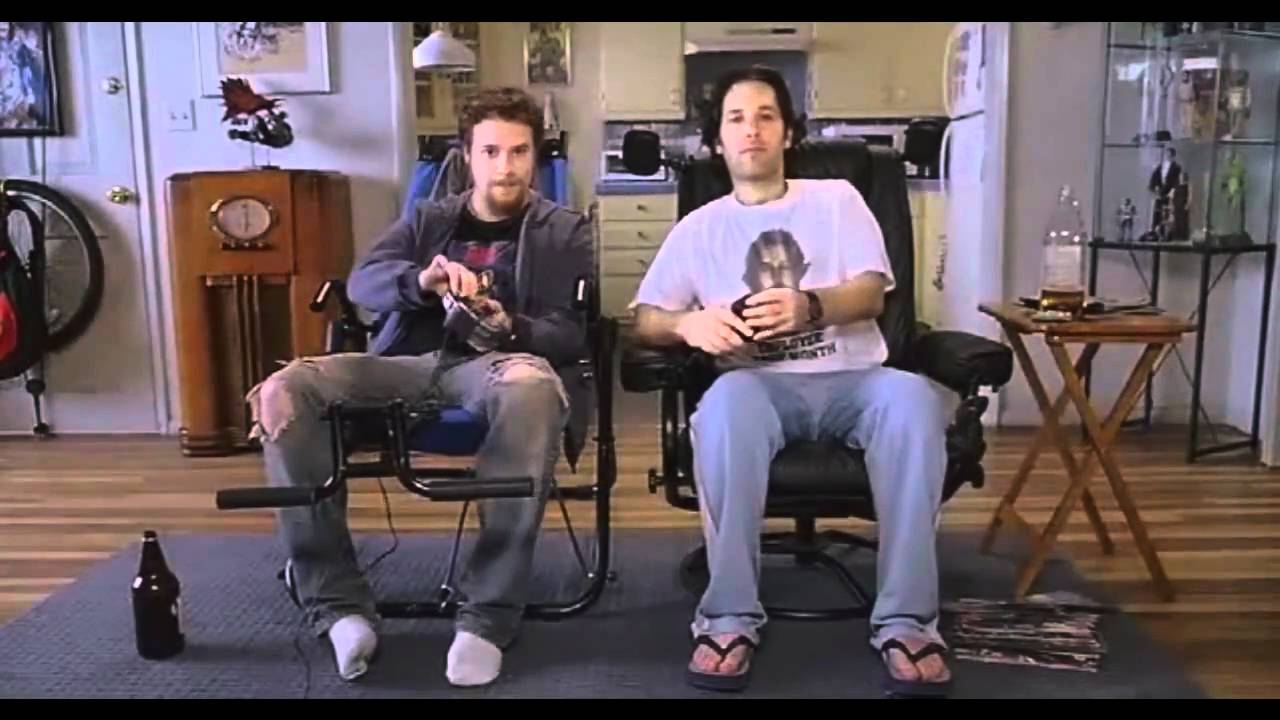
It was 2005. Seth Rogen and Paul Rudd were sitting in a car. They weren't doing much, just riffing, trying to kill time in a Judd Apatow comedy that would eventually change the trajectory of R-rated humor forever. Then came the back-and-forth. It started with a simple setup: you know how i know your gay.
If you grew up in the mid-2000s, you couldn't escape it. People quoted it in high school hallways. It was on MySpace bulletins. It was everywhere. But looking back at The 40-Year-Old Virgin now, that scene feels like a time capsule of a very specific, slightly awkward era in American comedy. It's fascinating how a bit of improvised dialogue became more famous than the actual plot of the movie for some people.
The Improv That Defined an Era
Apatow is famous for letting his actors just go for it. He keeps the cameras rolling and lets funny people be funny. In this specific scene, Rogen and Rudd were tasked with insulting each other in a way that felt like two bored friends passing the time.
They weren't following a rigid script. They were competing.
The "You know how I know you're gay?" routine wasn't meant to be a grand social statement. Honestly, it was just a game of one-upmanship. One guy would lob a ridiculous reason—like liking Coldplay or wearing a specific shirt—and the other would fire back. It was rapid-fire. It was silly. It was also, by today's standards, pretty controversial.
Comedy evolves fast. What killed in a theater in 2005 might get a cold reception in 2026.
Why the Scene Went Viral Before "Viral" Was a Thing
You have to remember that in 2005, YouTube was barely a year old. We didn't have TikTok. Memes were shared via word of mouth or clunky forum posts. Yet, this specific string of dialogue bypassed the digital infrastructure of the time.
It worked because it captured the "guy talk" of that decade perfectly. It was that weird mix of affection and aggression that defined a lot of male friendships. You don't tell your friend you like them; you tell them their taste in music is questionable using the most offensive language available.
Seth Rogen has since talked about this. He’s been pretty open about how his older movies contain jokes that he wouldn't make today. He isn't necessarily apologizing for them—he's acknowledging that the culture has shifted. And that's okay.
The Cultural Shift and Modern Context
We live in a different world now. The "gay as a punchline" trope has mostly been retired from mainstream Hollywood scripts. Why? Because it got lazy.
Back then, saying you know how i know your gay was a shorthand for "you like something that isn't hyper-masculine." In the movie, the punchlines were things like "you like Asia" (the band) or "you macraméed a pair of jean shorts."
It’s weirdly specific.
If you watch the scene today, the humor doesn't really come from the "gay" part of the joke. It comes from the absurdity of the "evidence." Paul Rudd’s delivery is so deadpan that he makes the most nonsensical accusations sound like cold, hard facts. That’s the brilliance of Rudd. He can make a list of random hobbies sound like a devastating character assassination.
The Apatow Effect
Judd Apatow didn't just make movies; he created a vibe.
- Knocked Up
- Superbad
- Pineapple Express
All these films relied on "the riff." The plot was often secondary to the chemistry between the leads. In The 40-Year-Old Virgin, the chemistry between the supporting cast—Rogen, Rudd, Romany Malco, and Jane Lynch—was arguably just as important as Steve Carell’s lead performance.
The "Know how I know you're gay?" scene is the peak example of this. It’s a five-minute detour that does nothing to move the story forward. Steve Carell isn't even in the car for most of it. But it’s the scene everyone remembered.
Deconstructing the Humor
Is it still funny? That’s the big question.
Humor is subjective, obviously. For some, the scene is a nostalgic reminder of a simpler time in comedy. For others, it’s a cringey relic of "bro-culture" that relied too heavily on easy targets.
But if you look at the mechanics of the jokes, they are built on a foundation of self-deprecation. The characters aren't actually attacking gay people; they are attacking each other’s perceived lack of "coolness."
Paul Rudd’s character is supposed to be the sensitive, "enlightened" one who listens to NPR and has a huge collection of posters, yet he’s the one participating in this juvenile back-and-forth. That’s where the irony lies.
The Legacy of the "Riff"
This scene paved the way for the "insult comedy" we saw in Parks and Recreation or Brooklyn Nine-Nine, but in a much more raw, unpolished way. It showed studios that you didn't need a high-concept setup to get a laugh. You just needed two talented actors and a rolling camera.
Interestingly, many of the "reasons" given in the movie have become legendary in their own right.
- Coldplay. Poor Chris Martin. This movie did more to cement the "Coldplay isn't cool" narrative than anything else in history.
- The "Man-O-Lantern." A reference to Steve Carell's character that became a recurring gag.
- The Framed Poster of Asia. It’s just such a specific, weird thing to own.
The sheer randomness of the items mentioned is what keeps the scene from feeling purely mean-spirited. It’s too ridiculous to be taken seriously.
How to View Old Comedy in 2026
We don't have to "cancel" the past to appreciate the present.
Understanding the context of you know how i know your gay means recognizing that comedy is a reflection of the time it was made. In 2005, this was the peak of "Frat Pack" humor. Today, we have different sensibilities, and our comedies reflect that. We focus more on situational irony, diverse perspectives, and less on "othering" groups of people for a quick laugh.
But we can still appreciate the craft. The timing between Rogen and Rudd is impeccable. They never step on each other's lines. They build the energy until it reaches a fever pitch. That is a skill that many modern comedic actors still try to emulate.
Actionable Insights for Content Creators and Film Buffs
If you're looking at this from a creative perspective, there are a few things you can take away from the longevity of this scene.
- Prioritize Chemistry: You can't script the kind of energy Rudd and Rogen had. If you're casting a project, look for people who naturally vibe together.
- The Power of the Specific: Don't just make a general joke. Mentioning a specific band (Asia) or a specific craft (macramé) makes the humor much stickier.
- Context Matters: Always be aware of the "shelf life" of your humor. What feels edgy today might feel dated in five years. If you want longevity, aim for universal truths about friendship or frustration rather than relying on slang or social tropes that might expire.
- Embrace the Improv: If you're a director or writer, leave room for your actors to breathe. Sometimes the best line of the movie isn't in the script; it’s the one that happens when someone forgets their line and has to fill the silence.
The scene remains a fascinating piece of pop culture history. It’s a reminder of where we’ve been and how much the "rules" of what we find funny have changed over the last two decades. Whether you love it or find it dated, you can't deny its impact on the landscape of modern American film.
To truly understand the evolution of comedy, one has to look at these inflection points. The 40-Year-Old Virgin wasn't just a movie about a guy who hadn't had sex; it was a movie that redefined how men talked to each other on screen. It replaced the "action hero" archetype with the "vulnerable, slightly pathetic, but ultimately well-meaning" guy next door. And in that transition, we got some of the most memorable—and debatable—dialogue in cinema history.