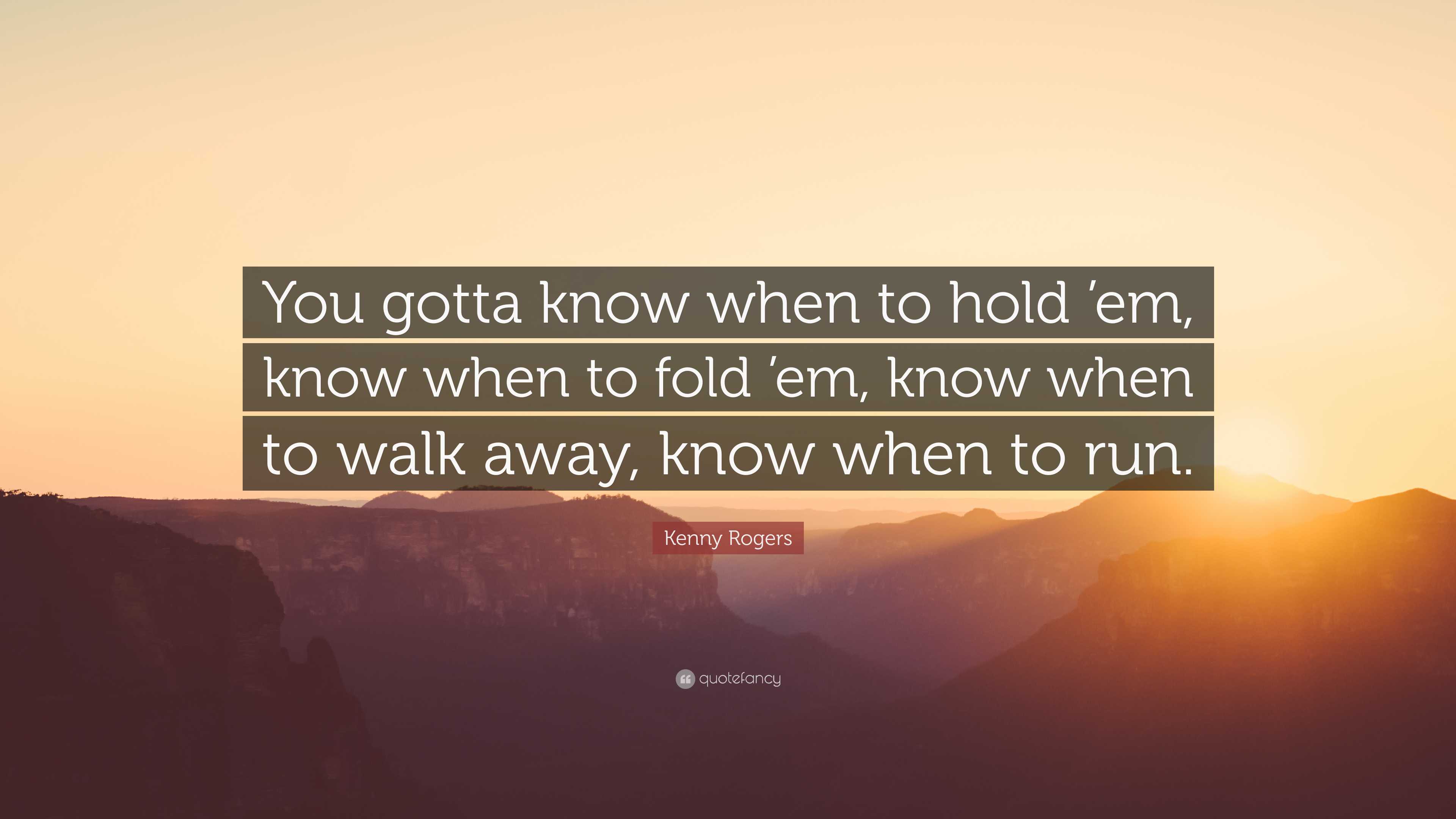
In 1978, a bearded country singer named Kenny Rogers sat down in a studio and recorded a story about a late-night train ride that changed how we think about survival. It wasn’t just a song. Honestly, it became a cultural shorthand for knowing when to quit. When people say you gotta know when to hold’em, they aren't usually talking about a literal game of five-card draw. They’re talking about the agonizing, sweat-inducing moments where you have to decide if you’re going to double down on a failing project or walk away with your dignity intact.
Don Schlitz wrote the lyrics in 1976. He was only 23 years old. Think about that for a second. A kid in his early twenties penned the definitive philosophy on life-long wisdom and professional restraint. He shopped it around for two years. Other artists tried it—Roger Miller and even Johnny Cash took a swing at it—but it didn't stick. It took Kenny Rogers’ gravelly, weathered delivery to make the world actually listen. It’s a song about a gambler, sure, but it’s mostly a song about the math of human choice.
The lyrics are deceptive. On the surface, it’s a dark vignette about two strangers on a train bound for nowhere. One guy is out of aces; the other is out of hope. But the core advice—know when to hold, know when to fold, know when to walk away, and know when to run—is basically a masterclass in game theory. It’s about the "sunk cost fallacy" before that term became a buzzword in Silicon Valley boardrooms.
The Psychology of Folding
Most people are terrible at folding. We are wired to keep going. Psychologists call this loss aversion. Research by Daniel Kahneman and Amos Tversky basically proved that the pain of losing $100 is twice as powerful as the joy of gaining $100. Because we hate losing so much, we stay in bad relationships, bad jobs, and bad poker hands far longer than we should. We think that if we just stay a little longer, we can "break even."
But the gambler on the train knew better. He understood that every hand has a shelf life.
When you say you gotta know when to hold’em, you’re acknowledging that sometimes the bravest thing you can do is quit. Quitting gets a bad rap in our "hustle culture" era. We’re told that winners never quit. That’s a lie. Winners quit constantly. They quit things that aren't working so they can save their energy for the things that will. If you’re holding a pair of deuces and the guy across from you is acting like he’s got a full house, staying in isn't "grit." It’s a mistake.
Strategy Over Luck
Let’s talk about the difference between a gamble and a calculated risk. In the song, the gambler asks for a taste of the narrator’s whiskey in exchange for advice. He’s observant. He says he can see the narrator is "out of aces" just by looking at his face. This is what experts call "reading the room."
In business, this translates to market signals. In 2006, Netflix was still mailing DVDs. They saw the "aces" of physical media were disappearing. They had to decide: do we hold onto the mail-order business or fold it into a streaming service that might fail? They chose to fold the old model. If they hadn't, they’d be sitting in the graveyard next to Blockbuster right now. Blockbuster didn't know when to fold. They held onto their late-fee business model until the train hit a dead end.
Real expertise isn't about being lucky. It's about knowing the odds.
Professional poker players like Annie Duke, who wrote Thinking in Bets, argue that we should judge our decisions by the process, not just the outcome. You can make a perfect decision and still lose because of a bad break. Conversely, you can make a "stupid" move and win by pure luck. But over a long enough timeline? The person who knows the math—the one who knows when to walk away—is the only one who survives.
Knowing When to Run
There is a specific escalation in the lyrics. Holding and folding are tactical. Walking away is strategic. But running? Running is an emergency response.
There are moments in life where the situation isn't just "not working"—it’s toxic. This applies to high-stakes investing and personal safety alike. If you’re in a venture where the ethics are shifting or the foundation is crumbling, you don't "walk." You run. You cut your losses and you don't look back.
The gambler died in his sleep at the end of the song. It’s a bit grim, but it highlights the stakes. Life is finite. Your "chips" are your time, your money, and your sanity. You only have a certain amount of each. Spending them on a hand that you know is a loser is the ultimate waste of a life.
Common Misconceptions About the "Gambler" Mentality
People often think this phrase means you should be cautious. Not really.
- Holding isn't passive. It’s an aggressive choice to stay the course when things get shaky.
- Folding isn't weakness. It’s a tactical retreat to preserve resources for a better opportunity.
- Walking away isn't quitting. It’s recognizing that the game itself is no longer worth playing.
Think about the tech bubble of the early 2000s or the housing crash of 2008. The people who "won" weren't necessarily the ones who stayed the longest. They were the ones who recognized the "look" in the market’s eye—the same look the gambler saw on the train—and realized the aces were gone.
Actionable Insights for Decision Making
If you find yourself staring at a "hand" in your life and you aren't sure whether to hold or fold, try these steps.
First, ignore what you’ve already spent. The money is gone. The time is gone. Ask yourself: "If I were walking into this situation today for the first time, would I buy in?" If the answer is no, you’re just holding out of pride. Fold.
Second, check your "tells." Are you staying in because you believe in the project, or because you’re afraid of what people will say if you quit? The gambler told the narrator that "every gambler knows that the secret to survivin' is knowin' what to throw away." Your reputation for "never quitting" might be the very thing you need to throw away to save your future.
Third, look for the "break even" trap. If your strategy is "I’ll quit as soon as I get back to where I started," you are in a dangerous spot. The universe doesn't owe you a break-even point.
You gotta know when to hold’em because your resources are limited. Stop treating your life like a series of infinite rounds. Treat it like a single night on a dark train. Every choice matters. Every discard counts.
To apply this today, audit your current commitments. Identify one project, habit, or investment that is clearly "out of aces." Write down exactly what it would take for you to "fold" by the end of the month. Don't wait for the hand to play out if you already know the dealer has the advantage. Start looking for the next game instead.