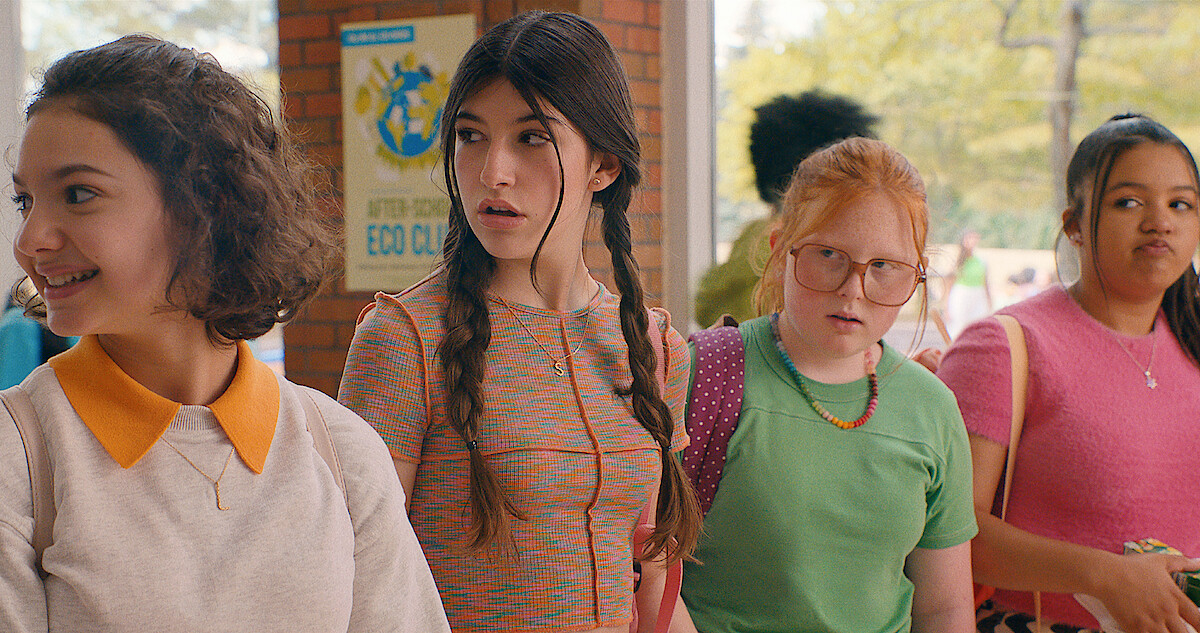
Growing up is a mess. It's sweaty, awkward, and usually involves saying something incredibly stupid to the person you like most in the world. When Netflix dropped You Are So Not Invited to My Bat Mitzvah, a lot of people expected another "Adam Sandler movie." You know the vibe—goofy voices, tropical locations, and his real-life buddies. But this one was different. Honestly, it was a breath of fresh air because it felt real, even with the high-stakes drama of a middle-school party hanging in the balance.
The movie isn't just about a party. It’s about that specific, agonizing moment in time when a friendship break-up feels more world-ending than a literal apocalypse.
What You Are So Not Invited to My Bat Mitzvah Gets Right About Gen Z
Most "teen" movies written by 50-year-olds are painful to watch. They use slang that died three years ago and make everyone look like they’re 25. But because this film was based on Fiona Rosenbloom’s 2005 novel and updated for a world of TikTok and viral embarrassments, it hit a nerve. Sunny Sandler plays Stacy Friedman, and she’s not a polished Hollywood kid. She’s relatable. She’s messy. She makes terrible decisions because her prefrontal cortex hasn't finished loading yet.
Middle school is a war zone of social cues.
Stacy and her best friend Lydia (played by Samantha Lorraine) have a falling out over—what else?—a boy. Andy Goldfarb. But the boy is just a catalyst. The real story is about the transition from childhood playmates to young adults trying to figure out where they fit in the social hierarchy. It’s about the pressure of the Bat Mitzvah itself, which in many Jewish communities has evolved from a religious rite of passage into a high-production gala that rivals some weddings.
The Sandler Family Dynamic
One of the coolest things about You Are So Not Invited to My Bat Mitzvah is that it’s a total family affair. Adam Sandler plays the dad, Danny Friedman, and he’s remarkably understated here. He isn't the star; he’s the support. His real-life wife, Jackie Sandler, plays Lydia’s mom, and his other daughter, Sadie Sandler, plays Stacy’s older sister, Ronnie.
Seeing them interact on screen adds a layer of authenticity that you can’t fake with casting calls. When Danny yells at Stacy about the cost of the party or the "magic" of the moment, it feels like a real dad who is both annoyed and deeply in love with his kid.
- Sunny Sandler carries the emotional weight of the film with a performance that feels genuinely vulnerable.
- Idina Menzel returns as Sandler's on-screen wife (uncut gems fans, unite), providing a grounding force.
- Sarah Sherman (from SNL) steals every single scene she is in as Rabbi Rebecca. Her character is a perfect example of how modern religious leaders try to bridge the gap between ancient traditions and kids who just want to talk about "The Vibe."
Why the "Coming of Age" Genre Needed This
Let's be real for a second. A lot of modern comedies are cynical. They try too hard to be edgy or too hard to be "important." This movie just tries to be honest. It tackles the concept of the mitzvah—the "good deed"—not just as a checkbox for a ceremony, but as a way of living. Stacy spends most of the movie being incredibly selfish, which is exactly what 13-year-olds do.
The turning point isn't a magical realization. It's the consequences of her actions finally catching up to her.
Director Sammi Cohen manages to capture the specific aesthetic of suburban New Jersey/New York life. The bright colors, the frantic energy of the mall, the sheer terror of the school hallway—it all works because it doesn't look like a set. It looks like life.
The Cultural Impact and the "Nepo Baby" Conversation
You can't talk about You Are So Not Invited to My Bat Mitzvah without mentioning the "nepo baby" discourse. People love to complain when celebrities cast their own kids. However, the critical consensus shifted pretty quickly once people actually watched the movie. Critics from The New York Times and Variety noted that the Sandler daughters actually have talent. They aren't just standing there; they have comedic timing.
Adam Sandler has used his production company, Happy Madison, to take care of his friends for decades. Now, he’s using it to launch his kids, but he’s doing it by giving them roles that actually suit their age and experience. It’s hard to stay mad at a guy for making a sweet, funny movie with his family that actually ends up being one of his highest-rated projects on Rotten Tomatoes.
Small Details That Mattered
- The "Entrance" Video: Every kid who had a Bar or Bat Mitzvah in the last twenty years knows the cringe of the pre-taped entrance video. The movie nails this.
- The Music: The soundtrack moves from modern hits to the classic party staples that have been played at every Jewish party since 1994.
- The Rabbi: Rabbi Rebecca’s "modern" songs about the Torah are so painfully accurate to how some youth leaders operate that it’s almost triggering for anyone who grew up in Hebrew school.
The Reality of Friendship Breakups
Friendship breakups in your early teens are often more painful than romantic ones. When Stacy feels "uninvited" from Lydia's life, it’s a visceral rejection. The movie handles the "villain" arc of Stacy perfectly. Usually, we want our protagonists to be likable. Stacy is, for a good chunk of the runtime, pretty unlikable. She’s mean to her parents, she betrays her friend, and she sabotages Lydia’s big moment.
But that's the point.
Growth isn't linear. You have to mess up spectacularly to understand why the rules of being a "good person" exist in the first place. The movie doesn't let her off the hook easily, which is why the ending feels earned rather than forced.
Lessons from the Friedman Household
If you're watching this as a parent, there's a lot to learn about the "letting go" phase. Danny Friedman wants his daughter to stay his little girl, but he also has to watch her make mistakes that he can't fix with a joke or a hug. The "You Are So Not Invited" line isn't just a threat between girls; it's a symbol of the walls kids start building as they seek independence.
The film reminds us that:
- Apologies require more than just words; they require sacrifice.
- Your parents usually know more than you give them credit for.
- A party is just a party, but a "mitzvah" is a commitment to the community.
Actionable Steps for Navigating Middle School Drama
If you’re a parent or a teen dealing with the kind of drama seen in You Are So Not Invited to My Bat Mitzvah, here is how to handle the fallout without losing your mind.
For the Teens: Own the mess. If you did something "snakey" like Stacy did, a text message isn't going to fix it. True reconciliation usually involves an ego hit. You have to be willing to be the "loser" for a minute to win back a friend. Also, remember that the person you're crushing on at 13 probably won't matter in three years, but a best friend who knows your deepest secrets is irreplaceable.
For the Parents: Validate the feelings, even if the "problem" seems tiny to you. To a 13-year-old, a leaked video or a snubbed invitation feels like a social death sentence. Avoid the "back in my day" speeches for a bit. Just listen. Like Danny Friedman, sometimes you just need to be there with a snack and a willingness to drive them to the mall, even when they’re being "dramatic."
For Everyone: Keep the perspective. The film ends not when the party starts, but when the relationship is mended. Focus on the people, not the production. Whether it's a Bat Mitzvah, a birthday, or a graduation, the event is the frame; the friendship is the picture.
The movie isn't a masterpiece of cinema, and it doesn't try to be. It's a slice of life that captures a very specific, very loud, and very emotional period of time. It reminds us that we've all been "not invited" at some point, and we've all been the ones doing the uninviting. The trick is finding your way back to the dance floor together.