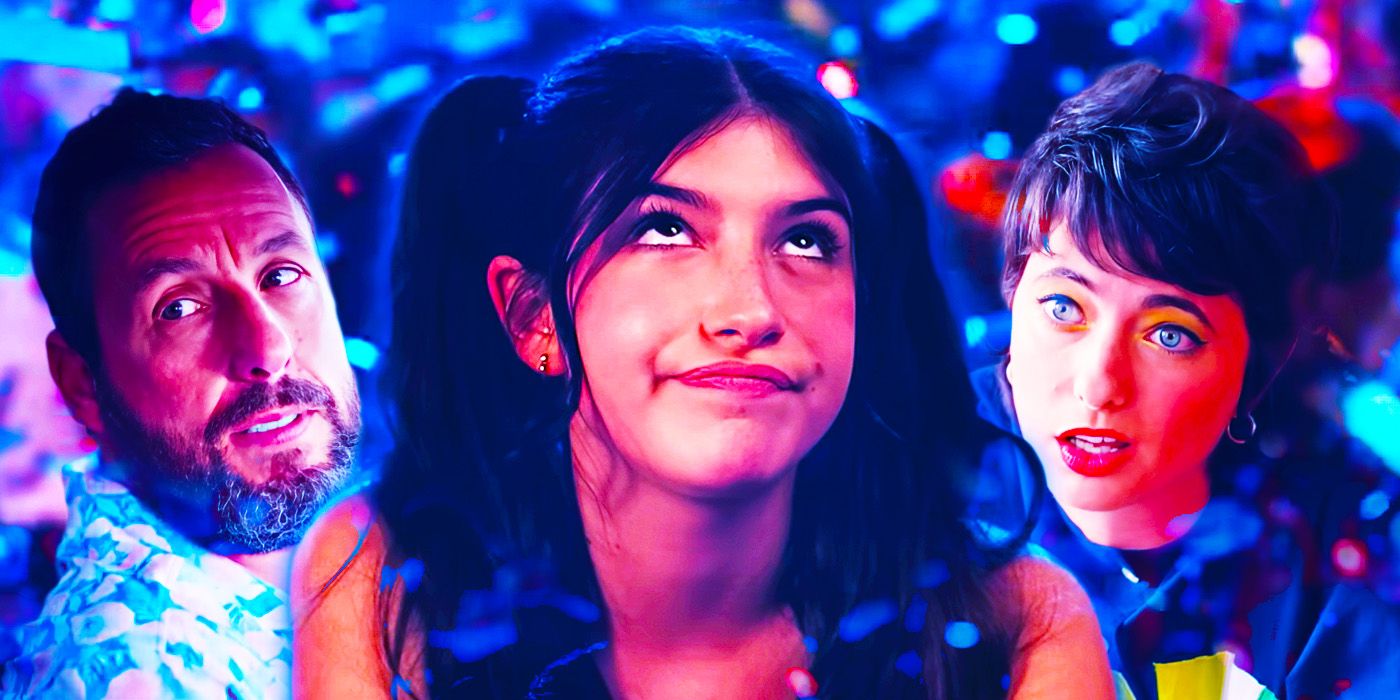
Adam Sandler finally did it. He made a movie that critics actually liked, and he did it by basically stepping into the background. If you haven't seen it yet, You Are So Not Invited to My Bat Mitzvah is a bit of a phenomenon. It’s not just another Happy Madison production where guys fall into pools. It’s a genuinely sweet, awkward, and painfully accurate look at being a thirteen-year-old girl in the suburbs.
Honestly, the stakes in this movie feel higher than an Avengers film. When you’re in middle school, a fight with your best friend over a boy feels like the end of the actual world. It’s dramatic. It’s messy.
The movie landed on Netflix in August 2023 and immediately started climbing the charts. People were surprised. Why was an Adam Sandler movie getting a 90% plus rating on Rotten Tomatoes? The answer is pretty simple: it’s authentic. It helps that the cast is mostly Sandler’s real-life family, which could have been a disaster of "nepo baby" proportions, but instead, it feels like we’re peaking into a real household.
The Real Story Behind the Screenplay
Fiona Rosenbloom wrote the original book back in 2005. It was a staple of the YA (Young Adult) scene for years before it ever hit the screen. The adaptation, directed by Sammi Cohen, keeps that mid-2000s heart but updates it for a world where TikTok and social media can ruin your life in roughly thirty seconds.
The plot follows Stacy Friedman. She’s obsessed with having the perfect Bat Mitzvah. She wants a high-end theme, a great dress, and she wants Andy Goldfarb to notice her. But things go sideways. Her best friend, Lydia, ends up kissing Andy, and suddenly the "You Are So Not Invited to My Bat Mitzvah" line gets dropped like a tactical nuke.
What’s interesting is how the movie handles the religious aspect. It’s not just a backdrop. We see the kids in Hebrew school, struggling with their Torah portions, and dealing with a Rabbi (played by Sarah Sherman) who is trying way too hard to be "cool." It captures that specific American Jewish experience where the party and the prayer are constantly at odds with each other.
Why the Sandler Family Dynamic Matters
Usually, when a celebrity casts their kids, the audience rolls their eyes. Here, it’s different. Sunny Sandler plays Stacy, and she’s actually... good. She has that specific brand of teenage frantic energy that you can’t really fake. Sadie Sandler plays her older sister, Ronnie, and Adam plays the dad, Danny.
Watching Adam Sandler play a suburban dad who is mostly just tired and wants to eat his snacks in peace is a vibe. He’s not the lead. He’s the support.
It feels grounded. When Danny tells Stacy that her dress is too short or that she’s being ridiculous, it doesn't feel like a scripted line. It feels like a dad who has had this exact argument four times today already. The chemistry isn't manufactured; it's decades of shared dinners and real-life arguments coming through the lens.
The Nuance of Middle School Friendships
Most movies about teenagers make them out to be either super-geniuses or complete idiots. You Are So Not Invited to My Bat Mitzvah treats them like people. Stacy and Lydia aren't "mean girls." They are just kids who are growing up at different speeds and hurting each other because they don't know how to handle their own big emotions yet.
The betrayal feels massive. You remember that age? The age where a friend liking your crush isn't just a bummer—it's a declaration of war.
Director Sammi Cohen told Variety that they wanted the movie to feel "messy and loud." They nailed it. There’s a scene involving a jump off a ledge into a quarry that perfectly encapsulates the "watch this" bravado of being thirteen. It’s stupid. It’s dangerous. It’s exactly what kids do when they’re trying to prove they aren’t "little" anymore.
Key Cultural Touchstones in the Movie
- The Mitzvah Project: Stacy’s struggle to find a "charity project" shows how kids often view community service as a checkbox until they actually connect with it.
- The Dress: The obsession with the "perfect outfit" is a universal rite of passage.
- The Rabbi: Sarah Sherman’s Rabbi Rebecca is a breakout. She’s weird, she sings, and she represents the bridge between tradition and the modern world.
- The Soundtrack: It’s a mix of pop hits and upbeat energy that keeps the pacing tight.
What Most People Get Wrong About the Film
Some critics tried to dismiss this as "just a kids' movie." That’s a mistake. While the primary audience is definitely the Gen Z and Gen Alpha crowd, there is a deep layer of nostalgia for parents.
It’s about the realization that our kids are separate people. Danny Friedman has to learn that he can’t fix Stacy’s social life with a joke or a stern talk. He has to let her fail so she can actually learn what a Mitzvah (a good deed or commandment) really is.
The film also avoids the "villain" trope. Andy Goldfarb, the boy at the center of the drama, isn't a bad guy. He’s just a middle school boy who likes attention and doesn't realize he's a wrecking ball. By not having a "bad guy," the movie forces the characters to look at their own actions. That’s a sophisticated move for a "teen comedy."
The Impact of Modern Trends
The movie doesn't shy away from the digital age. In the original book, Stacy didn't have to worry about a "B'nai Mitzvah" entrance video going viral for the wrong reasons. In the film, the threat of digital humiliation is everywhere.
It adds a layer of anxiety that feels very 2020s.
One of the most poignant moments is when Stacy realizes that her "perfect" party doesn't mean anything if her best friend isn't there to see it. It’s a trope, sure. But it’s a trope for a reason. The loneliness of a crowded room is a real thing, especially when you’re thirteen and the person you’ve spent every day with for a decade is sitting on the other side of the gymnasium.
Real-World Takeaways for Parents and Teens
If you’re watching this with your family, it’s a great conversation starter. Not in a "let’s have a meeting" kind of way, but in a "yeah, that sucks" kind of way.
- Apologies Matter: Stacy’s eventual realization that a real apology involves sacrifice, not just saying the words, is a huge lesson.
- Pressure is Real: The cost of these parties in real life—often ranging from $10,000 to over $100,000 in wealthy suburbs—creates an insane amount of pressure on kids to "perform" their coming-of-age.
- Perspective: At the end of the day, it’s one Saturday. The movie does a great job of showing that life continues on Sunday morning.
Moving Forward With Authenticity
The success of You Are So Not Invited to My Bat Mitzvah proves that audiences are hungry for stories that feel lived-in. We don’t need every movie to be a gritty reboot or a multiversal epic. Sometimes, we just want to see a kid try to navigate a middle school dance without crying in the bathroom.
It also signals a shift for Adam Sandler’s career. Through his Netflix deal, he’s found a way to transition from the "goofy lead" to the "supportive patriarch." It’s a smart move. It allows him to keep his brand alive while giving a platform to new voices and, evidently, his own family’s talent.
To get the most out of this story, look at it as a blueprint for modern coming-of-age tales. It respects the culture it depicts without being a caricature. It respects the emotions of its young leads without being condescending.
Next Steps for the Viewer:
Check out the original novel by Fiona Rosenbloom if you want to see how the story evolved from the 2000s to today. The differences are fascinating, especially regarding how technology has changed friendship. If you’ve already seen the film, watch the "making of" clips or interviews with Sammi Cohen to understand how they balanced the comedy with the religious significance of the ceremony. Finally, if you're planning a real-life event, use the film as a cautionary tale: the party is for the person, not the other way around. Focus on the relationships, and the rest usually falls into place.