You’ve heard it in the nursery. You’ve probably hummed it while rocking a baby to sleep. Maybe you even remember it from a cereal commercial or a particularly sentimental scene in a movie. On the surface, You Are My Sunshine the song feels like the ultimate lullaby—a warm, golden hug set to a simple melody. It’s a staple of childhood, right up there with "Twinkle Twinkle Little Star."
But here’s the thing. Most people are singing it wrong. Or rather, they’re only singing the "happy" part.
If you actually sit down and listen to the full lyrics—the verses that most parents conveniently skip—the song isn't a sweet ode to a child or a stable lover. It’s actually a desperate, slightly pathetic, and deeply depressing account of unrequited love and abandonment. It’s a song about a guy who is losing his mind because his partner left him for someone else. Honestly, once you realize the narrator is dreaming about his ex and waking up in tears, those "sunshine" metaphors start to feel a lot more like a heat stroke than a warm glow.
Who Actually Wrote It? The Jimmie Davis Controversy
Music history is messy. If you look at the official records, the song is credited to Jimmie Davis and Charles Mitchell. Davis was a country singer who eventually became the Governor of Louisiana (twice!), and he basically used the song as his political theme. It worked. People loved the "Singing Governor."
However, if you talk to folk historians or deep-dive into the archives of the late 1930s, the story gets murky. Many believe Davis didn't write it at all. Paul Rice, of the Rice Brothers Gang, is often cited as the real creator. Some say Davis bought the rights from Rice for about $35 during the Great Depression—a common practice back then. Rice allegedly wrote it about his wife, and when he needed cash, he sold his "sunshine" away.
Imagine that. One of the most profitable songs in history, sold for the price of a cheap dinner today.
The first recording actually came from The Pine Ridge Boys in 1939, shortly followed by the Rice Brothers. But when Jimmie Davis released his version in 1940, it exploded. It wasn't just a hit; it became a cultural phenomenon. By the time Davis was running for office, he was riding a horse named "Sunshine" and using the melody to convince voters he was a wholesome, god-fearing man. It’s a classic bit of political branding that we still see today, just with fewer banjos.
The Lyrics: It’s Not a Lullaby, It’s a Warning
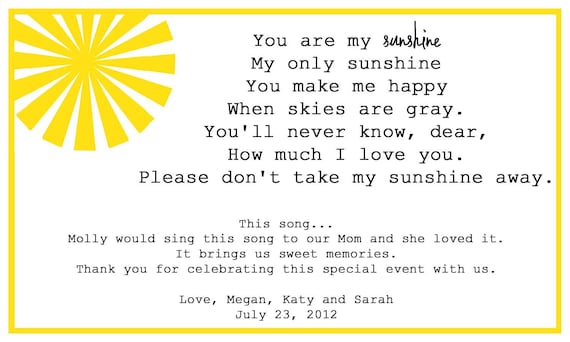
Let’s look at the verses. Most of us know the chorus by heart: "You are my sunshine, my only sunshine / You make me happy when skies are gray." It’s beautiful. It’s poetic.
Then we hit the second verse.
The narrator describes dreaming that he held his lover in his arms, but when he woke up, he was mistaken, and he "hung his head and cried." That is a massive tonal shift. We went from a sunny day to a lonely bedroom real fast. The song continues with the narrator pleading, "You've left me and behind you another / You have shattered all of my dreams."
It’s a breakup song.
Specifically, it’s a song about someone who is completely dependent on another person for their emotional stability. When that person leaves, the narrator’s entire world goes dark. There is a possessive streak in the lyrics too—"But if you leave me to love another / You'll regret it all some day." That sounds less like a lullaby and a lot more like a veiled threat from a bitter ex.
Why do we keep singing it to kids?
Probably because the melody is a "Major Key" earworm. It’s simple, repetitive, and easy for a toddler to grasp. We tend to cherry-pick the parts of culture that fit our needs. We need a song about love? We take the chorus. We ignore the part where the guy is weeping into his pillow.
This happens all the time in music. Think about "Every Breath You Take" by The Police. People play it at weddings even though Sting has explicitly said it’s about a creepy stalker. You Are My Sunshine the song occupies that same weird space where the vibe of the music totally contradicts the intent of the words.
The Ray Charles Effect and the Soul Revolution
While Jimmie Davis made it famous in the country world, Ray Charles made it legendary in the soul world. In 1962, Ray Charles released his version on the album Modern Sounds in Country and Western Music.
This was a pivot point for American music.
Charles took this "white" country song and injected it with pure, unadulterated grit. He slowed it down, added a brass section, and let the Raelettes provide a call-and-response that transformed the song into a soulful plea. He didn't hide the pain; he leaned into it. When Ray Charles sings it, you believe he’s heartbroken. You feel the "gray skies" he’s talking about.
Since then, everyone has covered it. We’re talking:
- Johnny Cash (who brought back the outlaw country grit)
- Aretha Franklin (who gave it a gospel-tinged power)
- The Beach Boys (who turned it into a psychedelic fragment)
- Ike & Tina Turner
- Carly Simon
Each artist picks a different "version" of the song to emphasize. Cash liked the darkness. The Beach Boys liked the irony. This versatility is why the song hasn't died. It’s a chameleon.
The Legal and Political Legacy
Jimmie Davis used the song to build a political dynasty in Louisiana. It was his "Old Town Road." It made him approachable. It’s fascinating how a song about a devastating breakup became the anthem for a successful gubernatorial campaign. It speaks to the power of a good hook. If you can get people to hum along, they’ll stop listening to what you’re actually saying.
In 1977, the Louisiana State Legislature even named it an official state song. They had to be careful, though. They usually focus on the chorus and the "spirit" of the song rather than the lyrics about being cheated on.
Interestingly, the copyright history of the song is a bit of a nightmare for researchers. Because it was bought and sold in an era of "handshake deals" and loose publishing laws, the exact lineage of the royalties is a maze. But one thing is certain: it is one of the top earners in the history of the music industry. It’s right up there with "Happy Birthday."
Why It Still Matters in 2026
We live in an era of "vibes." We stream playlists based on mood. You Are My Sunshine the song survives because it fits almost any mood depending on how you play it.
If you want to feel nostalgic, you play the acoustic folk version. If you want to feel the weight of the world, you listen to a minor-key cover on YouTube. It has become a vessel. It’s no longer just a song; it’s a piece of the American psyche.
But there’s also a lesson here about "folk process." Songs change. Their meanings evolve. What started as a potentially stolen blues/country lament became a political tool, then a soul masterpiece, and finally a sanitized nursery rhyme. It shows how we, as a culture, sanitize our history to make it more palatable for the next generation. We keep the sunshine and we bury the "hanging my head and crying."
Common Misconceptions
- It’s a song for children. No, it’s a song for people who just got dumped.
- Jimmie Davis wrote it from scratch. Highly unlikely. He likely bought it and polished it.
- It’s a happy song. Only if you stop listening after 30 seconds.
Actionable Takeaways for Music Lovers
If you're going to engage with this song, do it with some intentionality. Don't just let it be background noise.
- Listen to the "Full" Lyrics: Look up the versions by Gene Autry or Jimmie Davis. Actually listen to the story being told. It changes your perspective on the chorus immediately.
- Check out the Ray Charles Version: If you only know the "kiddy" version, this will blow your mind. It’s a masterclass in how to reinterpret a standard.
- Use it as a Case Study: If you're a songwriter or a creator, look at how "Sunshine" uses simple, universal imagery (sun, clouds, dreams) to convey complex emotions. It’s a blueprint for writing a song that lasts 100 years.
- Question the Source: Next time you hear a "classic," look into who actually got paid for it. The history of American music is full of unsung heroes like Paul Rice who sold their masterpieces for a pittance.
The next time you’re humming this tune to a kid or hearing it in a movie trailer, remember the guy waking up in a cold sweat, realizing his "sunshine" has found someone else. It makes the song a lot less cute, but a whole lot more human.