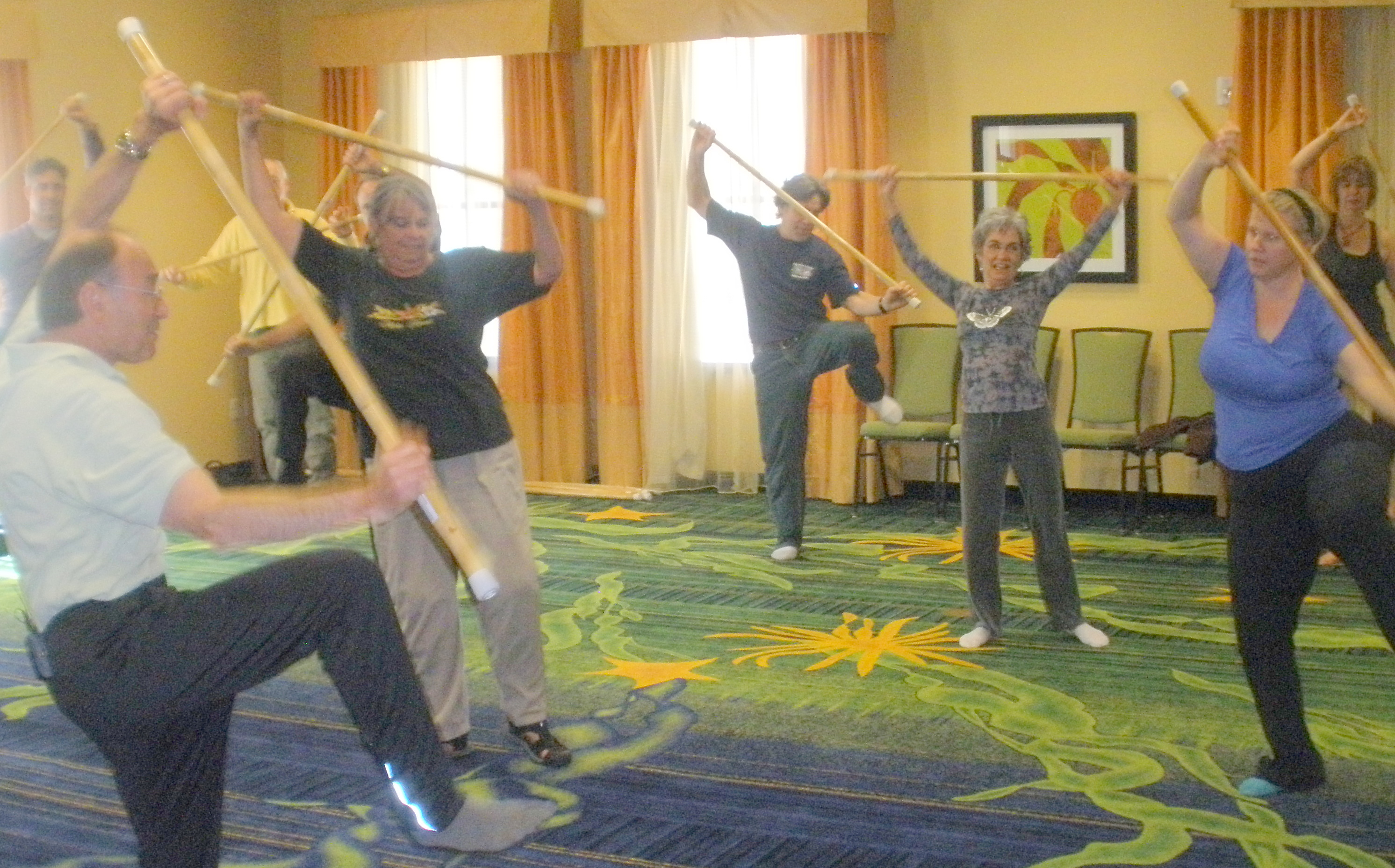
You’re probably used to seeing people in yoga studios clutching colorful foam blocks or stretching out with cotton straps. It’s the standard kit. But honestly, if you walk into a traditional Danda Yoga session or watch a seasoned practitioner using a simple wooden staff, you realize we might have over-complicated things with all the plastic gear. Yoga with a stick—sometimes called Danda Yoga or even just "stick stretching"—is basically the secret weapon for anyone who feels like their shoulders are permanently glued to their ears from staring at a laptop.
It’s simple. It’s cheap. And it works.
Most people think of yoga as this fluid, bendy thing where you need to be naturally supple to even start. That’s a total myth. Using a stick provides a fixed, unyielding axis that your body has to respond to. Unlike a strap, which can wiggle or give, a stick stays put. It forces symmetry. If your left shoulder is tighter than your right, the stick is going to tell you immediately. No lying. No cheating.
The Science of Proprioception and the Wooden Staff
Why does it feel so different? It’s mostly about proprioception—your brain’s ability to know where your limbs are in space. When you hold a rigid object like a dowel or a bamboo pole, you’re creating a closed kinetic chain.
A 2017 study published in the Journal of Physical Therapy Science looked at how weighted sticks affected trunk stability. They found that having that external reference point helped people engage their core muscles more effectively than just waving their arms in the air. It’s basic physics, really. By extending your reach and providing a lever, you’re changing the torque on your joints.
Think about a standard overhead reach. Most of us have "cheating" patterns. We flare our ribs or arch our lower backs because our shoulders are tight. When you do yoga with a stick, you can’t really flare one side without the stick tilting. It’s a literal feedback loop. You become your own alignment coach.
Why Your Shoulders Are Screaming for This
Modern life is a disaster for the thoracic spine. We’re all hunched. We’re all "tech-necking" our way through the day.
Dr. Kelly Starrett, a well-known physical therapist and author of Becoming a Supple Leopard, often talks about the importance of "external rotation" in the shoulders to create stability. Using a stick makes this position almost mandatory. If you grip a staff and pull your hands away from each other (without actually moving them), you feel your lats and posterior deltoids light up instantly.
It’s intense.
I’ve seen people who couldn’t touch their toes for a decade suddenly find a huge range of motion just by using a stick to stabilize their hips during a fold. It’s not magic; it’s just giving the nervous system a sense of safety. When your brain feels the support of the stick, it lets the muscles relax.
Getting Started: What Kind of Stick Do You Actually Need?
Don’t go out and buy a "luxury yoga wand" for $80. Seriously. It’s a scam.
Basically, any straight, sturdy pole will work. A lot of people just go to a hardware store and grab a 4-to-5-foot wooden dowel. You want it to be about an inch thick so your grip is comfortable. If you want to get fancy, you can look for a Bo staff used in martial arts, or even a heavy-duty PVC pipe.
- The Length Matters: Ideally, the stick should be about as tall as your armpit when it's standing on the floor.
- The Material: Wood is best. It has a bit of "soul" and a nice grip.
- The Weight: It should be light enough to move easily but heavy enough to feel substantial.
Some practitioners in India use a "Yoga Danda," which is a T-shaped wooden tool. It’s historically used to support the arm during pranayama (breathing exercises) to help change the flow of breath between nostrils. While that’s a bit more advanced, the concept remains the same: the tool serves the body, not the other way around.
Critical Poses That Change Everything
If you’re going to try yoga with a stick, you shouldn't just wing it. There are a few specific movements that offer the most bang for your buck.
The Overhead Pass-Through
This is the holy grail of shoulder mobility. Hold the stick in front of you with a very wide grip. Slowly lift it over your head and try to bring it all the way down to your lower back without bending your elbows.
Most people can’t do this at first.
You’ll probably have to slide your hands out to the very ends of the pole. That’s fine. As you get more mobile, you move your hands closer together. It’s a tangible way to measure progress. You can actually see yourself getting more flexible week by week.
Standing Side Lean (The Crescent Moon Variation)
In a normal yoga class, you reach one arm up and lean. It’s easy to collapse in the ribcage. With a stick held behind your neck (resting on the meaty part of your traps, not the bone!), you lean to the side. The stick ensures your chest stays open. It prevents that "crunching" feeling in the obliques and turns it into a massive side-body stretch.
The Stick-Supported Forward Fold
Place the stick on the floor about two feet in front of you. Grip the top with both hands and hinge at the hips. Push your butt back. This creates a "tabletop" spine that is nearly impossible to achieve solo if you have tight hamstrings.
It feels incredible. It’s like someone is gently pulling your spine long while you just hang there.
Addressing the "Gimmick" Accusations
Look, some purists hate this. They’ll tell you that yoga is about the body and the breath, and that props are a crutch.
They’re kinda wrong.
B.K.S. Iyengar, one of the most influential yoga teachers in history, revolutionized the practice specifically by introducing props. He used ropes, chairs, and—yes—sticks. He realized that most bodies aren't built like a 19-year-old gymnast. We have injuries. We have stiff joints. We have weird skeletal proportions.
A stick isn't a crutch; it’s an equalizer. It allows a 50-year-old construction worker with stiff shoulders to access the same heart-opening benefits as a flexible teenager.
A Note on Safety (Don't Be a Hero)
There is a downside. Because a stick provides so much leverage, it’s easy to push too hard.
Shoulders are delicate. They are "ball and socket" joints with a massive range of motion but not a lot of inherent stability. If you force a stick pass-through and feel a sharp, stabbing pain? Stop. Immediately. You aren't "stretching" a tendon; you're irritating it. Stick yoga should feel like a deep, dull ache of a good stretch—never a sharp bite.
The Mental Shift: Focus and Intention
There’s a meditative aspect to yoga with a stick that people don't expect. When you’re balancing a five-foot pole while trying to transition from a warrior pose to a balance, you have to be present. You can't think about your grocery list. If you lose focus, the stick wobbles.
It’s a form of moving meditation that uses an external object as an anchor. In some traditions, the stick represents the Sushumna Nadi, the central channel of energy in the body. By aligning the wooden stick, you are symbolically aligning your own internal axis.
Whether you believe in the "energy" side of things or not, the mental requirement is real. You’ve got to be locked in.
Real World Results: Who Is This For?
I've talked to golfers who swear by this. A golf swing is all about thoracic rotation and hip stability. If you spend 20 minutes doing stick rotations, your swing suddenly feels like it’s on grease.
It’s also huge in the "pre-hab" community. People recovering from rotator cuff issues (under professional guidance, obviously) use sticks to regain range of motion in a controlled way. It’s predictable. You know exactly where the pole is.
Actionable Steps to Start Today
You don't need a class. You don't need a $100 lululemon mat.
- Source your staff: Go to a hardware store. Ask for a 1-inch diameter oak or poplar dowel. Have them cut it to about 5 feet. Sand the ends so you don't get a splinter. Total cost: maybe $12.
- The 5-Minute Morning Reset: Every morning, do 10 overhead pass-throughs and 10 standing rotations. Keep your hips facing forward and only move your upper back.
- Use a Mirror: Especially at the start. You'll think the stick is level, but the mirror will show you it’s tilted 20 degrees to the left. Trust the wood, not your feelings.
- Incorporate it into Sun Salutations: Try holding the stick during a Warrior I or Warrior II. Feel how it changes the engagement of your arms and core.
This isn't just a fitness trend. It's a return to a more mechanical, honest way of moving the body. It takes the guesswork out of alignment. If you're tired of feeling "stuck" in your yoga progress, or just "stuck" in your own body, find a stick. Stand up tall. Start moving. You’ll feel the difference in your spine before you even finish the first set.