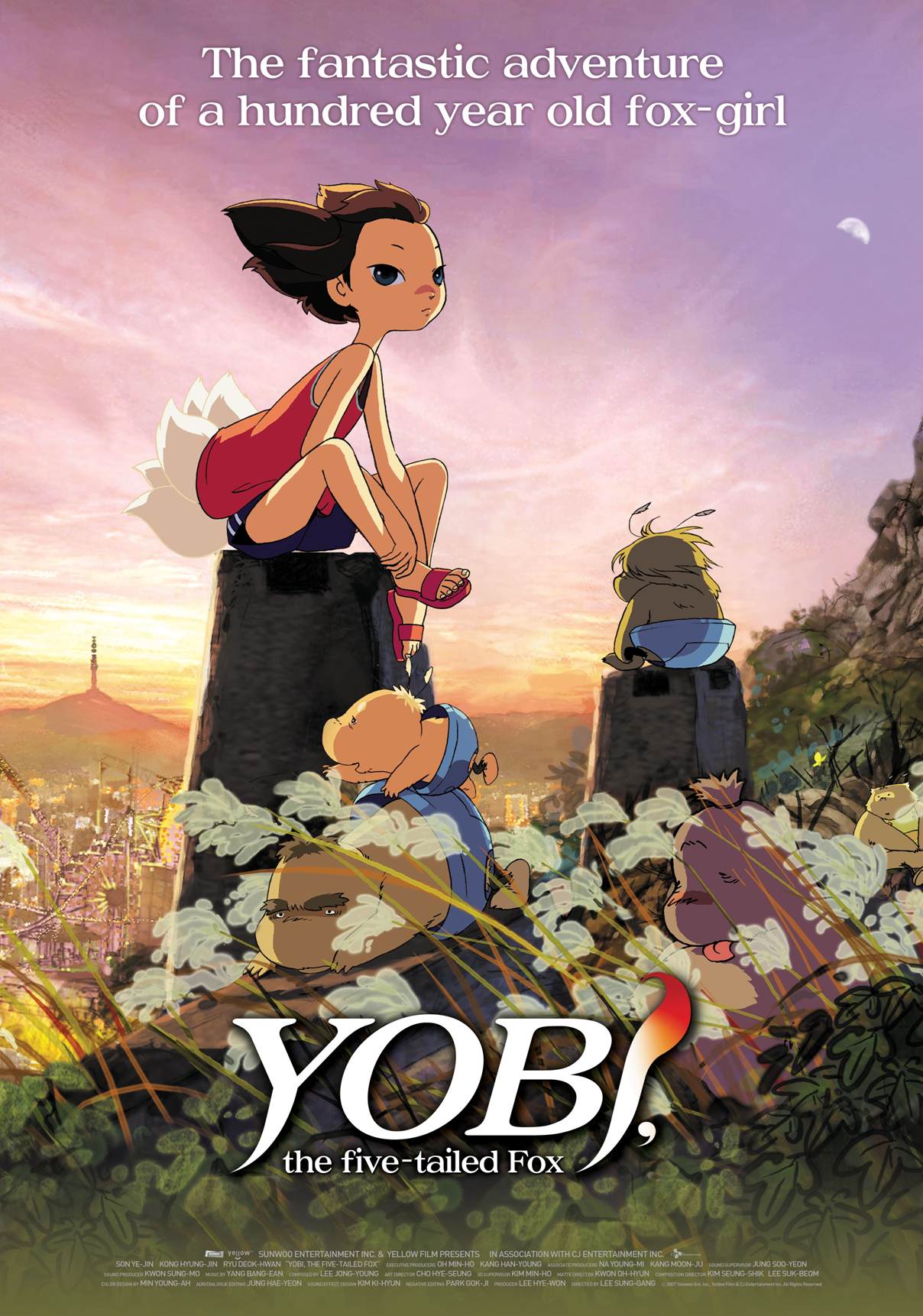
You've probably heard of the nine-tailed fox. The Gumiho is a staple of Korean folklore, usually portrayed as a seductive, bloodthirsty spirit that wants to eat your liver or heart to become human. But Yobi, the Five-Tailed Fox (Cheon-nyeon-yeo-woo-yeo-bi) flips that script. It’s a 2007 animated film directed by Lee Sung-gang, and honestly, it’s one of the most misunderstood pieces of Korean animation out there.
Most people expect a Gumiho story to be scary. This isn't that.
What Yobi, the Five-Tailed Fox is Actually About
Yobi is an outcast. She’s only got five tails, not nine, and she lives in the woods with a group of stranded aliens who look like sentient jellyfish. It sounds bizarre because it is. When one of the aliens gets captured by humans, Yobi has to venture into the world of people to save him. She ends up disguising herself as a young girl and joining a summer camp for "special" kids.
The stakes are higher than just a rescue mission.
There’s this Shadow Man who hunts souls. Yobi wants a human soul because she thinks it’s her ticket to becoming human herself. But here’s the kicker: she starts falling for a human boy named Geum-ee. Now she’s stuck in a moral vacuum. To get what she wants, she has to take it from someone else. It's a classic coming-of-age dilemma wrapped in 2D and 3D animation.
The Lee Sung-gang Style: Why It Looks So Different
If you're a fan of Studio Ghibli, you’ll notice the influence immediately, but it’s not a clone. Lee Sung-gang, who also directed My Beautiful Girl, Mari, has a very specific aesthetic. He loves soft, painterly backgrounds mixed with slightly clunky early-2000s CGI.
Back in 2007, Korean animation was struggling to find its identity. They were caught between the massive shadow of Japanese anime and the growing dominance of Disney-Pixar. Yobi, the Five-Tailed Fox was an attempt to carve out a middle ground. It uses traditional Korean motifs but tells a story that feels universal. The movement is fluid, but the pacing is dreamy. It doesn't rush to a climax like a Hollywood blockbuster. It lingers on the forest, the rain, and the quiet moments of loneliness.
Why Five Tails Instead of Nine?
Symbolism matters here. The number five is intentional.
In folklore, a Gumiho gets its ninth tail after living for a thousand years or performing specific tasks. Yobi is essentially an adolescent. She’s incomplete. That’s the core of her character—she doesn't quite fit in the spirit world, and she definitely doesn't fit in the human world. She's a "half-baked" creature trying to find where she belongs.
People often get confused by the Shadow Man. He’s not just a villain; he’s a catalyst. He represents the dark side of desire. In many Gumiho myths, the fox is purely predatory. In Yobi's world, the "predator" is an external force tempting her to give up her innocence. It’s a subversion of the original myth that makes her a protagonist you actually root for instead of fear.
The Voice Behind the Fox: Son Ye-jin
If the name Son Ye-jin sounds familiar, it should. She’s one of the biggest stars in Korea, known globally for Crash Landing on You.
She voiced Yobi.
It was a huge deal at the time because big-name "A-list" actors didn't always do voice work for animation in Korea back then. She brought a breathy, innocent, yet mischievous quality to the character. If you watch the subbed version, you can hear her range. She manages to make Yobi sound like a century-old spirit and a confused teenager at the same time. The chemistry (voice-wise) between her and Ryu Deok-hwan, who voiced Geum-ee, is what keeps the emotional core of the movie from falling flat.
Common Misconceptions and Critique
Let's be real: the movie isn't perfect.
Critics often point out that the plot is a bit of a mess. You have aliens, a shadow hunter, a school of misfits, and a magical lake. It’s a lot to jam into 86 minutes. Some viewers find the transition between the 2D characters and the 3D environments jarring. It was a product of its time—an era where everyone was experimenting with hybrid animation.
But if you look past the technical limitations of 2007, the heart is there. It’s a story about the weight of a soul.
The ending is notoriously divisive. No spoilers, but it’s bittersweet. It doesn’t give you the clean, tied-up-with-a-bow finale that Western audiences usually crave. It’s very "Korean" in its melancholy. It acknowledges that growing up usually means losing something precious.
Where to Find Yobi Today
Finding a high-quality stream of Yobi, the Five-Tailed Fox can be a bit of a treasure hunt. It pops up on various niche Asian cinema streaming platforms periodically. Physical copies are rare but highly sought after by collectors of Korean cinema.
If you're looking to explore more Korean animation, this is the gateway drug. It paved the way for more modern hits like The King of Pigs or The Fake, though Yobi is much lighter and more family-friendly than those titles.
How to Appreciate Yobi as a Viewer
To get the most out of this film, you have to stop comparing it to Pixar.
Appreciate the soundtrack by Yang Bang-ean (also known as Ryo Kunihiko). He’s a legendary composer who worked on Twelve Kingdoms and Aion. The music in Yobi is sweeping and orchestral, grounding the weird alien/fox plot in real emotion.
- Watch the original Korean dub. Even if you prefer English, the nuances in Son Ye-jin’s performance are worth the subtitles.
- Look at the backgrounds. The forest scenes are stunning and hold up better than the CGI elements.
- Research the Gumiho myth beforehand. Knowing how "evil" these foxes are supposed to be makes Yobi’s kindness more impactful.
Understanding Yobi, the Five-Tailed Fox requires looking at it as a piece of cultural history. It was a bold step for a country trying to find its voice in a medium dominated by its neighbors. It’s weird, it’s beautiful, and it’s a little bit sad.
If you want to dive deeper into Korean folklore through animation, start by tracking down a copy of the Yobi soundtrack. It sets the mood perfectly. After that, look into the filmography of Lee Sung-gang to see how his style evolved. He remains one of the few directors in Korea pushing for "art-house" animation that still appeals to a broader audience.
Don't go in expecting a high-octane action flick. Go in for a fable. You’ll find that Yobi’s search for a soul says a lot more about our own humanity than you might expect from a "cartoon" about a fox with five tails.
Actionable Next Steps
- Seek out the soundtrack: Search for "Yang Bang-ean Yobi the 5 Tailed Fox OST" on streaming platforms. It’s the best way to experience the film’s atmosphere.
- Compare with My Beautiful Girl, Mari: Watch Lee Sung-gang’s previous work to see the visual DNA that led to Yobi.
- Explore the Gumiho lore: Read up on the traditional Korean Gumiho stories to appreciate exactly how much Yobi breaks the mold.