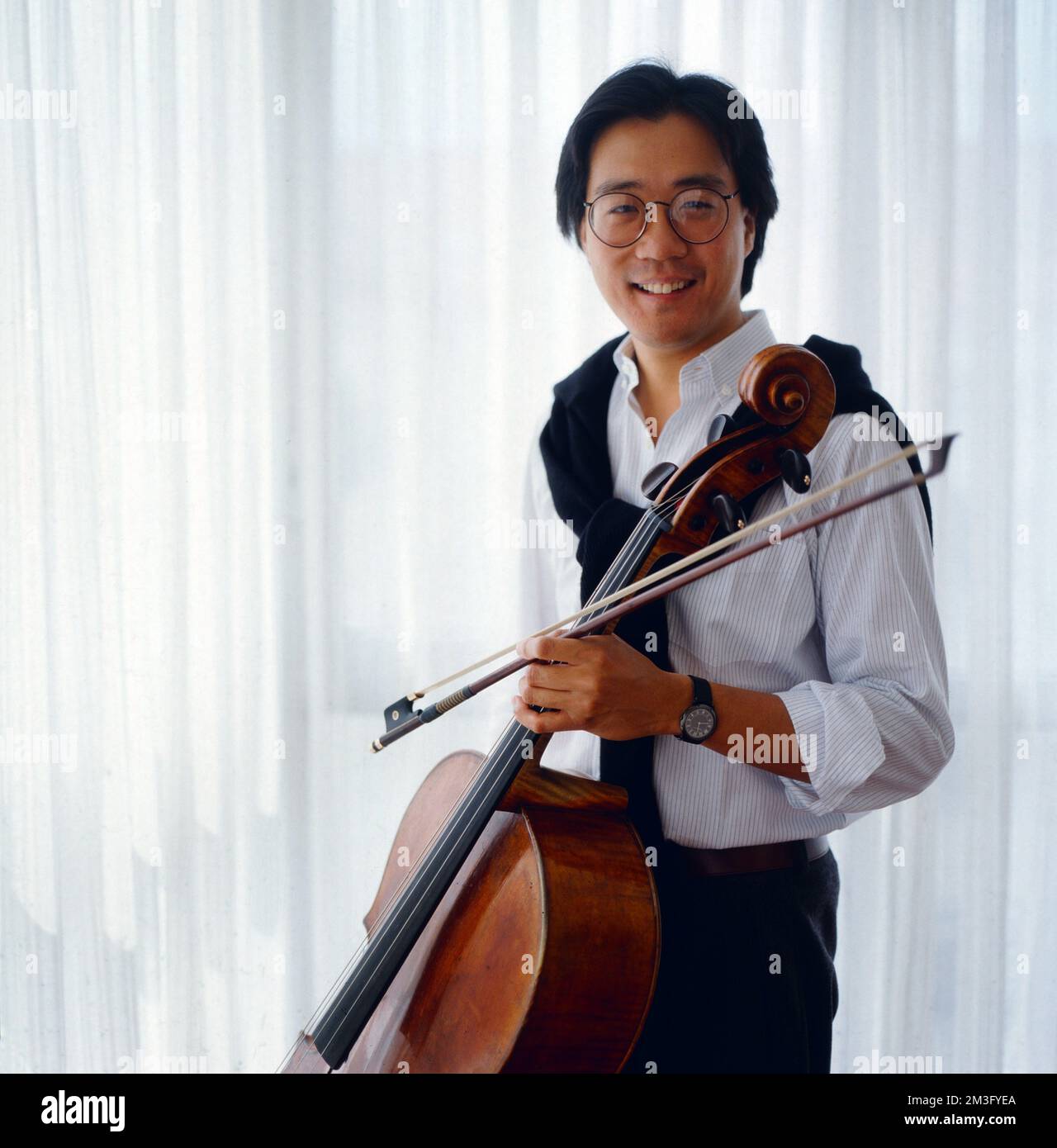
He leans in. Most people don't notice the way he almost hugs the instrument before the bow even touches the string, but that's where the magic starts. When you see Yo-Yo Ma playing cello, you aren't just watching a technical performance. You’re watching a guy who has spent over six decades trying to prove that a wooden box can actually speak. It’s intense. It’s also, weirdly enough, very chill.
He's a superstar, sure. But he's a superstar who shows up at community centers and subway stations.
The thing about Ma is that he doesn't just play the notes. He lives them. You can see it in his face—that "cello face" that has become a bit of an internet meme. He’s not performing for the back row; he’s reacting to the vibrations. Honestly, if you’ve ever sat close enough to a cello, you know it’s a physical experience. The low C string vibrates in your chest. Ma knows this better than anyone on the planet.
What's actually happening when Yo-Yo Ma starts playing?
Technique is boring to talk about, usually. But with Ma, it’s necessary because he broke the rules. Most classical trainers beat "perfect posture" into your head. Sit straight. Hold the bow like this. Don't move your torso.
Yo-Yo Ma basically said "no thanks" to the rigidness.
If you watch him closely, his body is constantly in motion. He uses his entire weight—shoulders, back, even his feet—to drive power into the instrument. This isn't just for show. By moving with the cello, he avoids the repetitive strain injuries that kill the careers of lesser musicians. He calls it "finding the center." When Yo-Yo Ma playing cello becomes a viral clip, it's usually because of that fluidity. He looks like he’s dancing while sitting down.
He uses a few different instruments, but the big ones are legendary. There’s the 1733 Montagnana cello from Venice, nicknamed "Petunia." It has a massive, earthy sound. Then there’s the 1712 "Davidov" Stradivarius. That one used to belong to Jacqueline du Pré. It’s finicky. It’s temperamental. It requires a touch so light it’s almost frustrating. Ma has mastered both, which is like being able to drive a heavy-duty truck and a Formula 1 car with the same level of comfort.
The Silk Road and the "Global" Cello
For a long time, the classical world was a bit stuffy. You played Bach. You played Beethoven. You went home.
Ma got bored.
In 1998, he started the Silk Road Project. He wanted to see what happened when you mixed a cello with a pipa from China or a duduk from Armenia. Critics initially hated it. They called it "musical tourism." They were wrong. What Ma realized was that the cello is essentially a vocal instrument. It has the same range as the human voice. Because of that, it can bridge the gap between cultures that don't even speak the same language.
He isn't just a "classical" guy anymore. He’s a collaborator.
The Bach Cello Suites: His lifelong obsession
You can't talk about Yo-Yo Ma playing cello without talking about Johann Sebastian Bach. The Six Unaccompanied Cello Suites are the "Mount Everest" of the instrument. Ma has recorded them three times. Think about that. Most people are lucky to record them once.
The first time he did it, he was in his twenties. It was technically perfect. The second time, he was looking for more color and character. The third time? He called it Six Evolutions.
He released it in his 60s. It’s slower. It’s heavier. It feels like someone telling a story at the end of a long life. There’s a specific track, the Prelude to Suite No. 1, that literally everyone recognizes. It’s been in every movie ever made. But when Ma plays it now, he adds these tiny hesitations—rubato—that make it feel like he’s discovering the notes for the first time. It’s not a recital. It’s a conversation.
Why he plays in weird places
Why would a man who can sell out Carnegie Hall play at a vaccination clinic or a border fence?
It’s about "cultural commerce." Ma believes that music only works if it’s shared where people actually live. During the height of the COVID-19 pandemic, he sat in a waiting room after getting his second shot and just... played. He played for the nurses. He played for the tired people in plastic chairs.
That’s the core of his philosophy. Music isn't a luxury item. It’s a tool for survival.
He once played at the edge of the Rio Grande, facing both the U.S. and Mexico. No stage. No fancy lights. Just a man and a cello. He was trying to show that while borders divide, culture connects. It sounds cheesy when most people say it. When Ma does it, it feels like a fundamental truth.
The gear: It's not just about the wood
A lot of people think he only plays multi-million dollar antiques. Not true.
He’s actually a big fan of carbon fiber cellos. Specifically, he’s used a Luis and Clark carbon fiber model for outdoor performances. Why? Because wood cracks. If you’re playing in the humidity of a rainforest or the cold of a mountain top, a 300-year-old Stradivarius will literally fall apart. The fact that he’s willing to use a "plastic" cello shows he cares more about the music than the pedigree.
He also uses a variety of bows. The bow is actually more important than the cello in some ways. It’s the "tongue" of the instrument. He has been known to use carbon fiber bows as well, though he usually sticks to high-end Pernambuco wood for concert halls.
Does he ever mess up?
Yeah. He does.
And that’s why people love him. There are recordings where you can hear his breathing. You can hear the "scratch" of the bow hair on the string. In a world of Autotune and perfectly polished digital albums, Ma’s playing is stubbornly human. He’s been known to break strings mid-performance. When it happens, he usually just laughs, swaps instruments with the principal cellist of the orchestra, and keeps going.
How to listen like an expert
If you want to truly appreciate Yo-Yo Ma playing cello, don’t just put it on as background music while you do the dishes.
- Listen for the "decay." Watch how he lets a note fade into silence. He doesn't just stop; he lets the air take the sound.
- Watch his left hand. He uses a lot of vibrato (that shaking motion), but he varies the speed of it to change the emotion of the piece. Fast vibrato for tension, slow for peace.
- Notice the silence. Ma is a master of the pause. Sometimes the most powerful part of his playing is the second after the note ends.
He’s also leaned heavily into the health benefits of music. He’s worked with neuroscientists to study how rhythm and melody can help people with Alzheimer’s or PTSD. He isn't just a performer; he’s basically a researcher now.
Practical steps for the aspiring listener
If you're new to this, don't start with the avant-garde stuff. It can be a bit much.
First, go find his 2018 recording of Bach: Six Evolutions. Use good headphones. Close your eyes. Don't skip tracks. Just let the whole thing wash over you. It’s the definitive statement on what a cello can do.
Second, look up his "Goat Rodeo Sessions." This is where he plays bluegrass/Americana with Chris Thile, Stuart Duncan, and Edgar Meyer. It will completely change your idea of what a "classical" cellist is allowed to do. He’s jamming. He’s improvising. He’s having a blast.
Finally, check out his Songs of Comfort and Hope project. It was recorded during the 2020 lockdowns with pianist Kathryn Stott. These are short, familiar tunes—everything from "Over the Rainbow" to "Amazing Grace." It’s a masterclass in how to play a simple melody with maximum soul.
Actionable Insight: If you really want to understand the physics of his sound, try to attend a "masterclass" video on YouTube rather than just a concert. Seeing him explain how he creates a specific tone to a student reveals the immense intellectual work behind the emotional exterior. The man is a scholar disguised as a poet.
The legacy of Yo-Yo Ma isn't going to be his Grammys or his Presidential Medal of Freedom. It’s going to be the fact that he took an instrument that was seen as a relic of the 18th century and made it feel essential for the 21st. He made the cello human. He made it approachable. And he did it all while looking like he was having the time of his life.