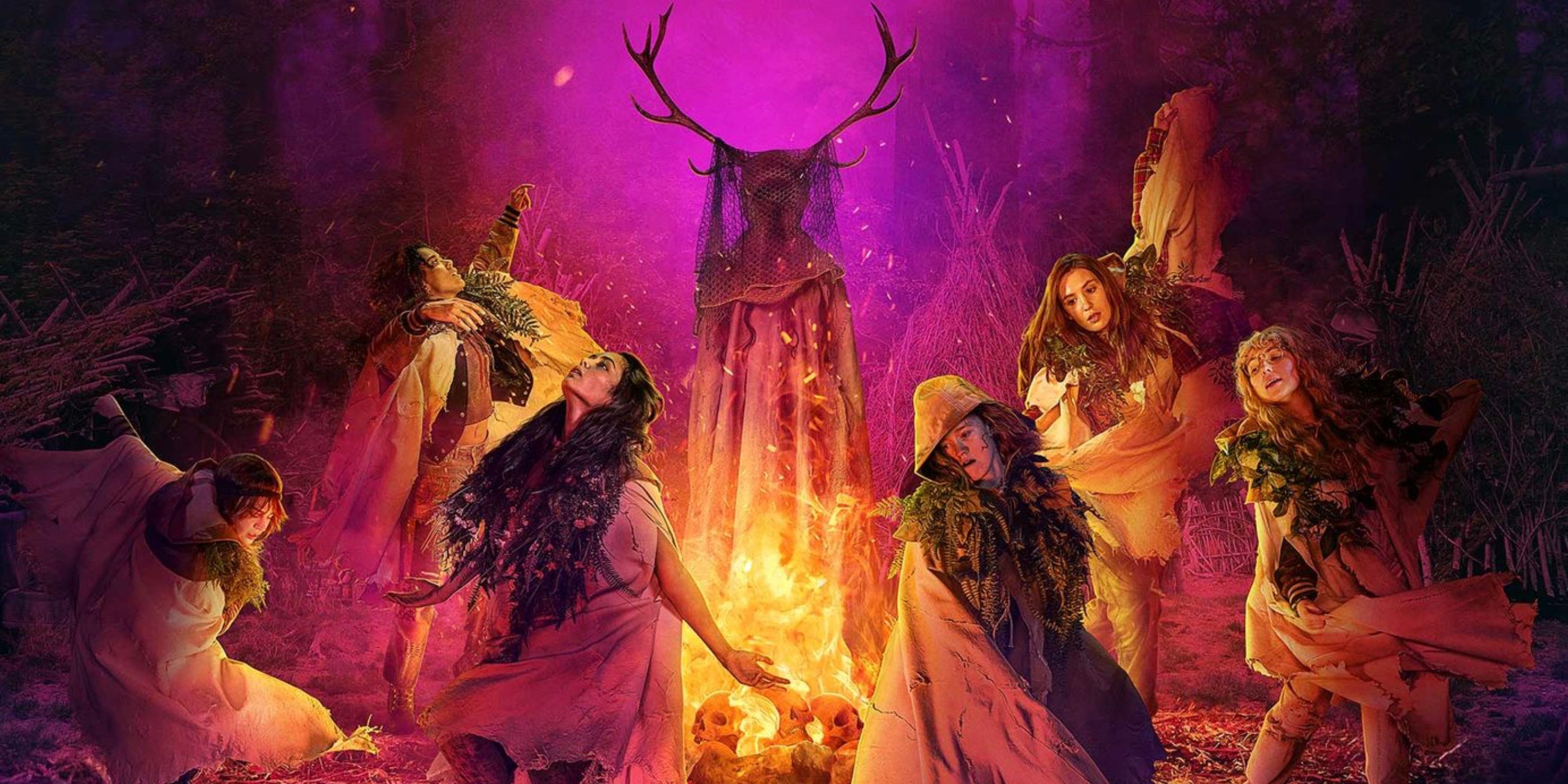
If you’ve ever found yourself staring at a drawing of a stick figure with a hook for a hand and feeling a genuine sense of dread, you’re probably a fan of the Yellowjackets tv show. It’s been years since that first season dropped on Showtime and basically rewired how we think about teenage girls, trauma, and, well, dinner. People came for the Lord of the Flies vibes. They stayed for the 90s nostalgia and the increasingly terrifying realization that the "antler queen" might not even be the scariest thing in the woods.
The show is a bit of a miracle. It balances two timelines—the 1996 plane crash in the Ontario wilderness and the present-day lives of the survivors—without ever feeling like it's dropping the ball on either. Honestly, it’s rare to see a series where the adult cast is just as compelling as the kids. Usually, you’re just waiting to get back to the "main" action, but watching Melanie Lynskey, Christina Ricci, Juliette Lewis, and Tawny Cypress navigate the wreckage of their adult lives is a masterclass in psychological horror.
What Really Happened in the Wilderness?
The big question everyone asks is about the cannibalism. "Do they eat each other?" Yeah. Obviously. The pilot episode showed us that within the first ten minutes. But as the Yellowjackets tv show has progressed, we’ve learned that the how and the why are way more disturbing than the act itself. It’s not just about starvation. It's about ritual. It's about a collective psychosis that might—or might not—be fueled by something supernatural living in those woods.
Showrunners Ashley Lyle and Bart Nickerson haven't been shy about their inspirations. They’ve cited the real-life 1972 Andes flight disaster, where members of a Uruguayan rugby team had to survive for 72 days in the mountains. But while the real-life survivors approached their situation with a grim, logical necessity, the girls in Yellowjackets lean into something darker. They start seeing things. Or they think they do. Lottie Matthews, played by Courtney Eaton in the past and Simone Kessell in the present, becomes the lightning rod for this "wilderness entity."
Is there a monster? Or is the "monster" just what happens when you strip away civilization and replace it with a deck of cards and a hunger that won't quit?
The Mystery of the Symbol
You see it everywhere. On the trees. On the floor of the cabin. On the postcards sent to the survivors decades later. That weird, geometric symbol with the hook and the circle. Fans on Reddit have spent thousands of hours trying to map it out using trigonometry and celestial charts. Some think it’s a map for mining. Others think it’s a sigil for protection.
The truth is, the show plays with the idea of "The Wilderness" as a character itself. Whether it’s a sentient force or just a reflection of their trauma is the tightrope the writers walk. It’s that ambiguity that keeps the Yellowjackets tv show from becoming a standard slasher. When Shauna kills a rabbit in her garden in 2021, she’s not just being a suburban mom with a hobby; she’s reaching back into that 1996 version of herself that learned how to skin a deer because she had no other choice.
Why We Are Obsessed With the 90s Timeline
Let’s be real. The soundtrack slaps. From PJ Harvey to Mazzy Star, the music in the Yellowjackets tv show isn't just background noise. It’s a tether to a very specific era of girlhood. The 90s were a time of "Girl Power," but also a time of intense, unspoken social hierarchies that the show deconstructs with a jagged knife.
The casting is also flawless. Finding actors who can mimic the mannerisms of their younger counterparts is a nightmare, but the production team nailed it. Sophie Nélisse and Melanie Lynskey share the role of Shauna Shipman, and their performances are so synchronized it’s almost eerie. You see the same simmering resentment and the same capacity for sudden, violent outbursts.
- Shauna: The "quiet" one who carries the heaviest secrets.
- Natalie: The rebel who turns out to be the moral compass.
- Taissa: The overachiever who literally eats dirt when she’s stressed.
- Misty: The nurse you never, ever want to have looking after you.
Misty Quigley is a whole different beast. Samantha Hanratty and Christina Ricci have turned her into one of the most fascinating characters on television. She’s a sociopath, sure. She smashed the flight recorder. She poisons people. But she also just wants to be liked. It’s a weirdly relatable kind of evil. We’ve all known a Misty—someone who tries too hard and ends up making everything a million times worse.
Debunking the Biggest Theories
Since the show is such a puzzle box, the internet is full of wild guesses. Let’s look at what holds water and what’s probably just fan fiction.
Theory 1: Jackie is still alive. Look, we saw her freeze to death. We saw the "dream" sequence. We saw the survivors... deal with her remains in Season 2. Jackie (Ella Purnell) is gone. Her death served as the catalyst for the group’s descent into ritualistic behavior. She represented the world they left behind—the world of prom queens and soccer captains. Once she was gone, the rules died with her.
Theory 2: It’s all a hallucination caused by heavy metal poisoning. Some fans point to the red creek and the strange behavior as signs of lead or cinnabar poisoning from nearby mines. It’s a grounded explanation for the visions. While it’s possible, the show seems more interested in the psychological and "spiritual" aspects of their isolation. If it turns out to be just "bad water," it might feel like a bit of a letdown for a show that builds so much atmospheric dread.
Theory 3: There are other survivors we haven't met yet. This is almost certainly true. We know a few names from the flight manifest that haven't been accounted for in the adult timeline. The writers have been careful to keep some mystery around who else made it out. This keeps the stakes high in the present-day plotlines, as any new character could be a friend or a deadly threat.
The Trauma of the Adult Survivors
While the survival stuff is thrilling, the heart of the Yellowjackets tv show is actually about what happens after you survive. How do you go to a PTA meeting when you know what human flesh tastes like? How do you maintain a marriage when your husband knows you’re capable of incredible violence?
The adult timeline shows that none of them really left the woods. Taissa is sleepwalking and destroying her political career. Natalie is struggling with addiction and a sense of purposelessness. Shauna is trapped in a mundane life that she occasionally punctuates with infidelity and murder. They are all "stuck" at the age they were when the plane went down.
This is where the E-E-A-T (Experience, Expertise, Authoritativeness, and Trustworthiness) of the writing comes in. The show accurately depicts the long-term effects of complex PTSD. It’s not just flashbacks; it’s a fundamental shift in personality. They are hyper-vigilant. They are prone to dissociation. They have "trauma bonds" that make it impossible for them to ever truly walk away from each other, no matter how much they might hate one another.
How to Watch and What to Expect Next
If you’re just starting, you need to pay attention. This isn't a "background noise" show. Every line of dialogue in the 1996 timeline often mirrors something happening in the 2021 timeline.
The production of Season 3 was delayed due to the strikes in 2023, but the hype hasn't died down. The creators have mentioned a five-season plan. This means we are only about halfway through the story. We still haven't seen the actual "winter of our discontent" where the girls fully transition into the masked cult we saw in the pilot. We haven't seen the rescue. We haven't seen how they managed to hide their secrets for twenty-five years.
Essential Viewing Tips:
- Watch the background. The showrunners love hiding things in the shadows. Look at the trees, the corners of the rooms, and the reflection in mirrors.
- Listen to the lyrics. The 90s songs aren't just for vibe; they often comment directly on the plot.
- Track the cards. The deck of cards the girls use is missing the jokers. When someone draws a specific card, it usually means something bad is coming.
The Yellowjackets tv show works because it doesn't give easy answers. It asks if we are all just one bad day away from being monsters. It asks if the things that happen to us define us forever. And it does all of this while being incredibly entertaining, darkly funny, and genuinely gross.
If you're looking for a show that respects your intelligence while also trying to scare the living daylights out of you, this is it. Just maybe don't eat a big meal right before the "Snackie" episode in Season 2.
To get the most out of your viewing experience, track the character arcs by their survival skills. Pay close attention to who is "providing" and who is "leading" in the 1996 timeline; these roles almost always invert or distort in their adult lives. You can also dive into the various fan forums, but be warned: the theories get dark fast. The best way to engage is to watch for the recurring motifs of sight and blindness—who is looking, who is hiding, and who is truly "seeing" the wilderness for what it is.