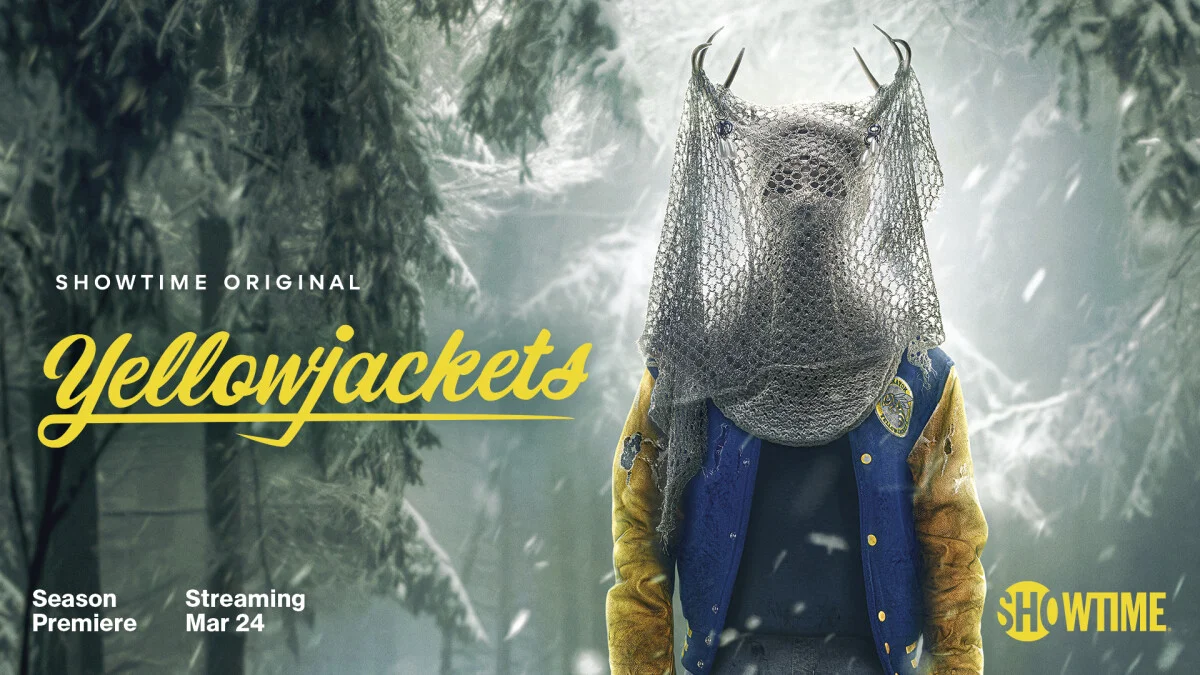
Honestly, the pilot of Yellowjackets was a hell of a hook, but it’s Yellowjackets season 1 ep 2, titled "F Sharp," where the show actually reveals what kind of monster it’s going to be. Most people remember the plane crash. They remember the girls screaming. But "F Sharp" is where the survivalism stops being a theoretical tragedy and starts becoming a gritty, blood-stained reality. It’s the episode where Misty Quigley stops being the weird girl with the equipment bag and starts being the most dangerous person in the woods.
You’ve got two timelines working in tandem here, and the contrast is jarring. In 1996, the wreckage is still smoldering. In the present day, we see the adult survivors—Shauna, Taissa, Natalie, and Misty—trying to navigate the fallout of a mystery that has followed them for twenty-five years. If you thought the show was just about a soccer team getting lost, this is the hour that proves it’s actually about the terrifying things people do when they finally feel powerful.
The Day After the Crash: Misty’s Terrifying Pivot
The 1996 storyline in Yellowjackets season 1 ep 2 is bleak. It’s cold. The adrenaline has worn off, replaced by the crushing weight of several dead classmates and a coach who is literally missing a leg. This is where we see Misty Quigley, played with bone-chilling precision by Sammi Hanratty, find her "purpose." Back in New Jersey, Misty was the outcast. She was the girl who sat by the phone waiting for a prank call just to have someone to talk to. In the wilderness? She’s the only one who knows Red Cross CPR and basic first aid.
She's thrives.
There is a specific, gruesome sequence where Misty has to tend to Coach Ben Scott. His leg is a mess of mangled flesh and bone thanks to the crash. While the other girls are vomiting or frozen in shock, Misty is methodical. She chops. She cauterizes. She saves his life, sure, but the look on her face isn't one of heroic desperation. It’s satisfaction. She finally has people who need her.
The pivotal moment of the episode—and arguably the most important beat of the entire first season—comes at the end of the 1996 segment. Misty finds the flight’s black box. It’s beeping, signaling for rescue. Instead of bringing it to the group, she smashes it. She literally destroys their only hope of being found because, for the first time in her life, she’s a protagonist. If they get rescued, she goes back to being a nobody. If they stay lost, she’s the queen of the camp. It’s a move that is both pathetic and purely evil. It sets the stage for months of unnecessary suffering, all because one girl wanted to feel important.
Natalie and Travis: The Beginning of the End
While Misty is playing god with the medical supplies, we start to see the friction between the other survivors. Natalie and Travis are the outsiders. In Yellowjackets season 1 ep 2, their bond starts to form out of shared disdain for the "popular" kids and the realization that their fathers were both pretty terrible.
Travis is grieving his dad, the head coach who fell out of the plane during the descent. Natalie is just trying to stay sober and stay alive. Their relationship is the emotional anchor of the series, but here it’s raw and antagonistic. It’s also where we see the division of labor starting to happen. Some girls are gatherers. Some are hunters. Some, like Jackie, are starting to realize that being the team captain doesn't mean anything when there’s no field to play on.
The 2021 Timeline: Blackmail and Dead Rabbits
Fast forward twenty-five years. The survivors are receiving postcards with a mysterious symbol—the same one they saw carved into the trees in the woods. This isn't just a "where are they now" story; it’s a noir thriller.
Shauna, played by Melanie Lynskey, is the standout here. In Yellowjackets season 1 ep 2, she’s living a suburban nightmare. She’s bored. She’s unappreciated. And then a rabbit starts eating her garden. Most people would buy a fence or some repellent. Shauna kills the rabbit, skins it, and feeds it to her family for dinner without blinking an eye. It’s a subtle, brilliant way to show that the girl who survived the woods is still very much alive inside the housewife.
The chemistry between the adult cast is electric. You can feel the decades of shared trauma and secrets. When Natalie (Juliette Lewis) shows up at Misty’s (Christina Ricci) house with a rifle, it doesn't feel like a reunion. It feels like a standoff. They don't like each other. They don't trust each other. But they are bound by the fact that they are the only people on earth who know what really happened out there.
What People Get Wrong About the Postcards
A lot of fans initially thought the postcards were sent by a ghost or some supernatural entity. But if you look closely at the events of this episode, the show is planting seeds for a much more human threat. The postcards are a catalyst. They force the women back into each other's orbits.
Taissa is running for State Senate, and she has the most to lose. Her story in this episode introduces the idea that the trauma isn't just emotional—it might be physiological. Her son is seeing a "man with no eyes," and Taissa herself is starting to show signs of the sleepwalking that haunted her in the woods. Is it a haunting? Or is it the brain breaking under the weight of suppressed memories?
The Symbolism of the "F Sharp"
The episode title refers to the note Misty's recorder plays, but it’s also a metaphor for the discord within the group. An F sharp is a dissonant note if played in the wrong key. That’s exactly what the survivors are—they are the "wrong notes" in a society that expects them to be normal.
They are trying to play a melody of "normalcy," but they are fundamentally sharp. They are jagged.
Lessons in Survival and Psychology
If you’re watching this for more than just the gore, there are some serious psychological deep dives happening here. The show uses "F Sharp" to illustrate several key concepts about human behavior under extreme stress:
- The Hero Complex: Misty’s destruction of the black box is a textbook case of someone creating a crisis just so they can be the one to solve it. It’s a dark manifestation of Munchausen by proxy, but on a communal scale.
- The Erosion of Social Hierarchy: Jackie is the "Queen Bee" in high school, but in the woods, she’s useless. She doesn't know how to cook, clean, or survive. This episode shows the exact moment the social ladder begins to flip.
- Suppression as a Survival Tactic: The adult survivors have spent 25 years pretending. This episode proves that suppression doesn't work. It just makes the eventual explosion more violent.
Practical Takeaways for Fans
If you're revisiting the show or watching for the first time, pay attention to the background of the 1996 scenes. The production design is incredible. The way the plane wreckage is used as a makeshift home is realistic and terrifying.
Also, watch the mirrors. In almost every scene involving the adult survivors in Yellowjackets season 1 ep 2, there is a mirror or a reflection. The show is constantly reminding you that there are two versions of these women: the ones they show the world and the ones that stayed in the woods.
To truly understand the trajectory of the series, look at the following:
- The Black Box: This isn't just a plot point. It’s the original sin of the survivors. If they ever find out Misty did that, she’s dead.
- Shauna’s Journal: We see her writing in the present day. These journals are the only honest record of what happened, and they are the ultimate leverage.
- The Symbol: It appears in both timelines for the first time in a meaningful way here. It’s not just a drawing; it’s a map and a warning.
The brilliance of this episode lies in its refusal to give easy answers. It doesn't tell you if the woods are haunted or if the girls are just losing their minds. It just shows you the cost of staying alive. By the time the credits roll, you realize that for these characters, the crash wasn't the end of their lives—it was the beginning of a different, much darker one.
Go back and re-watch the scene where Misty destroys the transmitter. Notice the sound design. The silence of the woods is louder than the beeping of the machine. That silence is what they’ve been living with for decades. It’s why they can’t handle the quiet of suburban life. They need the chaos to feel real.
Next time you’re watching, track the power dynamics. Notice how Natalie is the only one who sees through Misty’s "helpful" act. That intuition is why Natalie is the most tortured of the survivors—she’s the only one who can’t lie to herself about what they did.