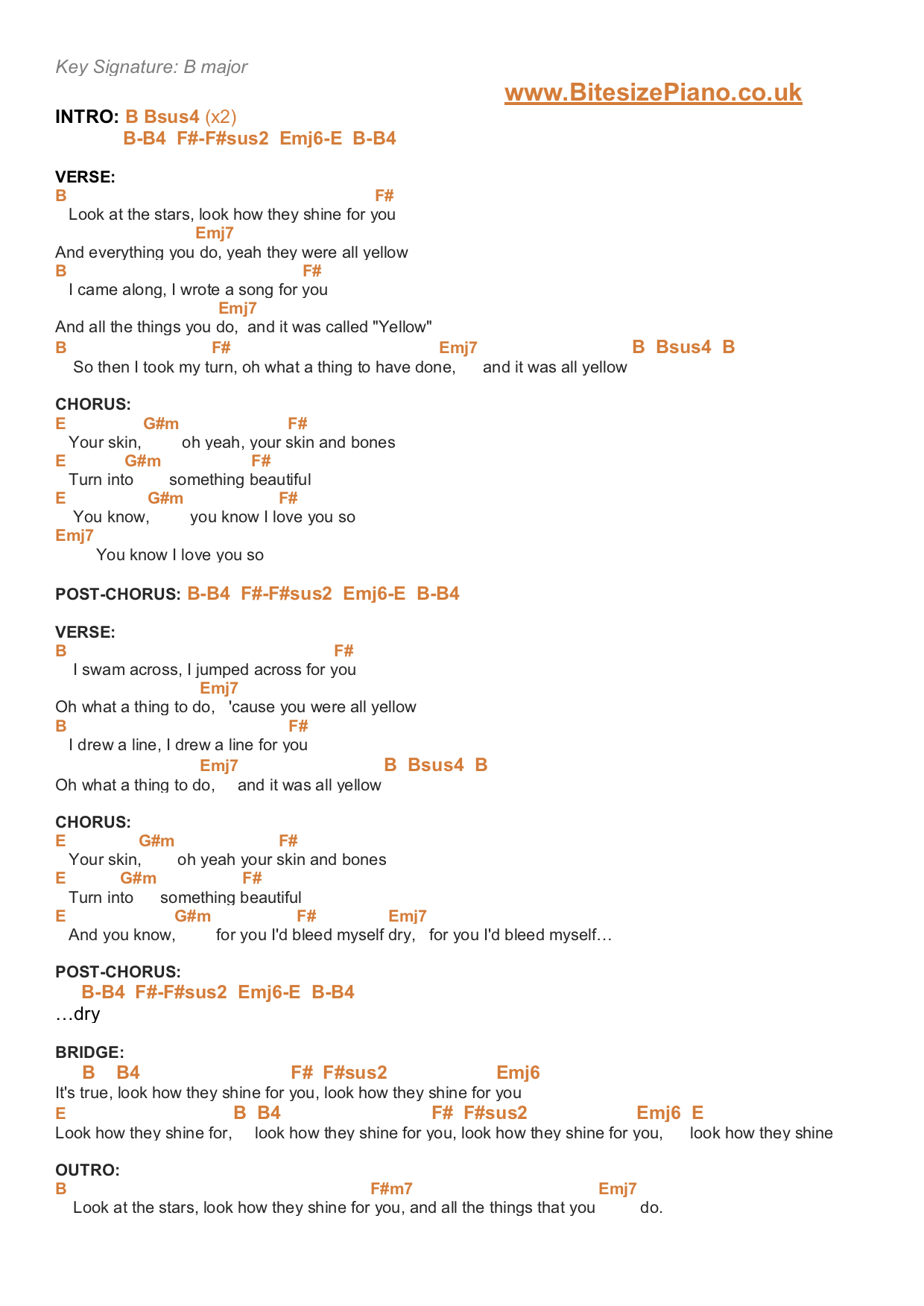
Look at the stars. Look how they shine for you.
If you were alive in the year 2000, those ten words were basically inescapable. Chris Martin was just this lanky kid from Devon with paint on his face, standing on a cold, wet beach in Dorset, singing about the color yellow. It felt small. It felt like a demo tape that somehow escaped into the wild. Yet, here we are over two decades later, and all Yellow Coldplay lyrics are still being dissected by wedding planners, grieving families, and teenagers who just got their hearts ripped out for the first time.
The song is weird. Honestly, if you actually sit down and read the lyrics without the soaring guitars, they're borderline nonsensical. "I swam across / I jumped across for you." Across what? The ocean? A puddle? It doesn't matter. The emotional logic of the song overrides the literal grammar every single time.
The Night a Star Map Became a Hit
Most people think "Yellow" is some grand metaphorical statement about cowardice or maybe jaundice—yes, that’s an actual theory people had back in the day. It’s not.
The band was at Rockfield Studios in Wales, recording Parachutes. It was pitch black outside. Ken Nelson, their producer, told them to go look at the stars. Chris Martin, feeling a bit "Neil Young-ish," started singing in his best imitation of the folk legend. He didn’t have a title. He didn't have a hook. He just saw a copy of the Yellow Pages sitting nearby and decided that was the word.
That’s the secret. The song isn't about the color yellow in a poetic, Victorian sense. It’s about a feeling that Chris couldn't quite find a better word for. It’s a placeholder that became permanent.
"It was simply because that word sounded right," Martin told Howard Stern years later. "It didn't mean anything else. I’ve tried to make up better stories, but the truth is it was just the Yellow Pages."
Breaking Down the Verse: I Drew a Line for You
The opening verse sets a scene that is both cosmic and uncomfortably intimate. "Look at the stars / Look how they shine for you / And everything you do."
It’s a massive exaggeration. The universe doesn't care what you do. But when you’re in love? The universe is a stage set built specifically for the person you’re looking at. That’s the brilliance of the songwriting here. It captures that specific, delusional stage of devotion where you feel like you could "draw a line" or "cross the sea" just to prove a point.
The line "I came along / I wrote a song for you / And all the things you do" is almost meta. It’s a songwriter admitting he’s doing the only thing he knows how to do to get someone's attention. It’s vulnerable because it’s so simple. There are no SAT words here. No complex metaphors. Just a guy with a guitar saying, "I made this for you."
That Specific Shade of Yellow
Why yellow? In color theory, yellow is the color of happiness, but also warning. It’s sunlight and it’s sickness.
When Martin sings "And it was all yellow," he’s describing a glow. If you’ve ever seen a person who seems to radiate a certain kind of warmth—someone who makes the room feel less heavy—that’s the "yellow" he’s talking about. It’s an aura. It’s the "skin and bones" turning into "something beautiful."
There is a visceral quality to those lines. "Your skin / Oh yeah, your skin and bones / Turn into something beautiful." It’s almost medical, right? It strips away the pretense of romance and looks at the physical human being. It acknowledges the fragility of the person he’s singing to. We are just skin and bones, but love makes that anatomy seem divine.
The Bridge and the Weight of Devotion
"It's true / Look how they shine for you."
The repetition in the bridge acts like a heartbeat. By the time the song hits this point, the guitars have swelled from that jangly, acoustic opening into a wall of sound. Jonny Buckland’s guitar riff is doing a lot of the heavy lifting here. It provides the "shimmer" that the lyrics describe.
Interestingly, the music video—that famous one-take shot of Chris walking on the beach—was supposed to feature the whole band. But it was raining, and it was the day of Chris’s mother’s funeral. The rest of the band stayed away, and Chris just walked. That context adds a layer of sadness to the lyrics that isn't necessarily in the text. You can see it in his face. He’s cold. He’s grieving. And he’s singing about the brightest color in the box.
That contrast is why the song works. It’s a happy song written in a sad moment. Or maybe it’s a sad song trying to convince itself to be happy.
What Most People Get Wrong About the Meaning
A huge misconception that keeps popping up on TikTok and Reddit is that "Yellow" is about a girl named Yellow. Or that it’s about a specific breakup.
It’s actually much more abstract than that.
Coldplay has always been criticized for being "earnest." Critics call them "bedwetters" or "boring." But "Yellow" succeeds precisely because it doesn't try to be cool. If you try to analyze the line "I swam across / I jumped across for you" with a cynical lens, it falls apart. How do you jump across something you just swam across? You don't. It’s a redundant lyric.
But in the heat of a performance, that redundancy feels like desperation. It feels like someone tripping over their words because they’re trying so hard to express a feeling that is bigger than their vocabulary.
- The "Yellow Pages" Origin: It is 100% confirmed. No deeper meaning.
- The Tempo: The video was shot at double speed, then slowed down to create that ethereal, slow-motion effect.
- The Devotion: The song is ultimately about "unrequited" or "total" devotion. It’s the act of giving yourself over to someone else’s light.
How to Actually Apply This to Your Life
If you’re looking at all Yellow Coldplay lyrics for a wedding toast or a tattoo, don't overthink the specific words. Focus on the intention.
The song teaches us that beauty isn't found in the complex; it’s found in the noticed. "Look at the stars." It’s a command to stop looking at yourself and start looking at the world around you.
If you want to live with a bit of that "Yellow" energy, start by acknowledging the "skin and bones" of the people you love. Recognize their fragility. Tell them you'd do something ridiculous for them, like swimming across an ocean you could probably just walk around. It’s the effort that counts.
Actionable Takeaways for the Super-Fan
To truly appreciate the depth of this track, you need to hear the early versions.
- Listen to the 'Mince Spies' version: It has a slightly different energy, more raw and less "stadium rock."
- Watch the 2012 Glastonbury Performance: You can see how the song transformed from a beach walk into a global anthem with 100,000 people singing along.
- Read the 'Parachutes' Liner Notes: It gives you a sense of where the band's head was—basically four guys in a room trying not to get dropped by their label.
The lasting power of these lyrics isn't in their poetic complexity. It’s in their space. Because the lyrics are so simple, we can pour our own lives into them. We can decide what our "Yellow" is. For some, it’s a child. For others, it’s a memory of a parent. For most, it’s just that one person who makes the stars look like they’re doing something special just for us.
Stop looking for a hidden code in the verses. There isn't one. There’s just a lanky guy on a beach, a copy of the Yellow Pages, and a feeling that was too big for any other word.
To dig deeper into the Coldplay lore, track down the "Blue" version of the lyrics—an early draft that never made the cut because, honestly, "it was all blue" just sounds like a song about a sad day at the office. Stick with the yellow. It’s brighter.
Next Steps for the Coldplay Obsessed:
- Check out the isolated vocal tracks for "Yellow" on YouTube. Hearing Chris Martin’s voice without the drums reveals just how much "shimmer" is actually in his vocal delivery.
- Compare "Yellow" to "Fix You": Look at how the band evolved from describing a person as "beautiful" to trying to "repair" them. It’s a fascinating shift in their lyrical philosophy.
- Visit Studland Bay: If you’re ever in the UK, go to the beach where the video was filmed. Stand in the spot where the stars supposedly shone for us all. It’s a lot colder than it looks in the video.