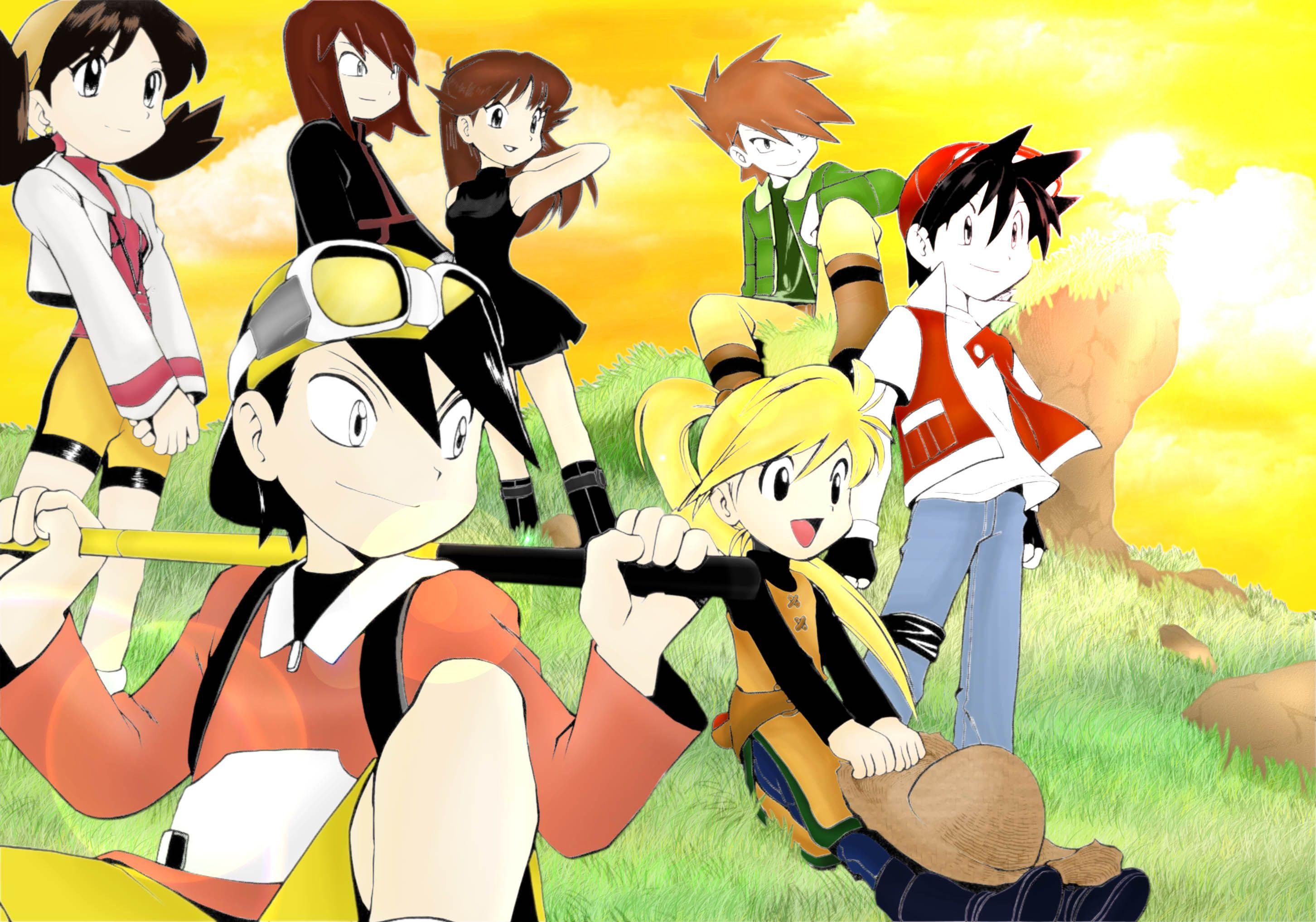
If you grew up watching the Pokémon anime, your idea of a protagonist is probably a loud kid from Pallet Town who wants to be the very best. But the manga—specifically Pokémon Adventures (or Pocket Monsters Special in Japan)—is a completely different beast. It’s darker, weirder, and way more creative with its lore. And honestly, no character embodies that creative risk-taking better than Yellow from Pokemon Adventures.
Most people first encounter Yellow and think they’re looking at a mistake. Who is this kid with a straw hat and a fishing rod? Why aren't they using Poké Balls like everyone else? It turns out, Yellow is arguably the most unique trainer in the entire franchise, mostly because she hates the very thing Pokémon is known for: fighting.
The Mystery of the Viridian Forest
Yellow isn't just some random trainer. She’s a "Viridian Trainer," a rare breed of human born with a psychic connection to the forest itself. This isn't just flavor text. In the Yellow arc of the manga, we learn that being born in the Viridian Forest every ten years grants a child specific, almost god-like powers. Yellow can heal Pokémon by touching them. She can read their thoughts. She can even synchronize her soul with theirs to boost their levels during a crisis.
It’s a massive departure from Red’s "battle hard and win" philosophy.
When Red goes missing after receiving a challenge from the Elite Four, Yellow shows up at Professor Oak’s lab to find him. But here’s the kicker: she’s disguised as a boy. This wasn't some trope for the sake of it; Blue (the girl, not the rival) actually convinced her to hide her identity to protect her during her journey. It's a plot point that kept readers guessing for a long time, and it added a layer of vulnerability to a character who was already physically weaker than almost every villain she faced.
Why Her Team Is a Total Nightmare (For Her)
Look at Yellow's team and you'll see a disaster on paper. She has a Pikachu (Chuchu), a Raticate (Ratty), a Doduo (Dody), a Graveler (Gravvy), an Omanyte (Omny), and a Butterfree (Kitty).
She didn't want any of them to evolve.
In fact, when Ratty evolved into Raticate, Yellow actually cried. She felt like she had lost her friend because they looked different. That’s the core of Yellow from Pokemon Adventures. She’s a pacifist in a world designed for war. She doesn't like to hurt people, and she doesn't like her friends to change. This makes her battle against Lance of the Elite Four one of the most stressful sequences in the entire series. She’s fighting a man who can literally command dragons to destroy cities, and she’s trying to win without actually "hurting" his Pokémon.
Her fishing rod is her primary tool. She uses it to move Poké Balls, snag items, and navigate the battlefield without throwing a single punch. It’s tactical. It's smart. It makes Red and Blue look like they’re just button-mashing.
The Power Creep is Real
While she starts out as a kid who can barely hold a rod, her power ceiling is terrifying. During the climax of the Yellow arc on Cerise Island, her emotions spike so hard that her entire team begins to evolve all at once. Because of her connection to the Viridian Forest, she was subconsciously suppressing their evolution the entire time.
When she finally lets go? It’s a total wipeout.
She essentially forces her Pokémon to reach temporary "level boosts" that shouldn't be possible. Hidenori Kusaka, the writer of the series, used Yellow to explore the idea that a trainer's bond isn't just about training—it's about empathy. If Red is the "Fighter" and Blue is the "Trainer," Yellow is officially dubbed the "Healer."
The Connection to Lance
One thing people often forget is that Yellow and Lance share the exact same origin. They both have the "Viridian Power." The difference lies in how they chose to use it. Lance became bitter. He saw how humans mistreated Pokémon and decided the only solution was to wipe out humanity. Yellow saw the same things but chose to heal the world instead.
It’s a classic foil. It’s also why their final confrontation feels so personal. Lance isn't just a boss; he's a glimpse of what Yellow could become if she let her empathy turn into anger.
The Disappearance and the GSC Arc
After her primary arc, Yellow kind of fades into the background, which is a shame. She reappears in the Gold, Silver & Crystal chapters, but she’s no longer the lead. She’s more of a mentor figure or a "wild card" that shows up when things get truly desperate.
There’s a great moment where she meets Silver, and her innocence acts as a direct contrast to his dark, stolen childhood. She doesn't judge. She just exists as this pure force of nature. Even her character design reflects this; she’s often drawn with softer lines and a smaller stature than the other "Pokedex Holders."
Misconceptions About the "Yellow" Game
A lot of fans think the Pokémon Yellow game is based on this character. It’s actually the other way around. The character was created to promote the game, but the manga team took the concept of "a trainer with a Pikachu" and turned it into a psychic-forest-pacifist-ninja story.
If you go back and play the Game Boy games now, you’ll find them empty. There’s no personality there. But read the Adventures manga, and suddenly that Pikachu isn't just a mascot—it's Chuchu, a Pokémon with a specific personality, a love interest (Red's Pikachu, Pika), and a trainer who would die before letting it get hurt in a gym match.
Practical Takeaways for Fans
If you're looking to actually get into the story of Yellow from Pokemon Adventures, don't just jump into the middle. The manga is serialized in a way that matters.
- Start with the Red, Green & Blue arc. You need to see Red's peak to understand why his disappearance is such a big deal when Yellow takes over.
- Watch the evolution of her hat. It sounds silly, but the straw hat is a symbol of her disguise. When it finally comes off, it’s a major character beat.
- Pay attention to the levels. The manga actually lists the Pokémon levels at the end of chapters. Yellow’s Pokémon are consistently lower-leveled than her opponents, which highlights how much she relies on her psychic powers to bridge the gap.
- Read the FireRed & LeafGreen arc later. Yellow returns here, and her role in the "petrification" plot is one of the most emotional moments for the original Kanto cast.
Yellow remains one of the most complex characters in the Pokémon universe because she challenges the fundamental loop of the franchise. She proves you don't have to be a "master" to be a hero. You just have to care enough to keep your rod steady when a Dragonite is charging at your face.
To truly appreciate her, look for the VIZ Media "Pokémon Adventures" omnibuses. Specifically, volumes 4 through 7 cover the bulk of her journey. It's a masterclass in how to take a simple game promotion and turn it into a high-stakes fantasy epic.