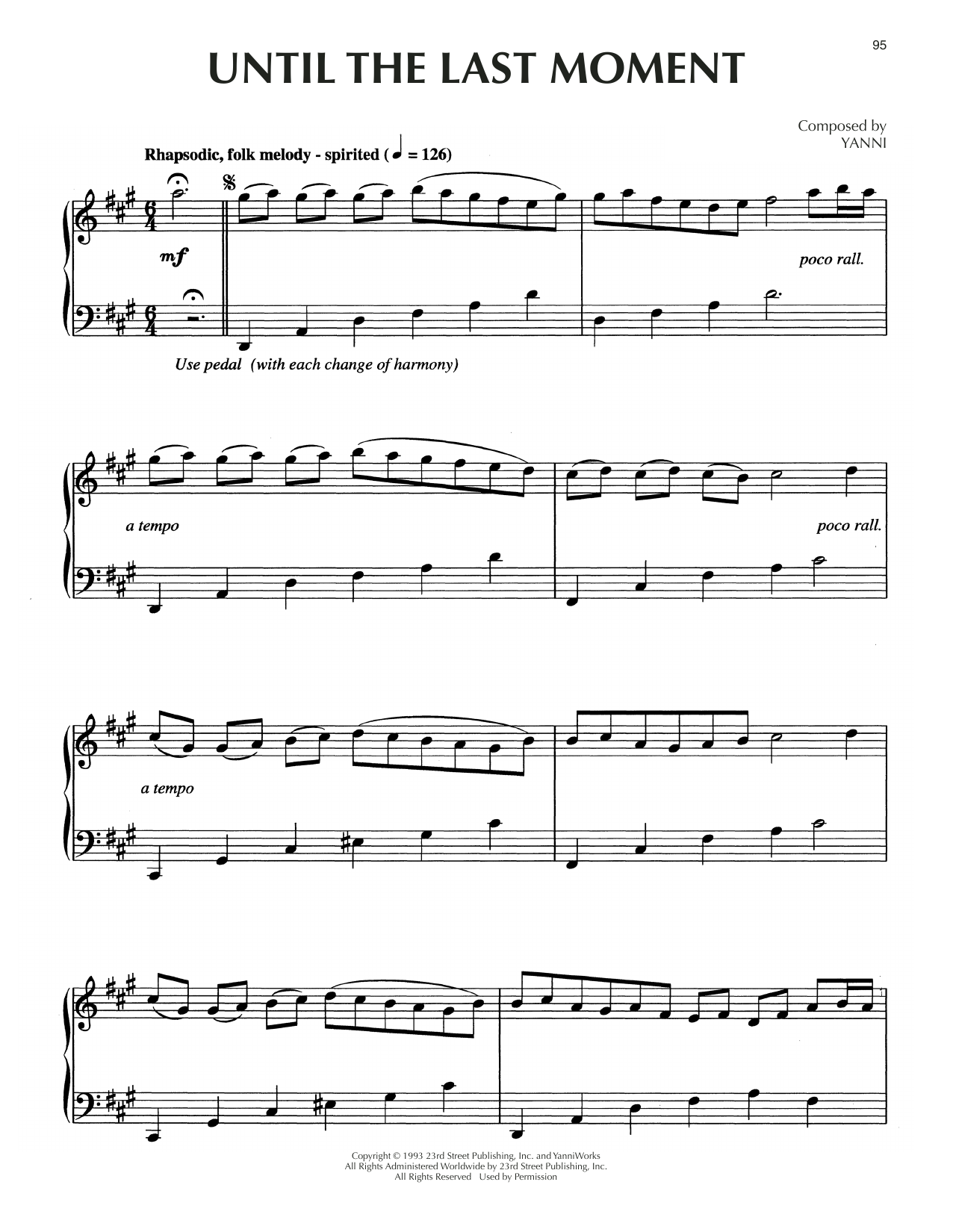
You know that feeling when a song just stops you in your tracks? It’s not about the lyrics—mainly because there aren't any—but about a certain "vibe" that feels like it’s pulling on your ribs. For a lot of people, that specific gut-punch comes from a track called Until the Last Moment.
Yanni Chryssomallis, the man basically everyone just calls Yanni, has a way of doing that. He’s the guy who looked at the 2,000-year-old Acropolis and thought, "Yeah, I can fit a full orchestra in there." But while the big, booming hits like Santorini get the adrenaline moving, Until the Last Moment is the one that sticks in the quiet parts of your brain. It's a song about time, or more specifically, the lack of it.
The Story Behind the Keys
If you look back at his 1993 album In My Time, this track stands out because it’s so stripped back. It isn't trying to be a stadium anthem. Honestly, it feels more like a private conversation between Yanni and his piano.
The title itself, Until the Last Moment, sounds a bit heavy, right? It’s meant to be. Yanni has often talked about how we spend our lives rushing, always looking at the next thing, the next goal, the next disaster. This piece was his way of saying, "Wait. Look at right now." It’s built on this 6/4 meter—a rhythm that feels a bit like a heartbeat or a pendulum—that keeps you grounded while the melody wanders.
Most fans first heard the live version from the 1994 Live at the Acropolis concert. If you watch the video, you can see Karen Briggs on the violin and Shardad Rohani conducting the Royal Philharmonic Concert Orchestra. There’s a moment where the piano melody hands off to the violin, and it feels like a physical shift in the room. It’s dramatic without being cheesy, which is a hard line to walk.
Why This Track Still Matters in 2026
It’s weird to think that a song written decades ago is still surfacing in people's playlists today. But here’s the thing: we’re more distracted now than we were in the 90s. Back then, "distraction" was just a long commercial break. Now, it's a 24/7 digital firehose.
Until the Last Moment acts like a reset button. People use it for meditation, for studying, or just for staring out a window when life gets too loud. It’s also become a staple for figure skaters and performers because it has this "rise and fall" structure. It starts quiet, builds into this sweeping orchestral swell, and then retreats back to a single piano note. It’s basically the lifecycle of an emotion in six minutes.
The Anatomy of the Song
- The Tempo: It’s slow. Very slow. It forces you to breathe.
- The Key: F-sharp minor. It sounds "sad," but it’s that specific kind of sadness that feels hopeful? Bittersweet is probably the better word.
- The Climax: When the full orchestra kicks in, it doesn't feel like a "drop" in a dance track. It feels like a realization.
What People Get Wrong About Yanni
There’s this weird misconception that Yanni is just "elevator music" or "New Age" fluff. If you actually look at the technicality of Until the Last Moment, that argument falls apart pretty fast. The guy doesn't even use traditional musical notation; he developed his own shorthand as a kid in Kalamata, Greece.
He’s a self-taught runner-turned-psychologist-turned-musician who broke all the rules of the music industry. He didn't have a record label backing him for the Acropolis show; he basically bet his own money on it. When you listen to the final notes of the song, you’re hearing the work of someone who refused to let his vision be "edited" for radio play.
How to Actually Listen to It
If you’re going to listen to Until the Last Moment properly, don't do it through crappy phone speakers while you're washing dishes. You've gotta give it five minutes of actual focus.
- Find the 25th Anniversary Remaster: The sound quality on the 2018 restoration is miles ahead of the original 90s tapes. You can hear the individual strings of the harp and the way the piano hammers hit the strings.
- Watch the Live Performance: Seeing the interaction between the musicians makes the "moment" feel more real. There’s a visible respect between Yanni and Karen Briggs that adds a layer to the music.
- Pay Attention to the Silence: The spaces between the notes are just as important as the notes themselves. That’s where the "until the last moment" theme really lives.
At the end of the day, music like this isn't meant to be "consumed." It’s meant to be lived in. Whether you’re a long-time fan who remembers the PBS specials or someone who just stumbled onto him via a random Spotify algorithm, there's something universal about the way this track handles the concept of time. It reminds us that the "last moment" isn't something to fear—it's something to make sure we're actually present for.
Actionable Next Steps
If you want to dive deeper into this style of composition, your next step is to compare the studio version from In My Time with the live version from The Dream Concert: Live from the Great Pyramids of Egypt. You'll notice how the environment—the literal acoustics of the desert—changes the way the song feels. From there, look into the 25th Anniversary Deluxe Edition of Live at the Acropolis for the most technically pristine version of the track available. Focus on the transition at the 3-minute mark to hear how the orchestration supports the solo piano without overrunning it.