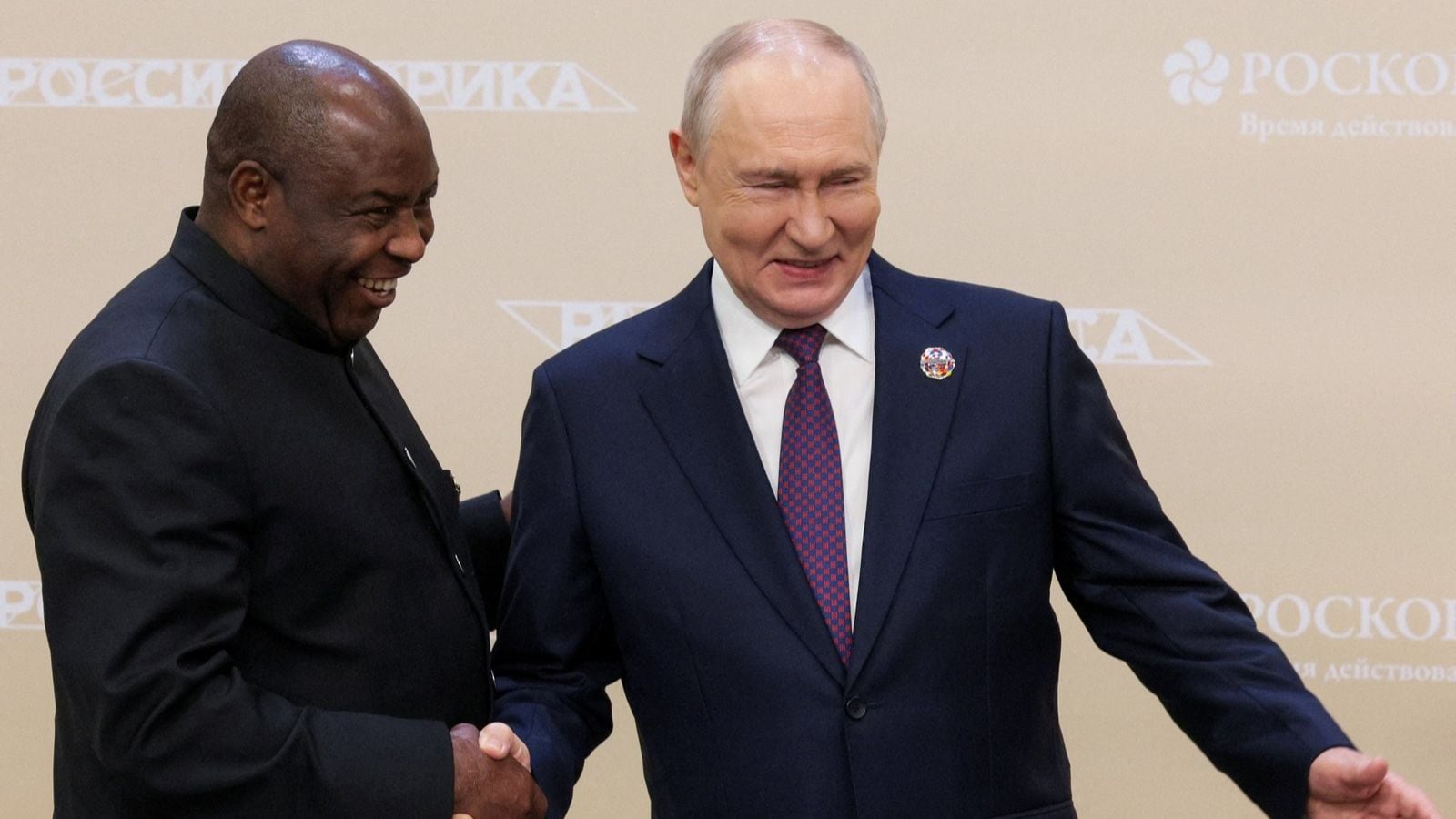
Mainstream coverage of the Russia-Africa summits operates on a predictable script. According to standard Western diplomatic reporting, Moscow hosts African heads of state, blames Western "colonialism" for global instability, promises free grain, and attempts to buy loyalty on the cheap.
That framing misses the entire point.
Western commentators treat African leaders like passive spectators being duped by Kremlin propaganda, or as desperate actors easily swayed by a few cargo ships of wheat. Both assumptions rely on outdated Cold War thinking. If you actually look at the balance sheets, the sovereign debt structures, and the security contracts being signed behind closed doors, a very different reality emerges.
African governments are not choosing Russia over the West because they believe Moscow is a benevolent anti-colonial savior. They are using Moscow as a geopolitical wedge to extract better terms from Washington, Brussels, and Beijing.
The Myth of the "Naïve" African Client
The lazy consensus in Washington and London is that Russia is exploiting African vulnerabilities through disinformation and Wagner-style security pacts. Analysts at institutions like the Chatham House and the Carnegie Endowment for International Peace have repeatedly pointed out that Russia's economic footprint on the continent is tiny compared to the European Union, the United States, or China.
The numbers back that up. According to data from the African Export-Import Bank (Afreximbank) and UN Comtrade, bilateral trade between Russia and Africa hovers around $18 billion to $20 billion annually. Compare that to China’s $280 billion-plus in trade with the continent, or the European Union’s $300 billion-plus. Foreign direct investment from Russia accounts for less than 1% of total inflows into Africa.
So why do dozens of African delegations still fly to St. Petersburg or Sochi?
Because low trade volume is a feature, not a bug. When a Western superpower arrives in an African capital, it brings billions in potential capital—along with strict governance conditions, International Monetary Fund (IMF) austerity mandates, human rights audits, and environmental compliance rules. When Moscow arrives, it brings zero lectures on domestic governance, targeted regime security, and diplomatic cover at the United Nations.
For an incumbent government facing an insurgency in the Sahel or domestic political pressure, a Western loan that takes three years to clear compliance checks is useless. Immediate military hardware, mercenaries rebranded as the "Africa Corps," and fertilizer shipments without political strings attached solve urgent survival problems.
Deconstructing the "Anti-Colonial" Narrative
During showcase summits, Russian President Vladimir Putin routinely invokes the Soviet Union’s historical support for African liberation movements, framing modern Russia as the natural ally against Western "neocolonialism."
Western pundits love to debunk this by pointing out Russia's own imperial history and its current resource-extraction models in countries like the Central African Republic (CAR) and Mali, where mining concessions for gold and diamonds are traded directly for security services.
Here is the nuance both sides ignore: African leaders know Russia is transactional. Nobody in Nairobi, Pretoria, or Bamako is under the illusion that the Kremlin is running a charity.
As South African international relations scholars and diplomats have repeatedly articulated through their doctrine of "active non-alignment," the goal is not ideological allegiance to Moscow. The goal is multi-alignment. By visibly engaging with Putin, African states signal to Western capitals that their diplomatic support—whether in UN General Assembly votes or in critical mineral supply chains—is no longer guaranteed by default.
Consider how this plays out in practice. Following the 2022 invasion of Ukraine, Western diplomats pressured African nations to isolate Moscow. Instead, nearly half the continent abstained or voted against key UN resolutions condemning Russia. Immediately afterward, high-level delegations from the U.S. State Department, the European Commission, and major European capitals began touring African nations at a pace not seen in decades, suddenly discovering a renewed urgency for infrastructure partnerships like the Lobito Corridor in southern Africa.
The Real Currency: Grain, Fertilizer, and Regime Survival
To understand Russia's actual staying power on the continent, stop looking at overall GDP metrics and start looking at choke points. Russia does not need to build railways across East Africa to hold influence; it only needs to control specific, high-impact commodities.
- Agricultural Inputs: Russia is the world's largest exporter of fertilizers and a dominant supplier of wheat. Several African nations rely on Russian and Ukrainian grain for over 30% to 50% of their domestic consumption. When supply chains tighten, domestic food inflation triggers urban riots—the fastest way to topple a government. Moscow’s offers of targeted, subsidized grain shipments directly address a regime's most acute domestic vulnerability.
- Nuclear Energy: Rosatom, Russia's state nuclear corporation, has aggressively pursued Memoranda of Understanding across the continent, from Egypt's massive El Dabaa nuclear power plant project to exploratory agreements with Rwanda, Ethiopia, and Burkina Faso. Unlike Western lenders, Rosatom offers build-own-operate financing models that cash-strapped nations can actually execute.
- Asymmetric Security: In nations like Mali, Burkina Faso, and Niger, years of Western counter-terrorism operations—such as France's Operation Barkhane—failed to stop the spread of jihadist insurgencies. When military juntas took power in those capitals, they expelled French and UN forces and brought in Russian operatives.
The Brutal Downside of the Russian Bargain
Acknowledging the strategic logic behind African engagement with Russia does not mean the strategy works long-term. In fact, the empirical track record on the ground shows severe structural flaws for the host nations.
First, Russian security deployments have not stabilized the Sahel. Data from the Armed Conflict Location & Event Data Project (ACLED) shows that civilian fatalities and insurgent attacks in Mali and Burkina Faso actually escalated after the transition from French and UN forces to Russian paramilitaries. Trading Western bureaucratic constraints for unrestrained kinetic operations often alienates local populations and fuels insurgent recruitment.
Second, Russia cannot fund Africa's infrastructure deficit. According to the African Development Bank, the continent requires between $130 billion and $170 billion per year for infrastructure development. Moscow simply does not have the capital markets, sovereign wealth liquidity, or banking infrastructure—especially while cut off from SWIFT and under sweeping Western financial sanctions—to finance ports, highways, or power grids at scale.
Third, relying on Moscow creates secondary sanction risks. African banks and state enterprises doing business with sanctioned Russian defense or financial entities risk losing access to dollar clearing systems and Western capital markets.
Answering the Questions Nobody Wants to Ask
Does Russia actually want to replace the West in Africa?
No. Replacement requires trillions of dollars in capital investment, institution building, and long-term economic integration. Moscow wants disruption, not administration. If Russia can deny Western powers uncontested access to uranium in Niger, gold in Sudan, or diplomatic consensus at the UN at a fraction of the cost of a traditional aid budget, the Kremlin considers that a massive return on investment.
Why don't Western nations just outspend Russia?
Because money isn't the bottleneck; speed and conditionality are. Western development finance institutions—like the U.S. International Development Finance Corporation (DFC) or European development banks—are bound by legislative mandates regarding transparency, debt sustainability, and governance standards. Those guardrails exist to prevent corruption and predatory lending, which are legitimate concerns. However, in emergency scenarios, a slow, heavily conditioned dollar loses to a fast, unconditioned rifle or shipment of urea fertilizer.
Are African nations trapped in a new Cold War?
Only if they allow themselves to be. The smartest policymakers in African finance and foreign ministries treat Washington, Brussels, Beijing, Moscow, Ankara, and the Gulf states like competing vendors in an open tender. They take security assistance from one, port construction from another, tech infrastructure from a third, and agricultural grants from a fourth.
Stop Measuring Influence by Summit Photo-Ops
If you want to know who actually holds power in Africa over the next decade, ignore the speeches about colonialism at showcase summits. Track three concrete metrics instead:
- Sovereign Debt Restructuring: Watch who sits at the table during G20 Common Framework negotiations when nations like Zambia, Ghana, or Ethiopia restructure billions in debt. Russia is virtually absent from these financial rescues; China, the IMF, and Western bondholders decide the outcome.
- Subsea Cables and Digital Infrastructure: Look at who is laying the fiber-optic cables and building the data centers powering Africa's fintech boom. It is American tech giants, European telecoms, and Chinese hardware firms—not Russian state enterprises.
- Critical Mineral Refining: Follow where lithium, cobalt, copper, and rare earths are processed. The battle for supply chain dominance is being fought between Chinese refiners and Western-backed industrial consortiums.
Russia’s summits are masterclasses in asymmetric diplomacy—generating maximum geopolitical noise with minimal capital outlay. Western analysts fall into the trap every single time by treating Moscow's rhetoric as an existential takeover rather than what it actually is: a low-cost disruption campaign that African leaders are happily exploiting to raise their own market price.