The metal of a flagpole makes a distinct, hollow ringing sound when it is struck. It is a sterile, mechanical noise. But when that sound echoes across a crowded city street, it changes. It absorbs the ambient tension of the pavement. It becomes a trigger.
In Birmingham, the fabric came down. It was just polyester and dye, a collection of threads woven together to represent an identity, a history, a grievance. To some, the flags were a statement of pride. To others, they were a provocation. When the authorities moved in to remove them, the space they left behind did not remain empty. It filled instantly with friction.
We tend to look at public protests through the lens of evening news broadcasts. We see the wide shots. We see the surging crowds, the flashing blue lights, the blurred faces of a community in flux. But macro-perspectives lie. They smooth over the sharp edges of human experience. They turn a volatile cocktail of emotion into a tidy headline. They tell you that a crowd gathered, but they rarely tell you what it feels like when the air in your own neighborhood turns sour.
The real story of what happened when Birmingham's tensions spilled over into the capital is not a story about politics. It is a story about the fragile physics of a crowd, the sudden velocity of a vehicle, and the terrifyingly short distance between a belief and a tragedy.
The Friction of the Pavement
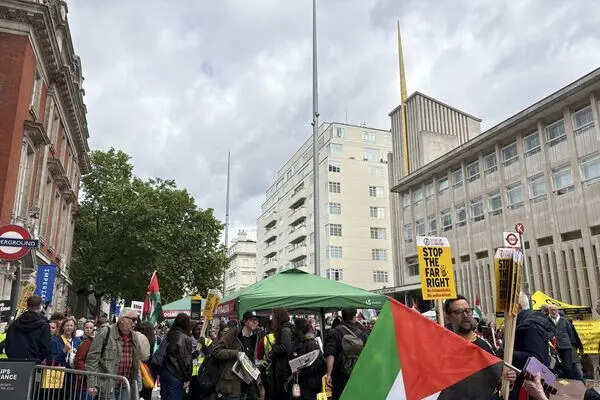
Protest is loud. It is sensory overload. There is the rhythmic chanting, the smell of cheap smoke flares, the constant, low-frequency rumble of hundreds of boots shuffling on concrete. If you stand in the middle of it, your chest vibrates.
When news traveled from the West Midlands that flags had been stripped away, the response did not stay localized. Anger is highly mobile. It migrates along commuter lines and motorways, feeding on digital updates and instant messages until it finds a new theater. London became that theater.
Consider the anatomy of a flashpoint. On one side, you have individuals who feel their symbolic territory has been eroded. On the other, you have the state, represented by high-visibility jackets and plastic barriers, trying to maintain an arbitrary perimeter. The flags themselves were gone, but their absence had become a physical weight.
People who have never stood in a escalating demonstration often assume that violence is a conscious choice. They imagine a moment where someone decides, deliberately, to cross a line. But that is not how the street works. The street builds momentum on its own. It is a series of micro-escalations. A push. A shout. A step forward. The collective temperature rises by fractions of a degree until the entire environment is hyper-reactive.
Then came the sound of an engine.
The Physics of a Two-Ton Shift
A van is not just a mode of transport when it enters a space thick with human bodies. It becomes an anomaly. The sensory landscape of a protest is built for pedestrians; when a heavy commercial vehicle gets caught in the gears of a demonstration, the atmosphere shifts from tense to lethal in seconds.
The reports are precise about the mechanics: a pedestrian was struck. A man was arrested. The police cordons tightened.
But look closer at the moment of impact. The human body is remarkably fragile when measured against steel and momentum. When a vehicle moves through a crowd, the noise changes instantly. The chanting stops. It is replaced by a specific, high-pitched gasp—the collective intake of breath from a hundred people realizing that the rules of engagement have just changed.
Imagine being the person on the tarmac. One moment you are part of a movement, a voice in a chorus, defined by the shared convictions of the people standing shoulder-to-shoulder with you. The next moment, the abstraction vanishes. There is only the hard reality of a bumper, the scraping of leather on asphalt, and the sudden, blinding realization that symbols cannot cushion a fall.
The driver of that van was detained by police officers who had been tracking the boiling point of the crowd for hours. In the immediate aftermath, the sirens took over the audio track of the street. The arrest was fast, a clinical intervention by authorities desperate to prevent a riot from consuming the block. Yet, the physical restraint of one individual did not dissolve the underlying heat. It merely capped the volcano for the afternoon.
The Mirage of the Neutral Observer
It is easy to sit back and parse these events with a detached, clinical skepticism. We analyze the legality of the flag removal. We debate the proportional response of the police. We judge the motivations of the drivers and the marchers from the safety of a screen.
That detachment is a luxury. And it is a lie.
When a community fractures to the point where a piece of cloth can catalyze a vehicular assault, everyone in the vicinity loses their status as a neutral observer. The shockwaves of that impact travel down the high street. They affect the shopkeeper locking their doors early, the commuter trying to navigate a suddenly hostile transit hub, and the family watching from a third-story window, wondering if their neighborhood is still theirs.
The truth is that we are all incredibly vulnerable to the currents of public anger. We walk through cities that we assume are governed by a shared social contract. We assume the red lights will work, the drivers will stop, and the crowds will remain orderly. But that contract is surprisingly thin. It relies entirely on a collective agreement to keep our grievances internal. When those grievances are externalized—when they take the form of banners, barricades, and boots—the contract frays.
The removal of the flags in Birmingham was meant to be an administrative act, a routine enforcement of local regulations or an effort to de-escalate neighborhood rivalries. Instead, it acted as a vacuum. It sucked in the latent anxieties of a population looking for a reason to stand their ground. By the time that energy reached London, it had mutated from a specific dispute about local symbolism into a generalized expression of raw force.
What Remains on the Asphalt
The crowds eventually disperse. The police vans pack up their cones and their tape. The traffic is allowed back onto the street, erasing the skid marks with fresh layers of rubber and exhaust. By the next morning, the high street looks identical to any other commercial artery in the city.
But the memory remains embedded in the geography of the place.
A man is in custody, facing the legal system. A pedestrian is dealing with the physical aftermath of a sudden, violent encounter with a machine. And two cities are left to figure out how a dispute over a few yards of fabric managed to travel over a hundred miles and culminate in an arrest on a London street.
We look for patterns in the chaos. We try to find a grand narrative that explains why people are willing to risk their freedom, or their lives, for something as ephemeral as a flag. Maybe the answer isn't grand at all. Maybe it is dangerously simple. When people feel unheard, the symbol becomes the reality. The flag becomes the land. The protest becomes the home. And the vehicle becomes the weapon.
The street is quiet now. The hollow ringing of the flagpoles has stopped. But the air still feels heavy, like a room immediately after a door has been slammed, leaving everyone inside waiting for the echo to finally fade.