The coffee in Mei’s cup went cold hours ago.
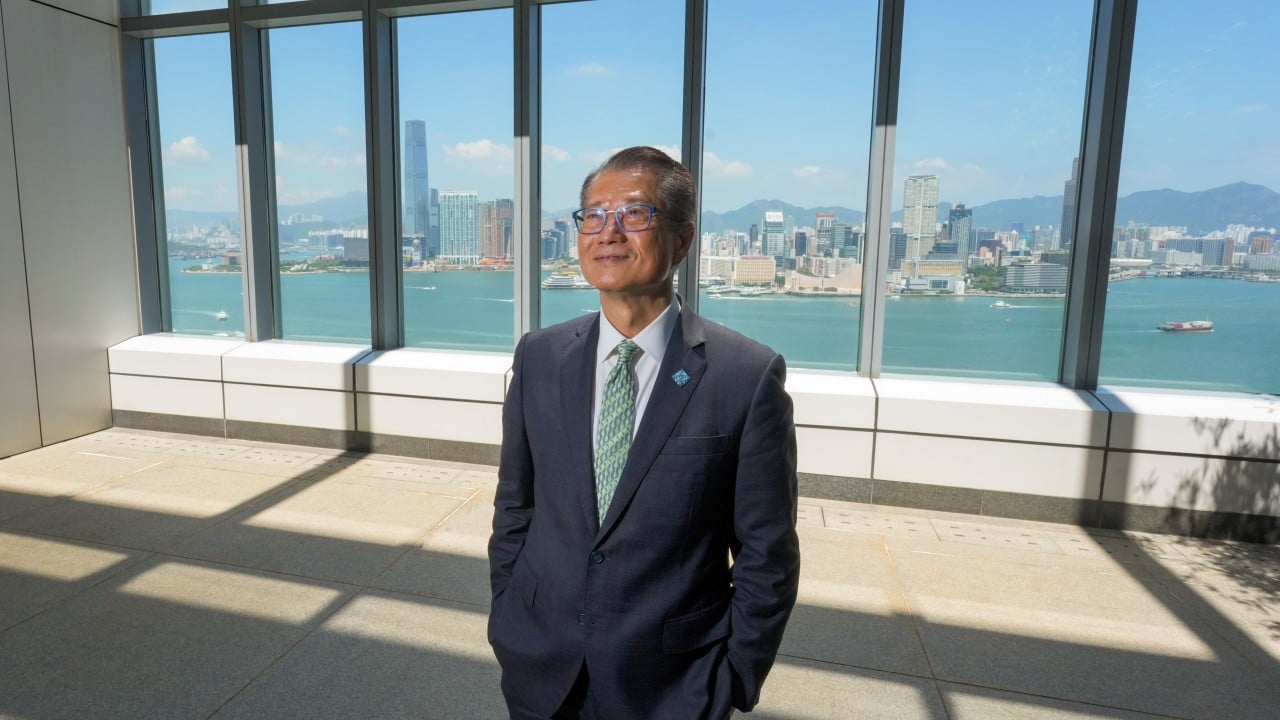
Outside the window of her high-rise office in Hong Kong, Victoria Harbour lay flat and slate-grey under a heavy, bruised sky. On her dual monitors, a live broadcast flickered. A man in a tailored dark suit was speaking at a podium thousands of miles away, his voice measured, his syllables clipped with diplomatic precision. Paul Chan, the territory’s Financial Secretary, was doing what financial secretaries do best. He was building a bridge out of words.
He spoke of renewed dialogue. He spoke of easing concerns. He spoke of the quiet, urgent necessity of keeping the lines of communication open between the two largest economic engines on Earth.
In the broadcast, the room nodded. Markets blinked, twitching upward by a fraction of a percent. Traders exhaled a collective, micro-dose of relief.
Mei did not exhale.
She looked down at her desk, where a digital spreadsheet glowed like an open wound. It was a labyrinth of red and green cells tracking component shipments from Shenzhen to warehouses in California. To the algorithmic eye of the spreadsheet, trade was an equation. To Mei, who had spent twenty-two years watching factories roar to life and fall silent, trade was a living, breathing ecosystem built on trust, raw materials, and the fragile physics of human expectation.
A handshake in Washington or Beijing could stop the shouting match. It could lower the atmospheric pressure in the room. But it could not rewrite the tectonic plates.
To understand what Paul Chan was really telling the world that morning, you have to look past the velvet-draped conference halls and into the damp, fluorescent-lit corridor of a manufacturing plant in the Pearl River Delta.
Imagine a production line assembling high-end optical sensors. Six months ago, this line stuttered to a halt because a single rare-earth refinement license got caught in the administrative gears of a cross-border sanction dispute. The factory owner, a man named Chen who had calloused palms and an ulcer he kept secret from his children, spent three sleepless weeks watching inventory rot in crates.
When Chen hears that dialogue has resumed, he does not throw a party. He buys a slightly better grade of lubricant for his stamping machines and keeps his eyes fixed on the door. He knows the fundamental rule of modern geopolitics: tension can be managed, but structural rivalry is permanent.
The relationship between the United States and China is not a misunderstanding that can be talked away over tea. It is a collision of two distinct economic models, two spheres of technological ambition, and two superpowers vying for the gravitational center of the twenty-first century.
When Chan steps up to a microphone to assure investors that dialogue will calm the waters, he is speaking the language of risk management. He represents Hong Kong, the eternal middleman, the needle and thread sewing together two fabrics that desperately want to tear apart. His job is to look at a room full of anxious bankers and tell them that the storm has a ceiling.
He is right. The dialogue matters. Without it, minor trade frictions escalate into kinetic conflicts through sheer lack of communication. A misread memo in an export agency becomes a blockade; a routine customs inspection becomes a weaponized embargo. Dialogue puts a floor beneath the descent.
Yet a floor is not a ceiling. And standing on a floor does not mean you are climbing.
For decades, globalization operated on a simple, intoxicating promise. Frictionless efficiency.
Capital flowed wherever labor was cheapest. Ideas crossed oceans in milliseconds. Supply chains stretched across the globe like gossamer threads, impossibly thin, impossibly complex, and catastrophically fragile. A typhoon in the South China Sea or a tariff signed on a whim in Washington could send shockwaves through assembly lines thousands of miles away.
We mistook efficiency for stability.
Then came the fractures. They did not arrive all at once. They came in whispers—a stolen patent here, a tightened export control there, a congressional committee locking its jaw around the word "security." Suddenly, the gossamer threads looked less like an interconnected web and more like a tripwire.
Companies realized that keeping their entire manufacturing apparatus concentrated in a single geopolitical zone was like building a house on the lip of a volcano. They started talking about decoupling. Then, when the sheer economic cost of total separation became too glaring to ignore, they softened the terminology. They called it de-risking.
Call it what you will. The result is the same. The world is splitting into parallel universes.
In one universe, the United States builds domestic semiconductor foundries with massive state subsidies, erecting walls around its technological crown jewels. In the other, China accelerates its indigenous innovation programs, racing toward self-reliance in artificial intelligence, aerospace, and advanced materials.
Between these two accelerating bodies sits Hong Kong. And standing right in the crosshairs is Paul Chan.
Watch Chan during an international economic forum. His demeanor is an exercise in high-wire discipline. He must acknowledge the gravity of the US-China friction without sounding panicked. He must pitch Hong Kong as the premier international financial hub while navigating a shifting legal and political reality that has made Western capital deeply jittery.
When he says that competition will remain, he is engaging in a masterpiece of understatement.
Competition is no longer just about who can sell cheaper shoes or more efficient microchips. It is a contest over the architecture of the future. Who writes the global standards for artificial intelligence? Whose currency settles international energy contracts? Whose security protocols protect the undersea fiber-optic cables that carry the nervous system of the global economy?
These are zero-sum questions. You cannot compromise on who controls the nervous system.
And yet, trade persists. This is the great paradox of our era. The politicians can posture, the trade hawks can rattle their sabers, and the security councils can classify industries as matters of existential defense—yet cargo ships still leave port every single day. Millions of consumers still buy products designed in California and built in Guangdong.
Why? Because human desire is stubborn. Profit is a powerful solvent. When the cost of total separation becomes too high for either superpower to bear, they find a way to do business through cracked doors.
This is where the dialogue comes in. It does not heal the wound. It just applies a tourniquet so the patient can keep walking.
Back in her office, Mei closes the spreadsheet.
She doesn't feel victorious. She doesn't feel defeated. She feels what every modern operator feels: the quiet, persistent fatigue of trying to plan a future when the rules of the game change every time the wind shifts.
She drafts an email to her primary supplier in Guangdong. She adjusts the shipping timeline by four days to account for tighter compliance checks at the border. She orders an extra buffer stock of microcontrollers just in case the next diplomatic weather report turns sour.
She is not waiting for a miracle. She is not waiting for a grand treaty that will erase the rivalry between Washington and Beijing. She knows that treaty will never come.
Instead, she is building resilience. She is accepting that the world has entered an era of permanent weather—where the sky is never entirely blue, but the rain is something you can learn to build better roofs against.
Paul Chan was right, ofreads-wise and data-wise. The dialogue will ease concerns. The markets will rally for a day or two. Business leaders will sleep slightly better tonight.
But tomorrow morning, the sun will rise over two superpowers eyeing each other across an ocean of ambition and mistrust. The factories will hum. The ships will sail. And the competition—cold, relentless, and unyielding—will continue to shape the destiny of every human being on the planet.
The trick is not wishing the storm away. The trick is learning to steer through the swells, knowing that the horizon is always moving, and the only constant is the weight of the hand on the wheel.