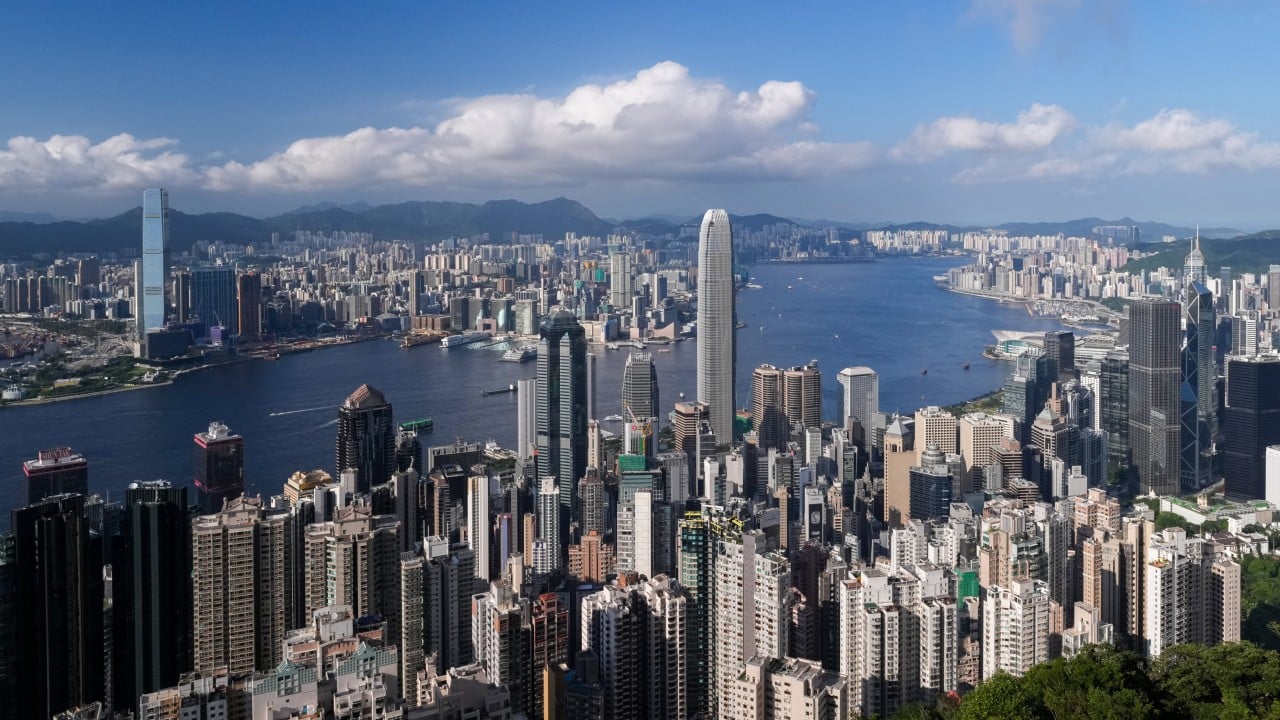
You can smell the harbor long before you see the water. It is a dense, metallic cocktail of salt, diesel exhaust, and the unmistakable humid breath of seven million people crammed into a sliver of granite and reclaimed silt.
Stand on the corner of Des Voeux Road in Central Hong Kong during the evening rush, and you feel the weight of it. Not just the physical weight of eighty-story steel towers stabbing into the bruised-purple sky, but an invisible, crushing arithmetic. Every square inch of this vertical sanctuary carries a price tag that defies human reason. Ground is not merely real estate here. Ground is oxygen. Ground is survival. Also making news lately: Why Paul Chan Is Betting Big on Hong Kong Strategic Sectors Right Now.
For decades, the city operated on a gilded trap: the high land price policy.
To understand how a government makes its fortunes by practically auctioning off dirt, you have to look back to a colonial quirk born out of necessity. When the British administration carved out this territory, private land ownership was rare. Instead, the government retained ownership of virtually all the land, leasing it out through grueling, multi-billion-dollar public auctions. Developers bid astronomical sums for the right to build upward. Those billions flowed directly into public coffers, funding glittering subway lines, world-class hospitals, and sprawling public housing estates without suffocating income taxes. Further insights on this are covered by The Economist.
It was brilliant. Until it broke.
The math stopped working the moment the skyscrapers ran out of room. When every square foot of downtown commanded prices that could buy a fleet of private jets, the cost of living morphed into a slow-moving crisis. Picture a thirty-something accountant named Jason, living with his aging parents in a flat the size of a suburban American walk-in closet. He works sixty hours a week, earns a respectable salary, and yet, the dream of owning a front door of his own is as distant as the rings of Saturn. He isn't failing. The board is simply tilted too steeply against him.
When shelter costs consume half a life, people stop taking risks. They stop inventing. They simply try to hold on.
Governments see the numbers in spreadsheets, but citizens feel them in their chests. And so, facing a boiling point where the social contract began to fray at the edges, the city’s architects realized they had to break their own golden rule. They had to invent a new way to manufacture the most precious commodity on earth.
Enter the grand gamble.
Instead of squeezing more towers into the already breathless canyons of Victoria Harbour, or watching helplessly as housing prices soared into orbit, leaders dusted off a playbook of epic proportions. They looked out at the choppy gray waters south of Lantau Island and decided to build an entirely new world from scratch.
This is not a modest neighborhood expansion. It is the Kau Yi Chau Artificial Islands project.
Imagine pouring millions of tons of sand, rock, and steel into the open sea to forge a three-thousand-acre metropolis floating between islands. It sounds like science fiction. But in the hyper-dense theater of Hong Kong, engineering ambition has always been the only alternative to suffocation. The plan is designed to house hundreds of thousands of people, inject a massive new commercial hub outside the congested core, and crucially, rewrite the rules of land supply.
Yet, every grand design carries a shadow.
When you anchor a massive economic engine in the middle of the sea, the financial stakes are staggering. Critics point to the sheer capital required—billions upon billions of dollars sunk into the ocean before a single apartment block rises. What happens if global markets shudder? What happens if the economic winds shift while heavy machinery is still churning up the seabed?
There is vulnerability in scale. Walking through the older districts of Sham Shui Po, where subdivided flats cram families into suffocating partitions, you hear the skepticism on the street. People want immediate relief, not a floating utopia scheduled to materialize a decade down the line. They want space today. They want a kitchen where two people can stand without bumping elbows. They want the government to slash the Gordian knot of housing scarcity right now, rather than betting the treasury on an aquatic engineering marvel.
And yet, standing still is a luxury Hong Kong has never possessed.
The city was built by refugees and dreamers who flattened hills and reclaimed bays because they refused to accept geographical limits. When the British first surveyed these barren rocks in the early nineteenth century, Palmerston famously dismissed them as a barren island with hardly a house upon it. Look at it now. It is a monument to human stubbornness.
The new land value strategy is an evolution of that stubbornness. By shifting away from the hyper-scarce auctions of downtown plots toward vast, master-planned maritime expansions, the city is trying to decouple its destiny from artificial scarcity. If successful, it changes the fundamental equation of urban existence. It turns a zero-sum game—where one person's gain of space is another's eviction—into an expanding horizon.
This is the hidden friction of modern civilization. We build cities that outgrow their own logic, and then we must reinvent the foundations while the inhabitants are still living inside the walls.
Out on the Star Ferry, as the engine chugs a rhythmic heartbeat against the harbor swell and the neon skyline begins to bleed into the twilight, you can see both sides of the argument. You see the gleaming monument to human triumph over nature. And you see the weary faces leaning against the railings, wondering how much longer the math can hold.
The water laps gently against the hull, indifferent to the billions resting beneath the waves, indifferent to the dreams hanging in the balance. The city pushes forward anyway, rewriting its shoreline, gambling its future on a patch of ocean yet to be born.