The clock on the wall of a suburban kitchen doesn't just mark time. It measures the distance between who a person was and who they are becoming. For millions of Americans watching their screens this week, that ticking sound has grown deafening. They aren't just looking at a politician on a stage; they are looking at a mirror of their own family dinners, their own aging parents, and their own deepest fears about the fragility of the human mind.
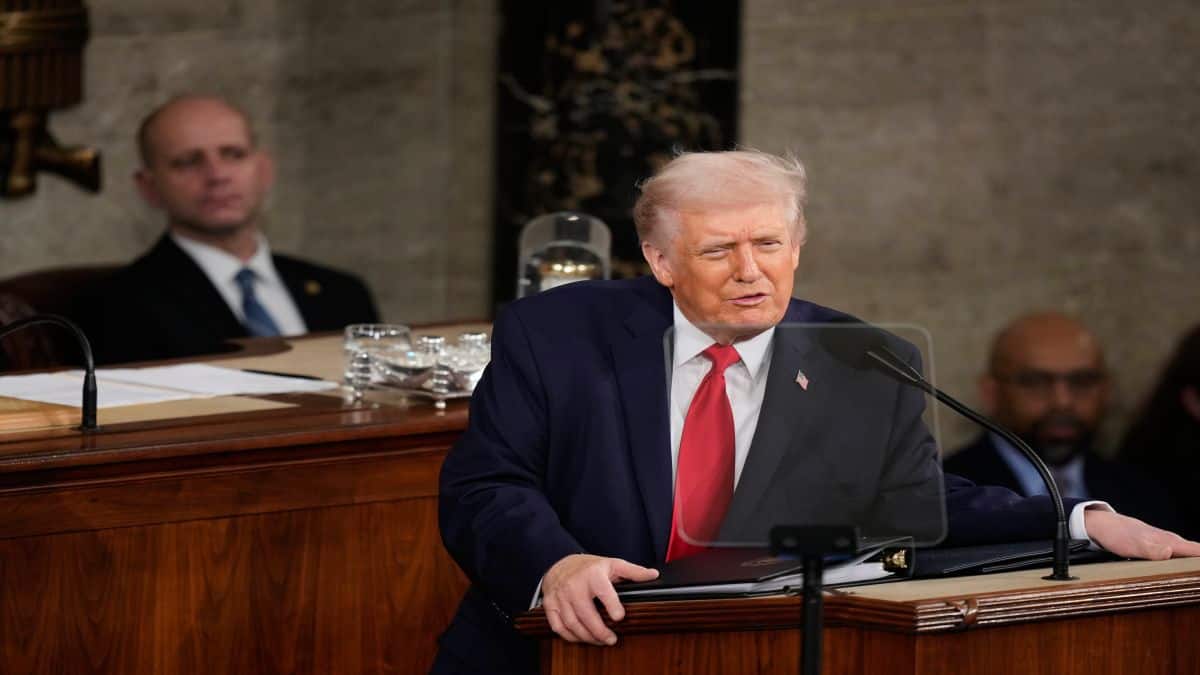
A new survey suggests a shift in the American psyche. It isn't a minor tremor. It is a landslide. A majority of the country now looks at Donald Trump and sees something more than just a polarizing figure. They see a man slipping. They see "erratic" behavior not as a tactical choice, but as a byproduct of the relentless march of years.
This isn't about policy. It isn't about tax brackets or border walls. It is about the visceral, human instinct to spot when the gears are no longer catching.
The Dinner Table Test
Consider a hypothetical voter named Sarah. She lives in a swing district in Pennsylvania. Sarah isn't a political activist. She’s a physical therapist who spends her days helping people regain what time has stolen from them. When she watches the news, she doesn’t see a "candidate." She sees a patient.
When she hears a speech that veers off into non-sequiturs about sharks or electric boats, she doesn’t think about the electoral college. She thinks about her father. She remembers the first time he lost his keys, and then the first time he forgot her name. The data tells us that Sarah is far from alone. The latest polling indicates that the "erratic" label is sticking, and it’s sticking because it resonates with the lived experience of an aging nation.
People are starting to trust their eyes over their party affiliations.
The numbers are stark. When a majority of a population looks at a leader and uses words like "unstable" or "declining," the political conversation shifts from "What will he do?" to "Can he do it?" This is the invisible stake of the 2024 election. It is a referendum on the biological clock.
The Anatomy of a Slip
What does "erratic" actually look like in the public eye? It is the sudden pivot. The jagged edge of a sentence that never finds its period. In the past, Trump’s supporters viewed his rambling style as a "weave"—a masterful display of rhetorical complexity. But the poll numbers suggest the weave is being reinterpreted as a fraying thread.
Aging is a thief. It starts with the small things. It steals the filter first. The part of the brain responsible for executive function—the prefrontal cortex—is often the first to feel the weight of the years. When that filter thins, the impulses rush out. The anger becomes sharper. The grievances become more circular. For a man whose entire brand is built on strength and vitality, these cracks in the armor are more than just bad optics. They are an existential threat to his persona.
The survey data reflects a growing consensus that we are witnessing this biological reality in real-time. It’s no longer just the "other side" saying it. The concern is leaking across the aisle, soaking into the moderate middle and even dampening the enthusiasm of the base.
The Great American Mirror
We are an aging country obsessed with youth. We hide our gray hair and filter our wrinkles, yet we are currently governed by the oldest cohort in our history. This creates a strange, bubbling tension.
When Americans express concern about Trump’s mental state, they are also expressing a fear about the leadership of an entire generation. They are asking: When is it time to let go?
There is a specific kind of exhaustion that comes with watching a leader struggle. It’s the same exhaustion a child feels when they realize they have to take the car keys away from a parent. It’s a mix of guilt, sadness, and a desperate need for safety. The "erratic" label is a manifestation of that collective anxiety. It is the sound of a nation realizing that the person behind the wheel might not see the road as clearly as they once did.
The stakes are invisible until they aren't. A missed word in a rally is one thing. A missed nuance in a briefing about nuclear tensions is quite another. This is the logic driving the poll numbers. It is a cold, hard calculation of risk.
The Language of the Long Goodbye
Politicians usually fall because of scandals or bad economies. They rarely fall because of the calendar. But 2024 is different. The calendar is the scandal.
Every time a microphone is turned on, a new test begins. The public is no longer listening for the message; they are listening for the glitches. They are looking for the "senior moments" that have moved from late-night comedy fodder to front-page national security concerns.
The poll shows that the majority of Americans believe he is getting worse. "Worse" is a terrifying word in politics. It implies a trajectory. It suggests that today is the best it will ever be, and tomorrow will only be more fragmented.
The narrative has moved past "he’s unconventional." It has settled into "he’s unwell." Whether that is medically true is, in some ways, secondary to the political reality. In a democracy, perception is the only truth that counts at the ballot box. If the American people perceive a candidate as erratic, they treat them as a liability.
The Silence in the Room
There is a quietness that falls over a room when someone says something that doesn't make sense. You’ve felt it. It’s that half-second of frozen air where everyone looks at their shoes, hoping someone else will speak first.
That silence is now happening on a national scale.
Even among those who plan to vote for him, there is a whispered acknowledgement of the change. They talk about "energy" and "fight," but the underlying tone is defensive. They are protecting a memory of the man he was in 2016, trying to ignore the reality of the man in 2024.
But the majority—those who aren't bound by loyalty—aren't looking away. They are staring directly at the glitches. They are seeing the confusion during depositions, the mixing up of names, the flashes of temper that seem disconnected from the provocation.
The poll is a map of this collective observation. It is the data point that confirms what people have been feeling in their gut while watching the evening news.
The Invisible Threshold
There is a threshold where a personality trait becomes a symptom. For years, the public has tolerated Trump's unpredictability. They called it "authenticity." They called it "disruption."
But the threshold has been crossed.
When "unpredictable" becomes "erratic," the context changes completely. A disruptor is a person who has a plan. An erratic person is someone who has lost the plot. The poll numbers are a signal that the majority of Americans now believe the plot is gone.
This isn't just about one man. It's about a nation that is tired. A nation that is looking for a steady hand on the tiller. When they look at the poll results, they aren't just seeing a political statistic. They are seeing a reflection of their own exhausted patience.
They are seeing a man who is no longer the master of his own narrative, but a passenger in a story written by the years.
The ticking clock doesn't stop for anyone. Not even for a man who has spent his entire life trying to outrun it.
The Last Words of the Story
A political campaign is a performance of strength. But aging is a story of vulnerability. These two things are fundamentally at odds.
When the poll says the majority believes he is getting more erratic, it is saying the performance is failing. The audience is seeing the wires. They are seeing the prompter. They are seeing the struggle.
The human heart is hardwired to respond to that struggle with a mixture of empathy and self-preservation. In politics, self-preservation usually wins.
The story of the 2024 election isn't a story of parties or platforms. It is a story of a man fighting the one opponent he can’t beat with a nickname or a tweet. It is a story of a nation watching that fight and deciding they can’t afford to be in the ring when he loses.
The second hand moves. The majority watches. The silence in the room grows.