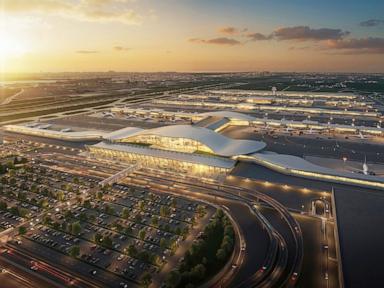
Everybody loves a shiny architectural rendering. Flash the blueprints for a twenty-two billion dollar airport overhaul, put a podium in the Oval Office, and watch the media swoon over shiny concourses and the death of those retro-futuristic mobile lounges.
Let us stop pretending this project is about passenger comfort.
The lazy consensus claims that throwing billions at Washington Dulles International Airport solves America's infrastructure embarrassment, giving the nation's capital a gateway worthy of a superpower. That perspective is completely backwards. Megaprojects in the United States do not fail because of bad concrete or outdated shuttle buses. They fail because of a profound, systemic allergy to cost control, regulatory paralysis, and magical thinking about timelines.
The Myth of the Quick Fix
Let us look at the actual mechanics of how this multi-billion dollar wishlist came together. The administration ran design charrettes right out of the Oval Office, rejecting wavy roofs and high-clearance bridges based on aesthetic whim rather than logistical engineering.
Imagine a scenario where a private corporation attempted to redesign its core operating hub by letting executives pitch exterior vibes directly to the chief executive on a whim. The stock would plummet before lunch.
Yet, when it comes to public infrastructure, we celebrate this top-down blueprint theater as visionary leadership. The Metropolitan Washington Airports Authority already had a deliberate, methodical master plan to stretch modernization out over decades. Compressing that timeline into an aggressive sprint does not magically generate skilled labor, eliminate supply chain bottlenecks, or bypass environmental reviews. It just triples the change-order fees.
I have seen corporations blow millions on compressed timelines, convincing themselves that sheer willpower can bend the laws of project management. It never works. You end up paying a premium for overtime, emergency materials, and frantic subcontractor bidding wars.
What Everyone Gets Wrong About The Mobile Lounges
The media is obsessed with the death of the "people movers"—those lumbering, accordion-sided transit buses that haul passengers between terminals and immigration. Critics call them archaic, slow, and embarrassing.
They are missing the engineering reality.
Eero Saarinen designed Dulles with those mobile lounges for a specific operational reason: flexibility. Fixed gates tie an airport down to rigid structural layouts. Mobile lounges allow an airport to service wildly fluctuating aircraft sizes and international arrivals without requiring every single square foot of concourse to have a permanent, multi-million-dollar jet bridge attached to it.
Sure, they feel like something out of a retro sci-fi B-movie. But replacing them with linear concourses and an expanded underground train system shifts the bottleneck from a parking lot for buses to the security checkpoints, baggage carousels, and FAA airspace management slots. You are not curing the disease; you are just upgrading the furniture while the underlying cost structure spirals out of control.
The Accountability Black Hole
Let us address the elephant in the room: budget overruns.
Whenever politicians promise a fixed-cost megaproject, the final bill invariably explodes. Look at recent history. American transit projects cost multiples per mile compared to their European or Asian counterparts. Why? Because the money does not go into steel and glass; it goes into litigation, environmental impact studies, political patronage, and endless consulting fees.
United Airlines CEO Scott Kirby can praise the new design all he wants because it aligns with his hub strategy, but airlines do not foot the capital expenditure bill when the project runs five billion dollars over budget and three years late. The taxpayer and the traveler absorb that blow through higher ticket taxes and airport facility fees.
Stop treating multi-billion dollar construction announcements as victories. A press conference in Washington does not pour a single yard of concrete. Until the federal government fixes the systemic rot inside its contracting process, this twenty-two billion dollar bet is nothing more than an expensive exercise in political vanity.
The concrete hasn't even dried, and the bill is already coming due.
Why America Is Spending $22 Billion on One Airport
This documentary breaks down the logistical hurdles and historical context behind the massive financial commitment to modernize Dulles International Airport.