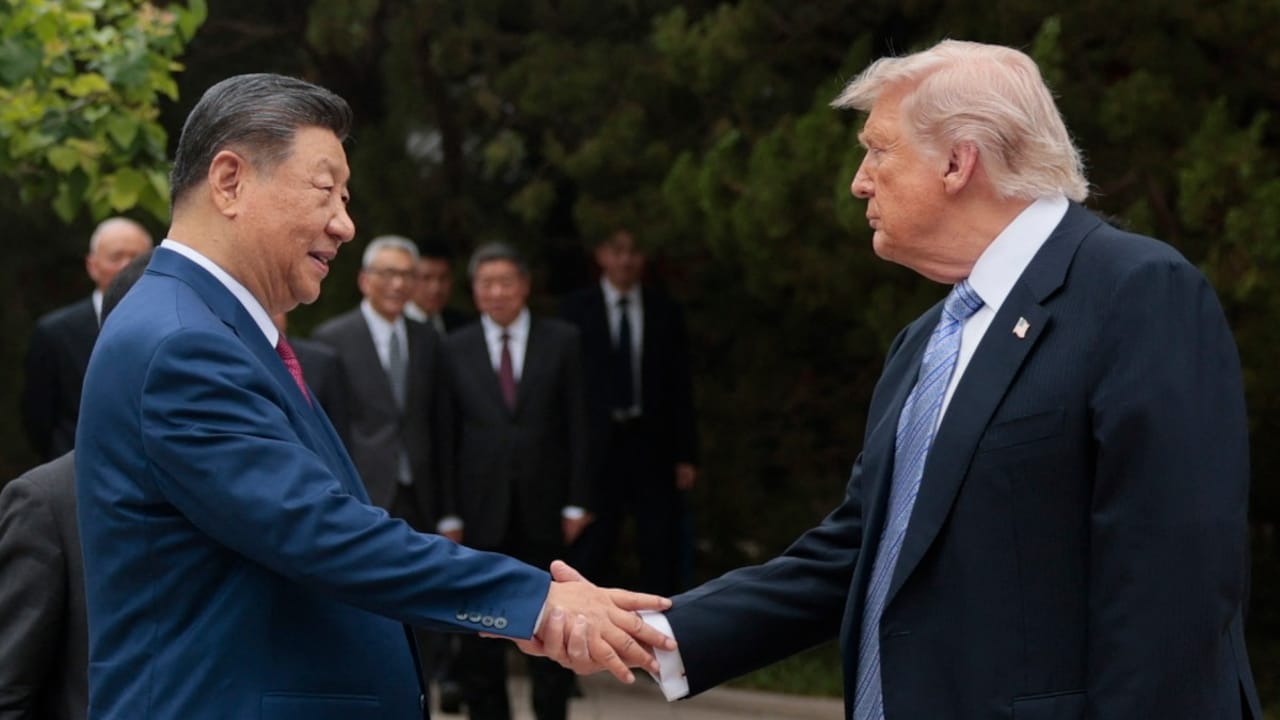
Donald Trump's vehement rejection of allegations that he offered to sell advanced American military hardware to Chinese leader Xi Jinping exposes the fragile, high-stakes architecture of superpower diplomacy. When such explosive claims surface through political memoirs or anonymous leaks, the public response is swift denial, yet the underlying strategic friction remains entirely unresolved. We must look past the immediate political posturing to understand how backchannel diplomacy operates between Washington and Beijing, where defense sales serve as both bargaining chips and radioactive poison.
To grasp the weight of this denial, one must examine the environment from which these reports emerge. Modern foreign policy is rarely confined to the sterile corridors of the State Department or the formal briefing rooms of the Pentagon. Instead, high-level bilateral relations often pivot on closed-door conversations where leaders test boundaries, throw out provocative propositions, and gauge reactions without committing their respective governments to formal treaties. When a former commander-in-chief denies offering military equipment to a primary geopolitical adversary, the statement is technically accurate regarding formal policy, but it often obscures the messy, transactional nature of summit-level negotiations.
The Mechanics of Backchannel Signaling
Diplomacy at the presidential level frequently defies standard bureaucratic protocols. Career foreign service officers spend decades drafting precise communiques designed to avoid miscalculation, but executives often prefer a more direct, abrasive style of communication. In private rooms, leaders use hypothetical scenarios to probe intentions. A comment framed as an inquiry about defense commerce can easily be interpreted by aides or observers as a concrete offer.
This ambiguity is intentional. By floating unorthodox ideas outside official channels, leaders can test whether an adversary is willing to offer reciprocal concessions on trade, currency manipulation, or regional security. However, introducing military hardware into such informal discussions crosses a dangerous threshold. Weapons systems are not ordinary commodities subject to commercial barter. They alter the regional balance of power, threaten allied nations, and trigger severe alarm within the domestic national security establishment.
When reports suggest that such an offer was made, the immediate reflex of any American politician is absolute denial. The domestic political cost of appearing soft on China, let alone offering to arm its military, is catastrophic. Yet veterans of diplomatic corps know that the distance between a casual probe during a tense negotiation and a formal policy proposal can be deliberately blurred by those attempting to sensationalize or reconstruct historical events.
The Transactional Mindset in Foreign Policy
The core of Trump's diplomatic philosophy has always been transactional. Everything from trade agreements to mutual defense pacts is viewed through the lens of a commercial deal. In this worldview, alliances are not permanent associations rooted in shared values, but temporary arrangements evaluated by immediate financial and strategic returns.
Applying this transactional framework to relations with Beijing creates a profound systemic hazard. Traditional strategists view military technology as a closely guarded national asset, protectively walled off by export controls, congressional oversight, and non-proliferation treaties. For a transactional leader, however, access to advanced manufacturing or aerospace technology can appear as a powerful card to play in a broader negotiation over market access or intellectual property theft.
Even if an explicit offer to sell arms never materialized into a formal bureaucratic proposal, the mere conceptualization of such a transaction highlights the friction between a president who views foreign policy as personal deal-making and a permanent state apparatus designed to contain rising adversaries. The defense industrial base and the intelligence community operate on a multi-decade timeline of threat assessment. They do not view military hardware as something to be traded away for short-term political wins.
Taiwan and the Red Lines of Defense
Any serious analysis of a potential arms transfer to Beijing must confront the central paradox of Sino-American relations: Taiwan. Washington maintains a deliberate policy of strategic ambiguity, supplying defensive weapons to Taipei under the Taiwan Relations Act while officially acknowledging Beijing's claim over the island.
Offering advanced military systems to the People's Republic of China would completely dismantle this architecture. It would render American security commitments in the Indo-Pacific entirely hollow and signal to allies like Japan, South Korea, and Australia that Washington's defense guarantees are negotiable commodities. The strategic fallout would be immediate and irreversible. Regional partners would rapidly pursue independent nuclear deterrence or seek accommodation with Beijing, fracturing the American alliance system in Asia beyond repair.
This is why the denial issued by the former administration is treated with such fierce urgency by institutional defenders of foreign policy norms. Acknowledging even a rhetorical exploration of selling arms to Beijing would undermine the foundational premise of American deterrence in the Pacific. It would confirm the worst fears of allies who worry about the reliability of American security commitments during periods of political transition.
Navigating the Bureaucratic Labyrinth
To understand why such explosive allegations persist, one must look closely at how information flows out of high-level meetings. Presidential entourages are composed of competing factions. National security advisers, cabinet secretaries, translators, and political aides all take contemporaneous notes, often viewing the same encounter through drastically different lenses.
A remark made in passing, perhaps intended as sarcasm or a negotiating bluff, can be recorded by a nervous aide as a serious policy consideration. Years later, when these individuals write memoirs or speak to investigative reporters, these notes are reinterpreted through the political alignments of the present moment. The line between what was said, what was meant, and what was politically useful to remember becomes hopelessly blurred.
Furthermore, the permanent bureaucracy in Washington often harbors deep suspicion toward executive branch actors who bypass institutional channels. Leaks regarding unorthodox or controversial conversations are frequently deployed as bureaucratic self-defense mechanisms. If career officials believe a leader is contemplating a policy that threatens national security, controlled disclosures to the press serve as a preventative brake, forcing the target of the leak into a defensive posture where they must publicly disavow the actions attributed to them.
The Political Theater of Denials
The public theater surrounding these controversies rarely changes minds; instead, it hardens existing partisan battle lines. Supporters view the allegations as malicious fabrications manufactured by a hostile establishment determined to sabotage any alternative approach to foreign affairs. Critics view the denials as transparent prevarications designed to conceal a reckless disregard for national security protocols.
Lost in this partisan noise is a sober evaluation of how great power competition is actually managed. The international system relies on predictable behaviors, credible commitments, and established red lines. When those boundaries are blurred by erratic rhetoric or backchannel improvisation, the risk of miscalculation multiplies exponentially.
Superpowers do not stumble into major conflicts because of simple misunderstandings; they drift into them when adversaries lose faith in the predictability and resolve of their counterparts. Whether an arms offer was formally tendered or merely weaponized as a rhetorical device during a high-stakes bargaining session, the episode reveals the inherent vulnerability of conducting foreign policy through personal intuition rather than institutional discipline.
The denial closes the immediate news cycle, but the structural anxieties remain unaddressed. As long as foreign policy remains susceptible to personalized deal-making and secretive backchannel maneuvers, the gap between official denials and the chaotic reality of high-level statecraft will continue to widen, leaving observers to parse the wreckage of competing narratives without ever reaching solid ground.