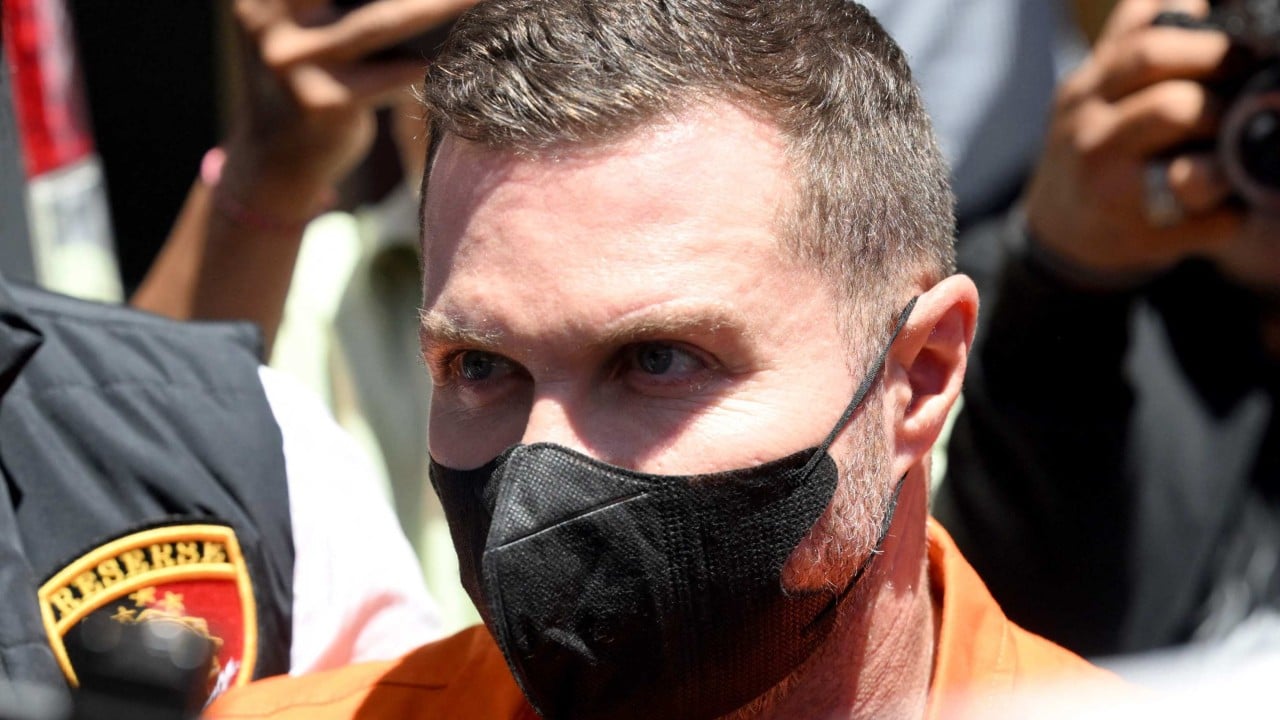
The arrest of a 43-year-old Scottish national in Bali, identified as a key operative within a high-tier organized crime group (OCG), reveals a critical vulnerability in the perceived safety of "lifestyle-arbitrage" destinations for international fugitives. This apprehension, executed via an Interpol Red Notice, functions as a case study in the collision between digital law enforcement integration and the physical constraints of cross-border flight. The subject was not merely a random traveler; he was a nodes in a supply chain involving large-scale narcotics distribution and sophisticated money laundering. His capture demonstrates that the utility of Bali as a sanctuary is diminishing as the Indonesian Directorate General of Immigration synchronizes its biometric databases with global policing networks.
The Infrastructure of the Interpol Red Notice
A Red Notice is often misunderstood as an international arrest warrant. In technical terms, it is a request to law enforcement worldwide to locate and provisionally arrest a person pending extradition, surrender, or similar legal action. The efficacy of this mechanism relies on the Triad of Enforcement Friction: Don't forget to check out our previous coverage on this related article.
- Database Interoperability: The speed at which a National Central Bureau (NCB) updates the I-24/7 global communication system.
- Border Control Integrity: The ability of local immigration officers to match physical identities with digital flags before "clearing" a passenger into the interior.
- Bilateral Extradition Treaties: The legal framework that allows for the transfer of the subject from the arresting state (Indonesia) to the requesting state (United Kingdom).
The Scottish operative’s presence in Bali suggests a calculated risk assessment that failed. Fugitives often choose Indonesia due to its vast geography and historical reputation for bureaucratic lag. However, the modernization of the SIKIM (Immigration Management Information System) has shifted the risk profile. When a passport is scanned at I Gusti Ngurah Rai International Airport, the system cross-references the data against the Interpol database in milliseconds. The failure of the subject to remain undetected indicates a breakdown in his "clean identity" maintenance, likely caused by the expiration of forged documentation or the retroactive linking of his real identity to his criminal activities back in the UK.
Mapping the Gang Logic: Supply Chain and Distribution
The individual in question is linked to a Scottish gang involved in the importation of Class A drugs—primarily cocaine and heroin. To understand why a mid-to-high-level operative flees to Southeast Asia, one must analyze the Operational Cost of Evading Prosecution. For a UK-based OCG, an operative facing a "Red Notice" level of heat becomes a liability. Their presence in the UK increases the probability of "network bleeding," where police surveillance on one individual exposes the entire cell. To read more about the history of this, TIME provides an in-depth summary.
The Scottish criminal landscape is dominated by few but highly violent entities that leverage maritime routes via the Netherlands and Spain. The subject’s role likely involved the management of these logistics or the "washing" of the resulting capital. In this context, Bali serves as a Low-Visibility Operational Node. It offers:
- Financial Opacity: High cash-usage rates and a burgeoning crypto-exchange market that facilitates the movement of illicit funds without triggering European banking "red flags."
- Lifestyle Camouflage: A dense population of Western "digital nomads" and expatriates provides a demographic screen. A Scottish man in Bali attracts significantly less scrutiny than a Scottish man in a non-tourist hub.
The Mechanics of the Arrest: A Multi-Agency Synthesis
The apprehension of the subject was not an isolated police action but a coordinated strike involving the Bali Regional Police (Polda Bali), the National Police (Polri), and the Ministry of Law and Human Rights. The process followed a strict Escalation Protocol:
Phase One: Identification and Verification
Upon the issuance of the Red Notice by the UK, Indonesian authorities entered the subject into the "Watch List" or Daftar Pencarian Orang (DPO). The identification of the subject's exact location—often tracked through visa extension filings or luxury villa rentals—is the catalyst for the operation. In this instance, the subject had been residing in Bali for an undisclosed period, suggesting he may have entered before the specific Red Notice was fully propagated or under an alias.
Phase Two: The Tactical Interception
The physical arrest is designed to minimize public disruption and the risk of the subject destroying evidence (mobile devices, ledgers). Reports indicate the arrest occurred without significant resistance, which is typical for fugitives who rely on "ghosting" rather than armed confrontation to evade capture.
Phase Three: Judicial Custody and Extradition
The subject is currently held in a high-security facility. The legal bottleneck now shifts to the extradition process. Indonesia and the United Kingdom do not share a simplified, streamlined extradition treaty comparable to the European Arrest Warrant. Instead, they operate under the Principle of Reciprocity and the 1976 Law on Extradition. This creates a protracted legal timeline where the subject’s defense will likely argue against the "dual criminality" of the offenses or claim potential human rights violations in the requesting state to stall the transfer.
The Cost Function of International Flight
For a criminal operative, fleeing to a non-extradition-heavy territory is a strategic play with a high "burn rate." The costs are not merely financial but structural:
- Asset Liquidity: The fugitive must convert domestic assets into portable or digital wealth, often losing 15-30% in laundering fees.
- Command and Control Decay: Distance from the primary market (Scotland) reduces the operative's ability to enforce discipline or manage logistics, leading to a loss of status within the gang.
- Informant Vulnerability: The longer a fugitive stays in one location, the higher the probability that a rival or a pressured subordinate will "sell" their location to law enforcement for a sentence reduction.
In this case, the Scottish gang's operative appears to have hit the Detection Threshold. Once the cost of maintaining his anonymity exceeded the gang's desire to protect him, or once his digital footprint became loud enough for Interpol to track, his capture became an actuarial certainty.
Strategic Implications for Regional Security
This arrest signals a shift in Indonesia’s stance on being a "waiting room" for international fugitives. The Bali Immigration office has recently increased its deportation and arrest metrics, targeting not just petty visa violators but high-value targets linked to transnational crime.
The First Major Shift: Increased use of facial recognition technology at ports of entry. Even if a fugitive uses a high-quality forged passport, biometric markers (inter-pupillary distance, jawline structure) remain constant and are now being indexed against global criminal databases.
The Second Major Shift: Enhanced cooperation between the UK’s National Crime Agency (NCA) and Indonesian authorities. This partnership bypasses much of the traditional diplomatic sluggishness through direct intelligence-sharing channels.
The subject's transfer to the UK will serve as a demonstration of force for the Scottish authorities, who are currently engaged in a massive crackdown on the "heavy hitters" of the Glasgow and Edinburgh underworlds. For the gang involved, the loss of a key operative in Bali is a sunk cost that signals the closing of a major escape route.
The strategic play for law enforcement moving forward is the Aggressive Integration of Financial Intelligence. By tracking the "lifestyle funding" of these fugitives— villa payments, luxury vehicle rentals, and high-end dining—authorities can locate subjects even when their travel documents are pristine. The Scottish operative’s downfall was likely not a mistake in his flight, but the inevitable friction of living a high-consumption lifestyle in an increasingly monitored digital environment. Fugitives in the current era are not running from people; they are running from an integrated data grid that does not sleep or forget.