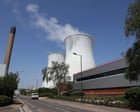
Turn on the tap in a quiet suburban kitchen in Slough, just west of London. Watch the water spill into a glass—clear, cold, ordinary. Now step outside and look toward the horizon, where windowless concrete warehouses stretch across acres of land. Inside those monoliths, millions of silicon chips are firing simultaneously, generating heat so intense that if left unchecked, the hardware would melt into useless slag within seconds.
To keep the digital world from burning up, something else has to drink.
A lot.
Every time you stream an ultra-high-definition video, ask an artificial intelligence model to compose a poem, or sync your photos to the cloud, a physical server somewhere swelters. To cool it down, operators pump millions of liters of fresh water through industrial heat exchangers. Much of that water simply evaporates into the cool British sky, gone forever from the local watershed.
Now, Britain is facing a quiet, stubborn crisis: the nation is running out of liquid to feed its growing digital appetite.
The Concrete Engine on the Thames
Consider a mid-level engineer named Sarah—a hypothetical composite of the facility managers operating along the M4 corridor. Her job used to be simple: secure power, install racks, ensure redundancy, keep the lights green. But over the last three years, her primary headache has shifted from electrical grids to plumbing pipelines.
Slough is the data capital of Europe, hosting one of the densest clusters of server farms on the planet. It sits in the South East of England, a region that receives less rainfall per person than Melbourne, Australia.
When tech giants announced plans to triple their digital footprint across the United Kingdom, trade organizations raised a red flag. The math simply does not work. You cannot build massive, water-cooled processing hubs in a geography that is already teetering on the edge of seasonal water rationing without forcing a choice between human consumption and digital convenience.
Water companies in the region face a staggering projection. Between population growth, climate volatility, and the explosive rise of compute-heavy software, local water authorities estimate a shortfall of hundreds of millions of liters per day over the coming decades. A single large facility can consume as much water as a town of ten thousand people.
Multiply that by dozens of proposed projects, and the equation breaks down completely.
How Cooling Actually Works
People often assume the internet lives in a ethereal ether. It does not. It lives in hot, humming metal boxes that require brute physical force to remain operational.
There are two primary ways to chill a warehouse full of servers:
- Air Cooling: Massive industrial fans blow ambient air over the equipment. It is cheap and simple, but it struggles when outside temperatures spike during summer heatwaves.
- Evaporative Cooling: Water is sprayed onto cooling pads or circulated through towers. As the water evaporates, it absorbs heat, pulling warm air away from the racks. It is remarkably efficient at keeping temperatures low, but it consumes vast quantities of fresh drinking-quality water.
Here lies the paradox. Air cooling takes massive amounts of electricity, putting strain on an already stretched national power grid. Evaporative cooling saves power, but it drains the reservoirs.
Pick your poison: blackout or drought.
When trade bodies audited the pipeline of planned developments, they found that local utility companies were being asked to guarantee water connections for facilities that had not yet been built, in areas where existing residents were already facing hosepipe bans during hot summers.
The Friction Point
Public awareness moves slowly until it hits the kitchen sink.
For years, the expansion of computing infrastructure was treated as a localized planning nuisance—mostly about noise from backup diesel generators or the visual blight of massive gray boxes taking over former industrial estates. But water changes the political dynamic. Water is personal. You cannot synthesize it, and you cannot import it effortlessly from three towns over without massive infrastructure investments that take decades to approve and construct.
In draft planning documents, utility providers have begun signaling that new large-scale connections might be delayed by years—or outright rejected—unless developers bring their own water solutions to the table.
Some operators are trying to pivot. They talk about closed-loop systems that recycle the same water repeatedly, or dry-cooling mechanisms that rely strictly on refrigerant gases and air currents. Others are exploring the use of non-potable "gray water"—treated sewage effluent—to cool their racks instead of tapping into the public drinking supply.
These solutions exist, but they are expensive, complex, and slow to deploy. Retrofitting an existing facility to use recycled water requires completely rebuilding its internal plumbing and negotiating complex contracts with local municipal treatment plants.
In the meantime, the approvals for new sites keep piling up on planning boards across the country.
A System Under Pressure
The conflict boils down to competing visions of the future. On one side stands the push to make the country a global hub for technological innovation and automated intelligence. On the other stands the unyielding reality of hydrology.
If a severe drought strikes the South East of England, who gets priority access to the main pipeline? The residential neighborhood down the road, or the facility hosting critical financial infrastructure, emergency communication networks, and corporate cloud databases?
Legally, human health and domestic supply come first. But in practice, shutting down a major data facility can cause cascading outages across economic sectors, triggering millions in losses within seconds.
It is a high-stakes game of chicken played with valve handles.
The trade bodies warning about this shortfall are not anti-technology. They represent the very companies trying to build this infrastructure. Their alarm is an admission of physical limits. They are telling regulators and the public that the current trajectory is unsustainable—that you cannot keep building water-intensive engines in dry regions without building new reservoirs first.
And building a new reservoir in Britain takes roughly fifteen to twenty years from initial proposal to the first drop of stored rain.
The Quiet Trade-Off
Late at night, when you send a message across the world, a faint pulse of heat radiates off a circuit board in an industrial park outside London. A valve opens slightly. A small mist of water sprays across a copper coil, flashing into vapor and drifting up into the cool night air.
We built an invisible world on top of our physical one, believing the digital realm was weightless, clean, and infinite. We forgot that every byte is anchored to a piece of silicon, every piece of silicon runs hot, and every cool stream ultimately has a bottom.
The glass of water sitting on your kitchen table and the server hosting your digital life are drawing from the exact same underground aquifer. Sooner or later, one of them will ask for a refill that the ground simply cannot provide.