Japan’s decision to commit approximately US$8 billion through targeted tax increases to fund a record military expansion is not a simple budgetary adjustment; it is a fundamental reconfiguration of the Japanese social contract and its post-war fiscal identity. This pivot signals the end of the "Peace Constitution" dividend, where low defense spending—historically capped at 1% of GDP—subsidized social welfare and industrial investment. The current strategy rests on a triad of fiscal extraction, domestic industrial scaling, and the procurement of counter-strike capabilities, each carrying distinct execution risks that the Japanese government must navigate to maintain sovereign solvency.
The Triple Fiscal Architecture of the Build-Up
The funding mechanism for this US$8 billion surge avoids the immediate political fallout of broad-based income tax hikes by utilizing a segmented extraction model. The strategy targets three specific revenue streams, creating a diversified but fragile fiscal base.
- Corporate Surtax: A layered tax on corporate profits designed to capture the "excess" earnings of Japan’s rebounding industrial sector. By focusing on corporations, the administration minimizes direct hits to individual purchasing power, though it risks disincentivizing the very capital expenditure (CAPEX) needed for the defense industry’s own modernization.
- Income Tax Reallocation: Rather than a new tax, the government is redirecting a portion of the "Special Reconstruction Tax" originally intended for the 2011 Tohoku earthquake recovery. This is a maneuver of fiscal substitution, effectively extending the lifespan of an emergency tax to fund a permanent defense shift.
- Tobacco Excise Adjustments: A traditional "sin tax" approach used to bridge the final gap. While politically low-friction, this stream is inherently regressive and subject to declining yields as consumption trends shift.
This architecture reveals a preference for political expediency over structural reform. By relying on surtaxes and reallocations, the government avoids a direct debate on the Consumption Tax—the most stable but most unpopular revenue tool in the Japanese toolkit.
The Counter-Strike Doctrine and Hardware Prototyping
The US$8 billion is the initial installment of a broader five-year, 43 trillion yen (US$315 billion) plan. The objective is to transition the Japan Self-Defense Forces (JSDF) from a "shield" (purely defensive) to a "shield and spear" configuration. The logic of this transition is governed by the concept of Integrated Deterrence.
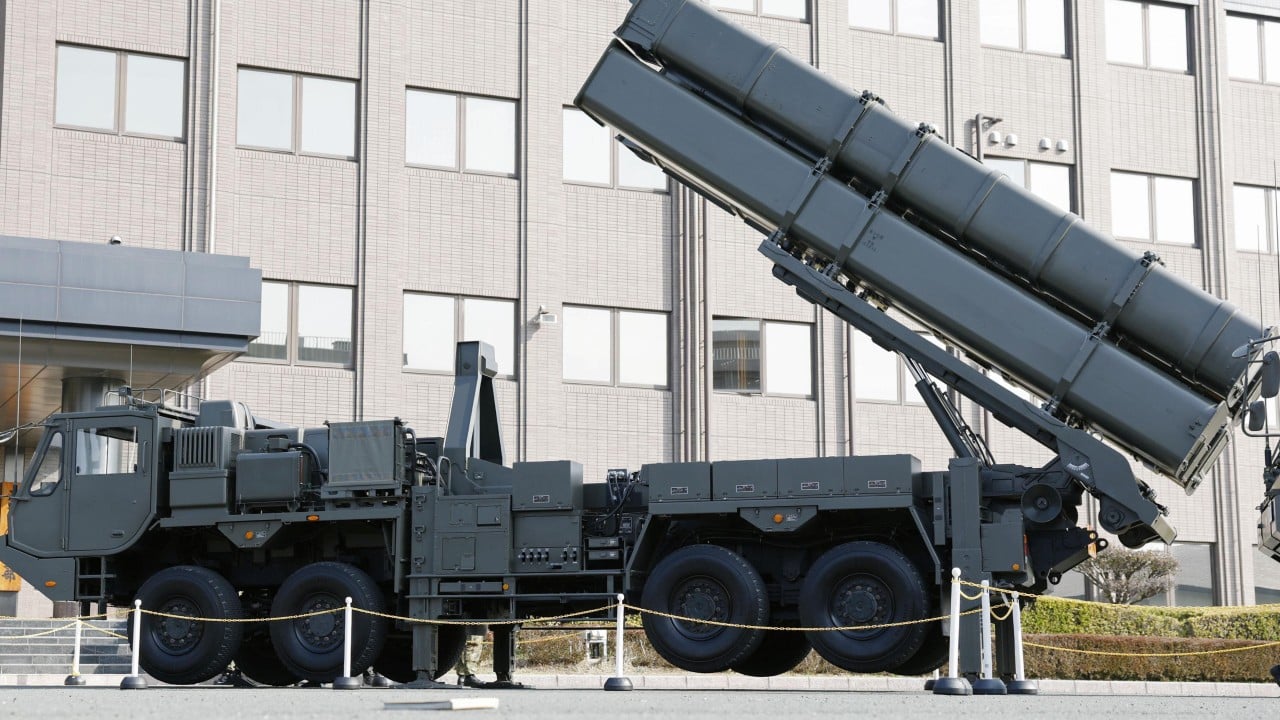
The primary capital allocation is directed toward the mass production and acquisition of long-range standoff missiles. This includes the upgrade of the domestic Type 12 surface-to-ship missile and the procurement of U.S.-made Tomahawks. The strategic intent is to increase the cost of regional aggression by ensuring that any strike against Japan can be met with immediate, proportional retaliation against enemy launch sites.
This shift introduces a new Cost-Benefit Function for Japanese defense:
- Variable Cost: Procurement of munitions and maintenance of high-tech sensors.
- Fixed Cost: Hardening of existing infrastructure and the development of indigenous satellite constellations for targeting.
- Opportunity Cost: The diversion of R&D talent from the consumer electronics and automotive sectors to the defense-industrial complex.
The Industrial Capacity Bottleneck
Japan faces a significant "Symmetry Gap" between its strategic ambitions and its industrial reality. Decades of low spending have left the domestic defense sector—led by entities like Mitsubishi Heavy Industries and Kawasaki Heavy Industries—with thin margins and aging production lines.
The success of the US$8 billion infusion depends on solving three specific supply-side constraints:
- Economies of Scale: Japanese defense firms have historically produced small batches for a single customer (the JSDF). Without an export market, which is still restricted by stringent "Three Principles" guidelines, the per-unit cost of equipment remains prohibitively high.
- Supply Chain Resilience: Much of the high-end semiconductor and sensor technology required for modern missiles is dual-use or imported. Any disruption in global trade directly threatens the timeline of the build-up.
- Labor Scarcity: Japan’s demographic decline is a silent threat to military expansion. The JSDF consistently fails to meet recruitment targets, and the industrial sector faces a shortage of specialized aerospace and systems engineers.
To overcome these, the government is transitioning toward a "Defense-Industrial Base Enhancement" model. This involves direct subsidies for production line automation and a gradual loosening of export restrictions to allow Japanese firms to join global supply chains, such as the Global Combat Air Programme (GCAP) with the UK and Italy.
Sovereign Debt and the Monetary-Fiscal Conflict
The most critical risk to this military build-up is the interaction between fiscal expansion and Japan’s unique monetary environment. With a debt-to-GDP ratio exceeding 250%, any increase in government spending exerts upward pressure on bond yields.
The Bank of Japan (BoJ) has spent years maintaining Yield Curve Control (YCC) to keep interest rates low. However, as the government issues more debt to fund defense, the BoJ faces a dilemma. If it allows rates to rise, the cost of servicing the existing mountain of national debt will skyrocket, potentially consuming more of the budget than the military itself. If it keeps rates suppressed, the yen risks further depreciation, which increases the cost of imported fuel and raw materials essential for defense production.
The US$8 billion tax increase is therefore a "Solvency Buffer." It signals to international markets that Japan is attempting to fund its new security commitments through revenue rather than just printing money. However, the magnitude of the tax is small compared to the total 43 trillion yen requirement, suggesting that the "Debt-to-Defense" spiral remains a looming threat.
Geographic Vulnerability and the Logistics of Deterrence
The allocation of these funds is increasingly focused on the "Southwest Wall"—the chain of islands stretching toward Taiwan. Military logic dictates that a centralized force in Hokkaido or Honshu is insufficient for modern regional threats.
The build-up requires a massive logistical overhaul:
- Distributed Lethality: Spreading missile batteries and radar stations across small, inhabited islands to prevent a single decapitation strike.
- Port and Airfield Hardening: Upgrading civilian infrastructure to support military operations during a crisis.
- Fuel and Ammunition Reservoirs: Solving the "Sustenance Deficit" where the JSDF currently lacks the stockpiles for a prolonged high-intensity conflict.
The US$8 billion is essentially "Seed Capital" for this geographic repositioning. It funds the initial land acquisitions and the construction of reinforced bunkers. The long-term challenge will be the "Social Friction" of militarizing civilian zones, which remains a potent political variable in prefectures like Okinawa.
The Strategic Realignment of the US-Japan Alliance
The funding of this build-up alters the power dynamics within the U.S.-Japan security treaty. Traditionally, the U.S. provided the "spear" while Japan provided the "shield." By developing its own counter-strike capabilities, Japan is moving toward a "Plug-and-Play" integration with U.S. forces.
This creates a Bilateral Multiplier Effect:
- Intelligence Sharing: To use long-range missiles, Japan requires deep integration with U.S. satellite and ISR (Intelligence, Surveillance, and Reconnaissance) assets.
- Interoperability: Standardizing hardware ensures that U.S. and Japanese forces can share ammunition and maintenance facilities during operations.
- Strategic Autonomy: While becoming more integrated, Japan also gains a degree of leverage. Its ability to act independently in the "Gray Zone"—short of full-scale war—reduces its total reliance on a U.S. response that might be delayed by domestic American politics.
Execution Requirements and the Path Forward
For the US$8 billion tax plan to translate into genuine national security, the Japanese administration must move beyond revenue collection and focus on "Functional Readiness."
The strategic priority must be the elimination of the "Legacy Hardware" drag. The JSDF continues to maintain expensive, outdated platforms that serve bureaucratic interests rather than modern combat needs. A rigorous "Cost-Per-Effect" analysis is required to ensure that every yen extracted from the corporate sector is spent on high-yield capabilities like electronic warfare, unmanned underwater vehicles (UUVs), and cyber-defense, rather than just maintaining 20th-century armor and surface ships.
The government must also address the "Private Sector Paradox." If the tax burden on corporations is perceived as a penalty for success, the very companies needed to innovate—such as those in robotics and AI—may shift their R&D centers overseas. The tax policy must be balanced with "Defense Innovation Credits" that allow companies to offset their surtax through contributions to sovereign technology goals.
Ultimately, Japan’s military build-up is a race against time. The fiscal window is closing as the population ages and the debt burden grows. The US$8 billion is the first test of whether a mature, debt-laden democracy can pivot its entire national strategy in response to a deteriorating security environment without triggering a fiscal crisis or a social backlash. Success will be measured not by the total amount spent, but by the speed at which Japan can convert yen into a credible, autonomous deterrent.