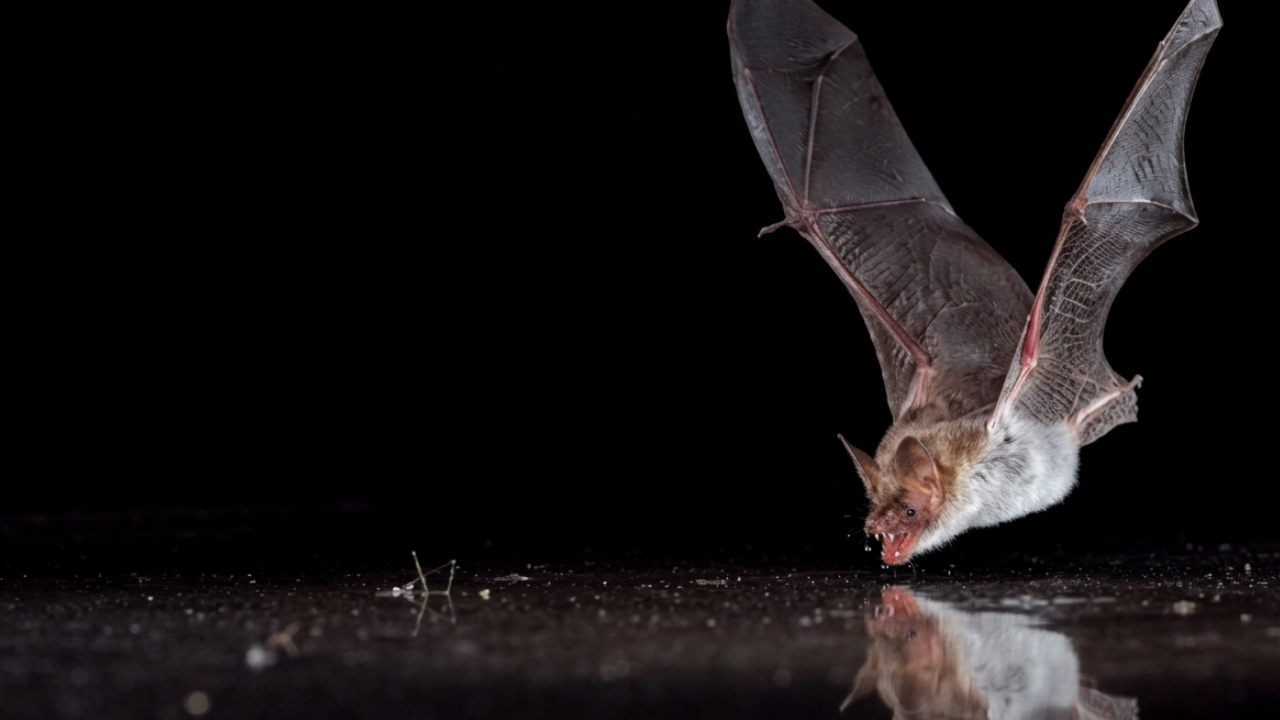
The headlines love a simple narrative. They tell you that eleven bat species were duped by a sheet of clear plastic, crashing their jaws into hard surfaces because they are hopelessly enslaved by their own ears.
The lazy consensus portrays bats as biological dumber-than-bricks draftees, tricked by cheap human engineering into a tragic comedy of errors. It is a comforting fable for humans who like to think their own sensory apparatus is superior.
It is also completely wrong.
The animals are not failing a logic test. They are executing an unyielding, highly optimized sensory algorithm that has worked without a single software update for millions of years. To call this "fooling" a bat is to fundamentally misunderstand how evolutionary pressure shapes survival.
Let us look at the mechanics. When a microchiropteran emits a high-frequency orientation call, a smooth, horizontal surface acts as an acoustic mirror. In the deep evolutionary history of these mammals, there was only one wide, horizontal, flat thing that reflected sound waves back in that specific, zero-scatter pattern: liquid water.
There were no glass skylights. There were no polished car hoods. There was no high-density polyethylene sheeting stretched across a field station table.
Natural selection does not code for hypothetical futures involving industrial manufacturing. It hardcodes for absolute environmental certainties. For a flying mammal burning calories at an astonishing metabolic rate, missing a water source means death. The cost of a false negative—ignoring a real pond because you suspect it might be a trick—is fatal dehydration. The cost of a false positive—swooping toward a strange acoustic mirror to check—is negligible.
Evolution does not optimize for rare anomalies; it optimizes for baseline survival. Treating any acoustic mirror as water is a feature, not a bug.
Researchers expressed shock that the bats did not learn. They watched animals strike a solid plastic sheet, bounce off, fly a loop, and come back for another attempt. Observers called this stubbornness. Behavioral biologists scratched their heads over why touch, vision, and olfaction failed to override the auditory signal.
This view assumes that a brain should treat all sensory inputs with democratic equality. That is a terrible design for a high-speed aerial predator.
Imagine a fighter jet flying at Mach 2 through a canyon. If the pilot's onboard radar screams that a mountain is ahead, but a casual glance out the side window suggests it looks clear, trusting the window is a great way to explode. Bats face an identical sensory hierarchy. Echolocation is their primary operating system. Vision and tactile feedback are low-latency peripherals. When the primary OS reports a life-sustaining resource, the brain suppresses contradictory input from secondary sensors because, in the wild, tactile feedback of a solid surface usually means an obstruction inside or near the water, not the total absence of it.
The plastic sheet experiment proves the dominance of an ancient sensory hierarchy. It does not prove cognitive failure.
We laugh at the wildlife footage of bats diving toward trash bags or metal plates because we suffer from chronological snobbery. We judge an ancient sensory adaptation by the standards of a synthetic landscape we built yesterday. The plastic wrap is an evolutionary trap, an edge case born from our own material surplus.
The next time you read about scientists easily duping wildlife with artificial tricks, remember what you are actually looking at. You are watching a living organism run an ancient, uncompromised program that refuses to update for human convenience. The bats are not the ones misinterpreting reality. They are just living in a world that hasn't learned how to lie to them yet.